A small order can be a surprisingly expensive thing. NTT DATA knew how to serve large enterprises. Smaller customers presented another problem: the attention required to get them started could overwhelm the economics of the sale. In NUWAVE’s account of the partnership, an SMB partner suggested iPILOT. The opportunity was sitting inside a process that needed to change.
- What it does: connects voice networks and automates cloud calling administration.
- Who buys: carriers, service providers, partners, and enterprises.
- The useful twist: partners can keep their carrier relationships and put their own brand on the experience.
01 The little order with a big problem
In July 2024, NTT launched its Communications Hub, a white-labeled version of iPILOT. Customers could order and manage communications services themselves. According to the case study, that helped NTT accept smaller deals it had previously declined. Onboarding had been consuming scarce development and service resources; a repeatable transaction made those customers more practical to serve.
“NUWAVE offered us market agility, enabling us to support previously unattainable markets while keeping our core business on track.”
Charlie Doubek · NTT DATA
In NUWAVE’s published customer case study
That is a useful entrance into NUWAVE. The company sells telecommunications services and the software that organizes them. Its customers include the businesses behind your business phone: carriers, managed service providers, resellers, and enterprise technology teams. Much of the value appears in work a caller never sees.
02 Three apps. One administrative headache.
An employee sees a call button. An administrator sees a number to acquire, a user to configure, a license to check, and a service to monitor. Multiply that across offices and customers, then across Microsoft Teams, Zoom Phone, and Webex Calling. A collection of individually sensible products becomes a rather untidy operating environment.
iPILOT addresses that environment. It manages provisioning, number assignments, reporting, and ongoing changes through a common interface. Its tools include call logs, quality dashboards, number porting, and migration staging. NUWAVE’s phrase is “Multi-UC”: multiple unified communications platforms, with the administrative work pulled together. The apps remain; the service team gets a more consistent way to manage them.
Conceptual flow. Supported configurations vary by service.
This is why NUWAVE belongs beside the calling platforms in a buyer’s thinking. It supplies connectivity and operational tools for delivering those services. A partner selling several platforms can reuse parts of its operating process instead of creating a separate administrative business around each one.
03 Keep the carrier. Change the plumbing.
Underneath the software is SYNTHESIS. It connects a partner’s SIP trunks, the connections carrying internet-based telephone traffic, to NUWAVE’s network. NUWAVE handles network and platform integration requirements; iPILOT provides the management interface. The arrangement lets a carrier participate in supported cloud calling services while retaining its own voice offering.
Microsoft lists NUWAVE as an Operator Connect Accelerator and onboarding partner. That is a specific role: helping eligible operators connect their services to Teams. AudioCodes, PingCo, Ribbon, and SIPPIO also occupy this market. NUWAVE’s pitch combines that carrier work with management across Teams, Zoom, and Webex, plus white-label delivery.

The expertise required crosses software, voice engineering, and customer onboarding. NTT’s implementation included adapting APIs and workflows, according to the joint project account. Putting a different logo on a portal was only part of the assignment. The ordering experience also had to fit the business behind it.
The distinction earned outside recognition in 2025, when the UC Awards named NUWAVE Best Service Management Platform. The category is revealing. Service management is where a provider discovers whether adding customers means adding staff at the same rate. Software can make a business more repeatable, provided the underlying service and its exceptions are understood.
04 The bill behind the button
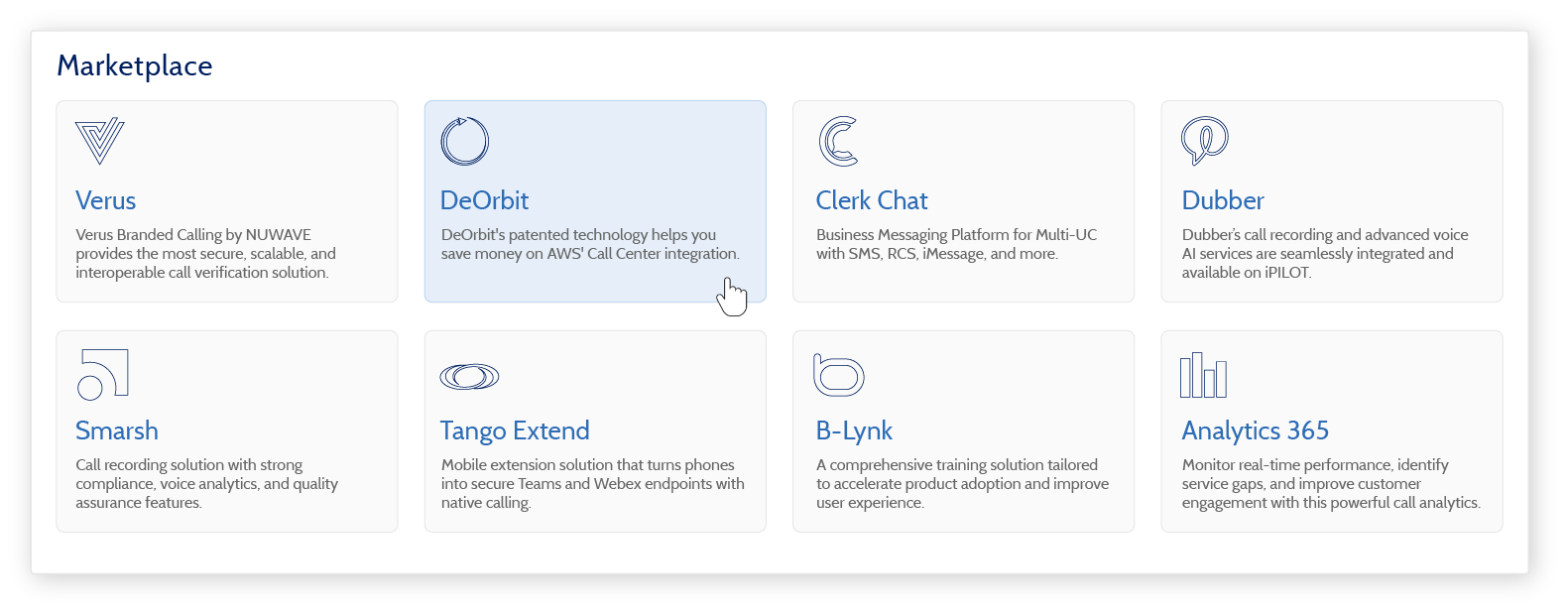
The business model follows the buyer: software and communications services for organizations that operate or resell calling. Partners can distribute a branded platform and add services through the marketplace. Those extras include recording, SMS, and cloud fax. It is a business in which recurring administration creates recurring opportunities to sell and support services.
One price deserves careful reading. NUWAVE advertises TELEPORT as a no-fee migration feature. It automates tasks such as batch moves and building call queues or auto attendants. The feature’s price does not erase the licenses, connectivity, and implementation work around a phone system. Its public page lists Teams and Webex support, with Zoom forthcoming.
TELEPORT migration tooling.
Budget separately for the calling environment.
Launchpad tackles the next repeated task: activation. Its guided Teams Phone workflow covers permissions, numbers, emergency addresses, queues, and auto attendants. Pulsar addresses Microsoft licensing. These products extend the same proposition: reduce the small pieces of manual work that make each additional customer expensive.
05 An assistant with a very specific job
iPILOT V4 adds global search, embedded documentation, and Navi, an AI assistant that answers account questions. How many numbers are assigned? What services are deployed? The ambition begins with information administrators already need, sitting inside the system they already use. That gives the assistant a concrete task and a practical test.
Governance adds work of its own. NUWAVE’s ISO 42001 certificate became effective in January 2026. The scope concerns its management system for specified third-party AI uses; certification does not promise perfect answers. In October, NUWAVE described roughly six months of preparation and monthly employee training. Time spent making an assistant trustworthy belongs in the cost of building it.
The wider AI offer needs the same precision. NUWAVE distinguishes available marketplace services from possible applications, such as voice agents and sentiment analysis. Its website says connections must be evaluated for the customer’s environment. A conceptual diagram can start a purchasing conversation; it cannot establish that a particular integration is ready to deploy.
06 Copy the workflow, then measure it
The practical lesson is to inspect the repeated steps around a sale. Count staff time per activation. Identify where orders wait. Automate a supported path, then compare the result with the baseline. NTT’s example suggests that a better process can change which customers a business is able to serve.
For a partner, a useful pilot would follow one order from purchase to activation. Record the handoffs, corrections, and support requests. Include the exceptions in the calculation. Saving clicks is helpful; reducing the labor required to deliver a working service is the more consequential result.
The fit depends on the environment. Operator eligibility, licenses, number portability, geography, permissions, and legacy configurations still matter. A simple deployment may need fewer tools; a complicated one needs careful validation. NUWAVE’s opportunity grows where several calling platforms and carrier relationships must coexist. The call button stays small. The business behind it gets easier to run.