LoopUp makes the telephone ring inside Microsoft Teams. That sentence is almost offensively simple. Behind it sit phone-number inventories, emergency-calling rules, tax regimes, carrier contracts, number-porting forms, session border controllers and support queues spread across scores of countries. The software is the visible bit. LoopUp sells the invisible work required to make it reliable.
Its customer is not the person hunting for a cheaper office phone. It is the multinational IT leader whose company has accumulated a small museum of communications systems - Cisco hardware in Australia, an Avaya contract in Britain, a local carrier in Chile, separate renewal dates everywhere and perhaps ten different portals that all claim to simplify administration. LoopUp offers to replace that patchwork with one provider, one pricing schedule, one management portal and one support team, while Microsoft Teams remains the interface employees already know.
The first failure
Teams swallowed the meeting room

Steve Flavell and Michael Hughes founded the company in 2003, reportedly sealing the idea over blackjack in Las Vegas. The business began as Ring2 and built an early BlackBerry application that turned the executive status symbol of its day into a remote control for conference calls. Instead of entering codes and wondering who had joined, a host could see and manage the call. Ring2 became LoopUp in 2012, adding screen sharing, Outlook integration and a polished remote-meeting product.
That narrowness was once a strength. LoopUp concentrated on lawyers, consultants and other professionals whose client calls mattered enough to pay for excellent audio and fewer small humiliations. It floated on London’s AIM market in 2016 at a reported £40 million valuation. In 2018 it paid £61.4 million for MeetingZone, a conferencing provider with roughly 6,000 customers. A £50 million equity placing and a £17 million bank loan funded the deal. Group revenue nearly doubled to £34.2 million that year.
Then the category moved. Microsoft Teams and Zoom made video meetings abundant, bundled and familiar. The pandemic initially filled every screen, but it also trained enterprises to standardize on broad unified-communications suites. A standalone meeting tool became harder to defend. In early 2022 LoopUp reported that revenue in the relevant period had fallen 60 percent against the 2020 comparison. The old product had not suddenly become useless; its reason for being had been bundled into something larger.
The second act
The platform still needed a phone company
LoopUp’s change of mind was less a leap than a turn toward assets it already owned. It had a global voice network built for demanding professional-services clients. Its Microsoft voice practice dated to 2010, through OCS, Lync, Skype for Business and then Teams. It employed network engineers, ran multilingual support and understood what happens when a phone number crosses a border. In August 2020, it launched a global cloud-telephony service using Direct Routing to connect Teams users to public phone networks.

Customers can connect through Microsoft’s Operator Connect program, through Direct Routing as a managed service, or by bringing an existing carrier in markets that require it. The differences are technical, but the buying logic is plain. Operator Connect offers tighter provisioning inside the Teams Admin Center. Direct Routing allows more customization and broader geographic reach. Bring Your Own Carrier preserves a local relationship while LoopUp manages the global picture.
LoopUp chose to qualify for Operator Connect directly, rather than use an accelerator that would put another platform between it and Microsoft. The company already had regulated operations, infrastructure and developers, so dependence on a third party would have traded speed for control. Its engineers reportedly produced a working API integration within weeks. It launched in 34 countries in April 2023 and expanded from there. That choice is central to the pitch: LoopUp is not merely a reseller of somebody else’s telephone service.
“I don’t have to think about it anymore. It just works.”Andrew Hastings / Murgitroyd
The proof is administrative
One is not a slogan. It is the product.
The most revealing LoopUp product is not the phone call. It is LoopUp One, the management portal. An administrator can see countries and sites, order and assign numbers, manage users, set role-based access, inspect usage, check service status, view invoices and connect a Microsoft tenant. This is where consolidation becomes visible. A map and a number inventory may lack the theater of an AI demo, but they answer the Monday-morning questions that occupy telecom teams.
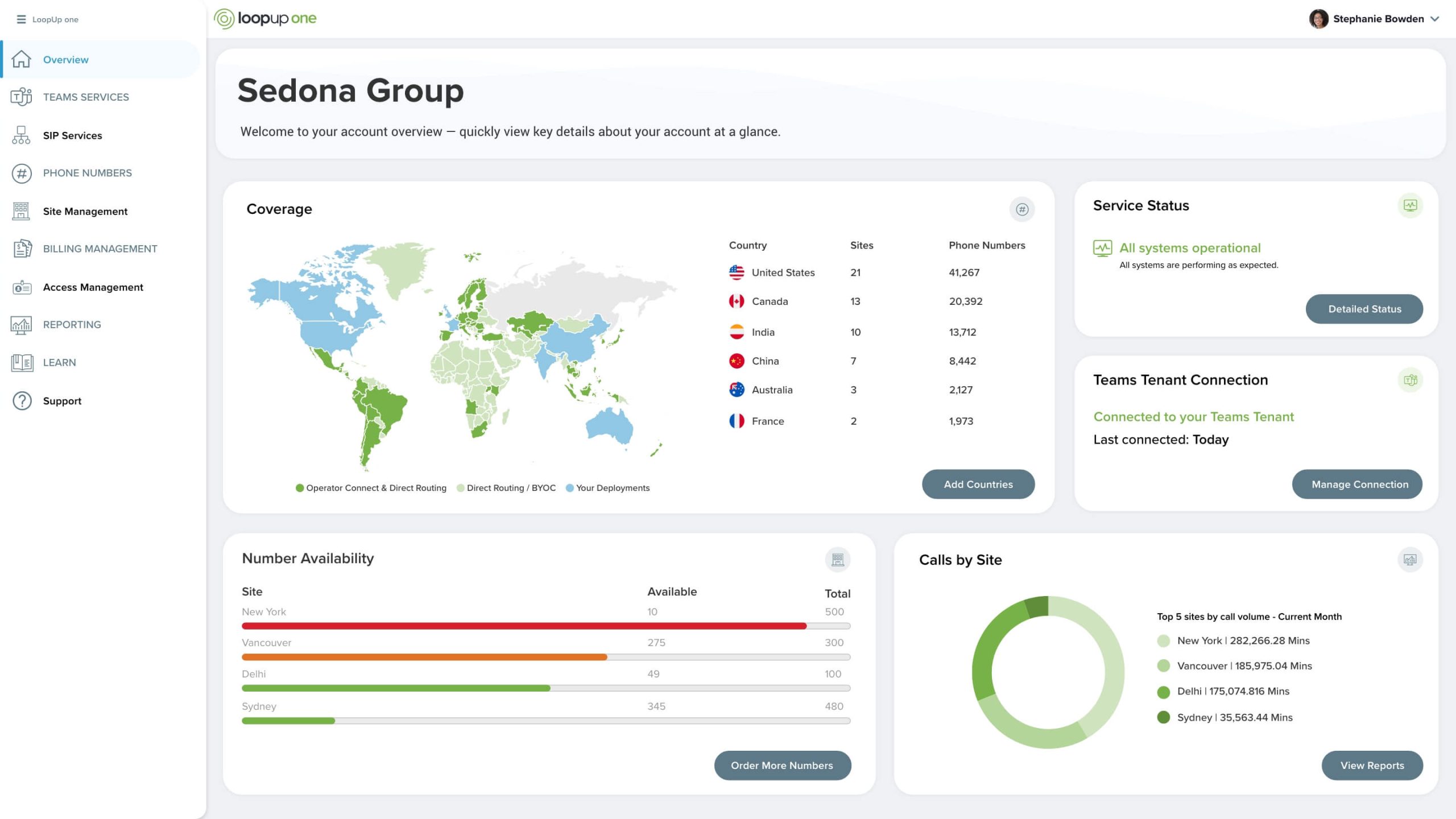
Honeywell Technologies supplies the most dramatic public example. Its starting estate had more than 80 carriers, more than 10 management portals and an average provisioning time of two weeks. LoopUp first won a competitive request for proposal in Latin America. Delivery there persuaded Honeywell to expand region by region, eventually covering roughly 35,000 Teams Phone users. The decision was not only about country coverage. Honeywell’s architect emphasized direct access to a team that understood the whole environment, rather than another procession through generic ticket queues.
Murgitroyd, an intellectual-property firm, offers a smaller and more copyable experiment. It needed service in Nicaragua, an awkward market for global provisioning. The team began with one telephone and one direct-dial number. Once that worked, and an Avaya RingCentral renewal approached, the firm ported just under 1,300 numbers. The first thing to test was the hardest country, not the easiest headquarters. That tiny proof changed the risk calculation.
PUMA followed the same consolidation logic. LoopUp deployments in Chile, Mexico and Argentina led into Australia and New Zealand, where a traditional Cisco PBX carried hardware and maintenance overhead. Murgitroyd wanted billing understandable without “a PhD in mathematics.” PUMA wanted a global standard without surrendering local billing and compliance. These are not glamorous buying criteria. They are exactly the criteria on which a multinational rollout survives.
Money and market
A recurring service, priced by geography
LoopUp sells business-to-business subscriptions, call usage and managed services, generally under multi-year enterprise contracts. The price depends on users, countries, number types, traffic and connection method. There is no useful universal sticker price for a global Teams estate. The company instead promotes a single negotiated schedule and GlobalPooling, which lets usage be considered across the organization rather than stranded in local bundles. Remote Meetings and operator-managed events remain, but cloud telephony is the growth thesis.
Competition comes from several directions. Microsoft sells Calling Plans. Large carriers including BT, Verizon, NTT, Colt, Orange and Tata can connect Teams. Pure-play providers and systems integrators offer Operator Connect or Direct Routing. RingCentral, Zoom, Cisco and 8x8 sell broader cloud communications. A multinational can also keep its local carriers and assemble the system itself. LoopUp’s distinction is the combination of broad country coverage, multiple connection methods, a single management layer and a support organization focused on Microsoft voice.
The pivot was not painless. LoopUp ended 2023 with £845,000 in gross cash and £5.3 million in net debt. Management concluded that the young cloud-telephony unit needed capital that the public market was unlikely to provide at the company’s then-small valuation. Shares fell sharply when the plan was announced. LoopUp left AIM in April 2024, refinanced with Bank of Ireland and raised £12 million privately that November from existing shareholders and new investors including 4Founders Capital, FJ Labs and BTS Group.
That financing bought time for an enterprise sales cycle measured in migrations rather than downloads. Management said cloud-telephony revenue doubled in 2023, was on track to double in 2024 and was planned to double again in 2025. It also reported no churn in that business through the funding announcement. Those claims came from the company, and private ownership means outsiders now receive less regular financial detail. The more concrete signs are customer expansions, the 2025 Luware contact-center partnership, and new 2026 case studies and industry awards.
Make the call less annoying
From BlackBerry control to LoopUp meetings, the company removes codes and confusion, then lists on AIM.
Buy scale
The £61.4 million MeetingZone acquisition nearly doubles reported group revenue and increases debt.
Move beneath Teams
Global Direct Routing launches, cloud telephony becomes the priority and Operator Connect follows.
Leave the market to fund the pivot
LoopUp delists, refinances and closes a £12 million private round.
Make customer scale visible
PUMA expands, Luware partners and Honeywell’s 35,000-user program gives the strategy a large reference.
The useful lesson
Keep the assets. Change the argument.
What can another company copy? First, inventory the capabilities beneath the product whose market is fading. LoopUp retained voice routing, Microsoft knowledge, enterprise accounts and regulatory experience. Second, look for work a dominant platform creates but does not want to perform. Teams made cloud calling more attractive, yet it did not repeal national telecom law. Third, test the hardest operational edge with the smallest possible deployment. One phone in Nicaragua said more than a broad pilot in London would have.
A lesson with boundaries
- The approach fits a Microsoft-centric multinational with several carriers, countries, contracts and support processes.
- It is less compelling for a single-country small business that can buy a standard calling plan in minutes.
- Consolidation raises supplier-concentration risk, so resilient routing, service commitments and exit provisions matter.
- Companies deeply committed to another collaboration suite will not gain the same value from LoopUp’s Teams specialization.
- Migration still depends on accurate number records, local paperwork and patient sequencing. A portal cannot make those disappear.
There is a pleasing continuity to LoopUp’s story. The BlackBerry app removed digits and uncertainty from a conference call. LoopUp One removes portals and uncertainty from a global telephone estate. The customer sees a cleaner interface; the company earns its keep by absorbing the mess behind it. Twenty-three years in, LoopUp is still trying to make a business call feel uneventful. It simply found a much larger billable definition of “uneventful.”