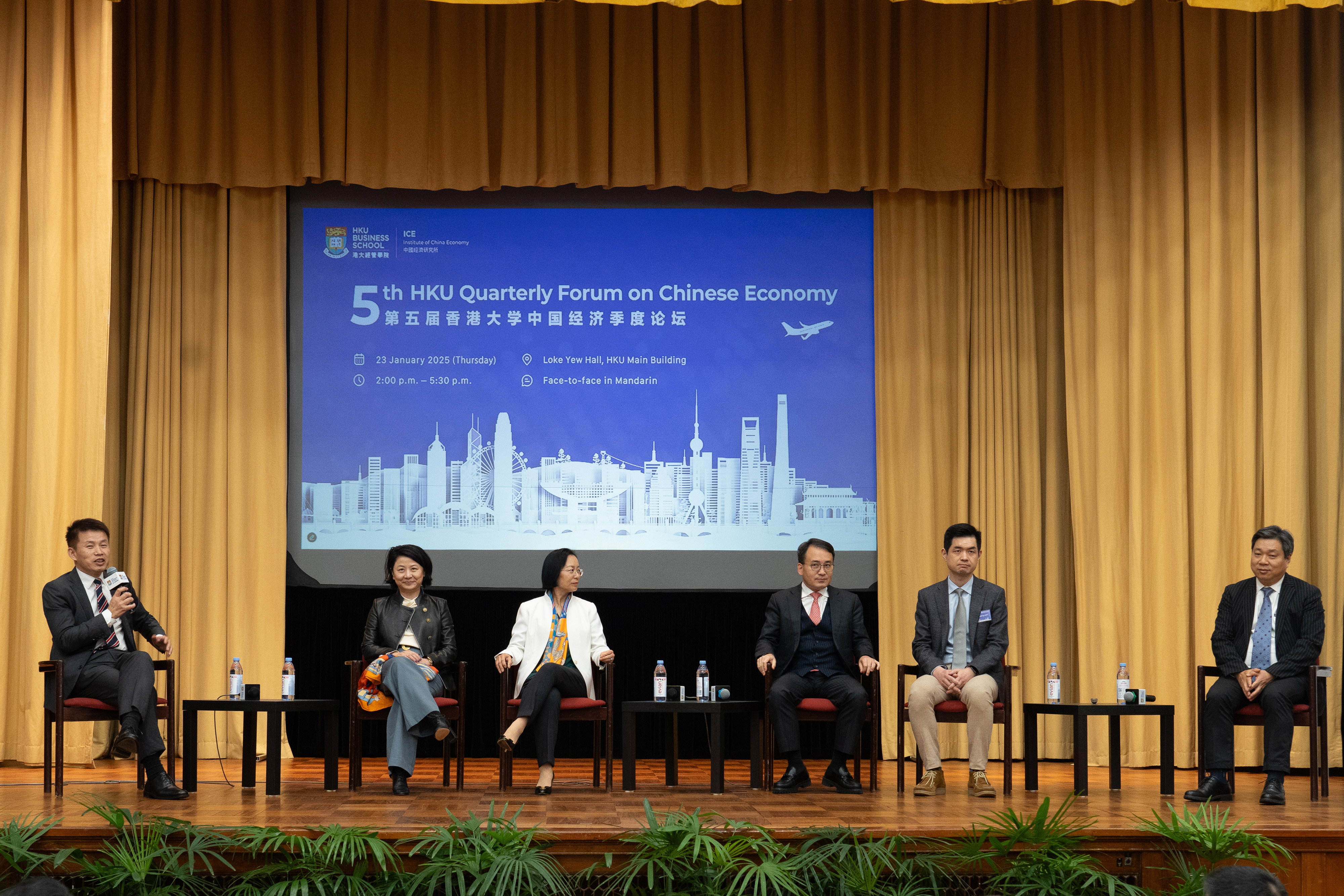
At the University of Hong Kong in January 2025, Hong Qiu sat on a stage with economists and investment professionals to discuss a question that refuses to stay politely inside an economics department: what happens next for Chinese business? The subject encompassed finance, international trade and the practical problems facing companies at home and abroad. Qiu brought the perspective of someone whose working life has involved helping those companies cross borders.
She was participating in the fifth HKU Quarterly Forum on Chinese Economy, held at Loke Yew Hall on 23 January. Nearly 350 business leaders, academics, alumni and students attended. Alongside her were UBS’s Yifan Hu, First Seafront’s Hongyuan Wang, Morgan Stanley’s Ziqiang Xing and J.P. Morgan’s Haibin Zhu. HKU Business School dean Hongbin Cai moderated. It was a discussion with several different kinds of financial experience gathered in the same row of chairs.
The setting offers a useful way into Qiu’s career. A transaction can be described in a sentence: one company buys another. The decision behind it stretches much further. Capital, industrial strategy and the rules governing a company’s expansion all have to meet somewhere. Qiu’s professional territory lies around that meeting point. The interesting part of her résumé is how often it returns to the businesses and institutions that make expansion possible.
Eight years with infrastructure
From 1999 to 2007, Qiu worked at EMP Global as a senior investment officer managing the AIG Asian Infrastructure Fund. Infrastructure was therefore part of her career well before her later leadership titles. Her subsequent advisory specialisms would include power, energy and industrial businesses, giving the early fund role a clear connection to the work that followed.
There is a useful distinction between investing in a business and advising on a transaction involving it. The investor has capital committed to the outcome; the adviser helps a client evaluate and execute a decision. Qiu’s career includes both kinds of responsibility. That sequence is worth attending to because it places her investment experience before her years at two large international banks, rather than treating every financial job as interchangeable.
She moved to Citigroup Global Markets Asia in 2007, serving as vice president and then director during a tenure that lasted until 2010. At Morgan Stanley Asia, between 2010 and 2014, she held executive director and managing director roles. She joined Lazard Asia in Hong Kong in 2014. The chronology is straightforward, but it covers different institutional settings: an infrastructure fund, Citi, Morgan Stanley and then Lazard.
Her qualifications add another strand. Qiu earned an MBA with honours from Thunderbird, the American Graduate School of International Management, and holds the CFA charter. She has also served on Thunderbird’s Finance Advisory Committee. The school connection gives her professional biography a point of return beyond successive employers.
- 1999–2007EMP Global
AIG Asian Infrastructure Fund - 2007–2010Citi
Vice president, then director - 2010–2014Morgan Stanley
Executive director, then managing director - 2014 onwardLazard
Joined the Hong Kong business
A border has more than two sides
Today Qiu is managing director, chairman and chief executive officer of Lazard Greater China, based in Hong Kong. Her work is in financial advisory. She advises on cross-border mergers and acquisitions involving Chinese businesses, with experience in power, energy, infrastructure and diversified industrials. Her clients and counterparties span central and provincial state-owned enterprises, entrepreneur-owned businesses and financing banks.
The traffic runs in both directions. She also represents international companies in acquisitions, strategic cooperation and divestments involving Chinese parties. This makes her remit broader than a simple story of Chinese companies buying overseas. An international business may be entering a relationship, changing one or leaving it. Each is a different commercial decision, even when the same countries appear on the map.
Qiu’s experience includes China’s rules governing outbound M&A. That detail matters to the shape of her work: the commercial appeal of a transaction and the route through the relevant regulatory system belong in the same conversation. A map makes crossing a border look wonderfully uncomplicated. It is less forthcoming about the paperwork.
From the essayThe commercial appeal of a transaction and the route through the relevant regulatory system belong in the same conversation.
Rio, Hong Kong and a changing job title
In November 2017, Qiu and Lazard colleague Lan Yan appeared at the Brazilian Center for International Relations, CEBRI, in Rio de Janeiro. The meeting followed China’s 19th Communist Party Congress and examined developments in Chinese politics and the economy. Discussion included China’s evolving international engagement. It placed Qiu in a conversation about the policy setting surrounding investment, several years after she had joined Lazard.
At the time, she was a director and chief operating officer of Lazard China. By the Hong Kong M&A Forum in December 2020, her title was managing director and chief operating officer for Greater China. Those operational leadership roles preceded her current position as chairman and CEO. They form a distinct chapter in the career: several years at Lazard in which her title explicitly combined banking seniority with responsibility for operations.
Another public discussion moved closer to the everyday experience of running an organisation. In 2021, Qiu joined a South China Morning Post panel about Hong Kong’s office of the future, alongside Cynthia Chung of Deacons, Tom Gaffney of CBRE Hong Kong and Joanne Ho of Fung Academy. The subject was the workplace itself. For a banker with an operating title, an office was also an organisational question, rather than merely a convenient backdrop for a transaction.
The transition needs a balance sheet
By September 2024, Qiu was moderating a Hong Kong Green Finance Association webinar on transition investing. The panel brought together Alexander Chan of Invesco, Swami Venkataraman of Moody’s Ratings, Hideki Suzuki of Manulife Investment Management and Maggie Ye of NIO Capital. Its agenda concerned risks, opportunities and the frameworks investors could use to assess businesses undergoing change.
The discussion’s practical questions included which sectors might attract investment, how transition frameworks could inform allocations, and how investors could avoid greenwashing or misleading transition claims. These were questions about the quality of investment decisions as well as environmental objectives. The format placed Qiu between specialists in investment management, ratings and private capital.
Later in 2024, the association identified her as its Asset Owners/Asset Managers workstream lead and described her moderating an energy-transition investing masterclass at the AVCJ Forum. Taken together, the two appearances show an additional professional commitment alongside her advisory role. They also connect with sectors that recur throughout her career: energy, infrastructure and industrial change.
A further industrial connection appears in the 2025 Global Automotive Supplier Study from Lazard and Roland Berger, which lists Qiu among Lazard’s global contacts. The study examines stagnant volumes, competitive pressure, technological change and trade barriers. Being listed as a contact does not make every conclusion hers, but it places her within the firm’s network serving an industry confronting several changes at once.
A different seat in the boardroom
On 30 September 2024, Qiu became an independent non-executive director of CIMC Enric Holdings, joining its audit and nomination committees. The appointment added a company board role to her banking responsibilities. CIMC Enric’s businesses include equipment and services for clean energy, chemicals and the environment, and liquid food industries. The industrial connection is easy to see without turning a board appointment into a claim about any particular deal.
A further responsibility followed on 1 June 2025, when she became chairman of its remuneration committee. The committee establishes and supervises procedures for remuneration policy and reviews pay packages for directors and senior management. In other words, the remit reaches into the incentives under which an organisation’s leaders work. It is a different use of financial judgement from advising a buyer or seller.
The chairmanship gives Qiu a defined role in the company’s governance, alongside her participation in the audit and nomination committees. Those duties extend her involvement beyond a seat at the full board meeting. Corporate titles can grow rather luxuriantly. Here the useful question is what each one requires its holder to do, and which company decisions fall within its remit.
For Qiu, the board appointment broadens a career already spanning investment and advice. It adds oversight to that sequence. The distinction is worth preserving: her Lazard position, her independent directorship and her committee chairmanship each carry a separate remit. An adviser’s assignment can centre on a particular transaction. A board committee’s work returns to the company’s policies and the way they are applied over time. Seen in that light, the committee role adds a different rhythm to her professional responsibilities. A reader learns more by keeping those responsibilities visible than by collecting them into a single impressive-sounding label.
Back to the decision
The HKU forum in January 2025 brought several of these threads back together. Its roundtable addressed the conditions facing Chinese businesses, including support for overseas expansion. The programme put a corporate adviser beside macroeconomic specialists, with an audience extending from established businesspeople to students. That mixture made room for the distance between an economic outlook and a company’s next move.
Across Qiu’s career, the recurring subjects are tangible: infrastructure, energy, industrial companies and the capital supporting them. The professional settings change, from fund management to international banks, from Lazard’s advisory practice to a listed-company board. The continuity lies in the kinds of business decisions involved. Her story is most clearly read through those responsibilities, accumulated over time.
A cross-border transaction has a public moment when it can finally be announced. A career in this field consists of much more than that moment. Qiu’s path draws attention to the work around it: understanding industries, navigating institutions, considering investment risks and, now, overseeing corporate incentives. The distance between a deal and a decision is where much of the job lives.