A ribbon is a convenient way to divide a project into before and after. Before: drawings, negotiations, budgets, permissions. After: photographs, applause, a pair of scissors retired from public service. For Manuel Rodríguez Arregui, the interesting part of an infrastructure investment extends well beyond that tidy moment. A road has to carry traffic. A water system has to deliver water. Somebody has to keep asking whether the enterprise behind it is doing its job.
Rodríguez Arregui is a founding partner and chief executive of AINDA Energía & Infraestructura, based in Mexico City. His working life has taken him through economic studies, consulting, federal government and private equity. The recurring subject is infrastructure, viewed from several seats around the same table. Sometimes he has represented the public institution. Sometimes he has advised it. Sometimes he has helped invest in the service it oversees.
That movement gives his biography its shape. An airport terminal and a fund’s investment committee may seem like distant worlds. In his career they sit on the same route. The question connecting them is practical: how do you organize money, authority and responsibility so that something useful continues to work? It is a less photogenic question than an inauguration. It also lasts considerably longer.
An economist meets the machinery of government
He graduated from MIT’s economics department in 1989 and earned a master’s in public administration at Harvard in 1993. His education joined the study of markets to the study of government. He later taught economics and finance at ITAM and Universidad Iberoamericana. The classroom belongs in this story because his subsequent career repeatedly brought those two subjects into contact with operating systems, contracts and public institutions.
In 1993-1994 he worked in studies at Mexico’s agriculture and water resources ministry. From 1994 to 2006, his professional history includes the consultancy Análisis y Desarrollo de Proyectos, where he was a founding partner; the business was acquired by Mercer Management Consulting. He went on to hold a managing director role in consulting. This was a period spent working on the design of businesses and the organization of services.
His consulting assignments included an airport business plan for Toluca, a drilling strategy for Pemex, a maritime fleet’s operating model, and the commercialization of liquefied natural gas in the Pacific region. The list is striking for its variety. These are different industries, with different equipment and different customers. They also demand decisions about how assets are used. Buying machinery is one decision; arranging for it to earn its keep is another.
A terminal, a train, an administrative desk
Rodríguez Arregui served as undersecretary of transportation from 2006 to 2008, followed by a structural change role at the communications and transportation ministry in 2008-2009. His public-sector project record includes Mexico City airport’s Terminal 2 and the suburban rail system. These are places where an administrative decision becomes part of someone else’s ordinary day: a departure, a connection, a journey to work.
He also chaired the board of Aeropuertos y Servicios Auxiliares and served as an alternate member of Pemex’s board in 2006-2007. The appointments brought oversight responsibilities alongside his executive work. His career was moving among institutions whose decisions have consequences for passengers, operators and the public purse. A title describes where a person sits. The more revealing detail is the range of systems passing across that desk.
In April 2009, he became chief administrative officer, or oficial mayor, at the interior ministry. Fernando Gómez Mont gave him possession of the post after his designation by President Felipe Calderón. The ministry work added a different kind of infrastructure to his record: projects involving citizen identity and the safeguarding of the General Archive of the Nation. Railways move people. Archives preserve the records by which a country remembers and administers itself.
Moving to the investor’s side of the table
The next turn was into fund management. He joined GBM in December 2010 and became director general of GBM Infraestructura in January 2011. He remained at the infrastructure business until 2015. The change placed him on the investor’s side of projects he had previously approached through government and consulting. The underlying assets remained familiar; the responsibility for selecting and managing investments became more direct.
At GBM, his work included the purchase of Cancún’s water system and the construction of the Tres Mesas I and II wind projects with financing partners including Goldman Sachs, OPIC and NADBank. Water and wind make an instructive pairing. One involves a service people expect to arrive through a pipe. The other turns a natural resource into electricity. Both need financing arrangements and an organization capable of sustaining operations.
AINDA was constituted in 2015, and Rodríguez Arregui has led it since May of that year. Its first listed investment vehicle was raised in 2018. The firm’s recorded sequence then moves through toll-road investments and into electronic mobility technology. Here the biography becomes a story of institution building: creating a manager, raising a vehicle, making investments and establishing the routines by which those investments are supervised.
- 1994Consulting
ADP / Mercer - 2006Public service
Transport ministry - 2011Fund management
GBM Infraestructura - 2015Founding partner
AINDA
Selected starting points; the full career includes additional roles.
A portfolio with traffic in it
AINDA’s Fund I is described as a $319 million vehicle. Its investment record includes three toll roads, an oil and gas exploration and production project, three solar projects, and two investments connected with electronic tolling and vehicle-related systems. The mixture matters. This is a portfolio containing both renewable generation and hydrocarbons, as well as the technology that helps roads function. Its responsible-investment argument has to operate across those differences.
The first highway investment, in the Monterrey-Nuevo Laredo route, came in 2019. Investment in the Tuxtla-San Cristóbal and Arriaga-Ocozocoautla highways followed in 2020. A stake in Neology Latam was acquired in December 2021. The progression puts physical roads beside the systems used to manage movement on them. The road surface is only one part of the service a driver encounters.
AINDA describes active participation in the management and governing bodies of its invested assets. That helps explain the emphasis in Rodríguez Arregui’s public remarks on clear rules, audits and governance. For a manager taking that approach, the purchase is followed by recurring decisions. The apparently dull matters - who reviews a risk, who authorizes an action, who checks compliance - become part of the investment’s everyday life.
Counts in AINDA’s Fund I description. Bar lengths show counts, not investment values or returns.
The appeal, and the limits, of a score
In a 2021 interview, Rodríguez Arregui put his view plainly: “El hacer las cosas bien es parte del negocio.” Doing things well is part of the business. His explanation connected environmental and social responsibility to reducing risk, with corporate governance providing rules and checks. It is an argument made in the language of a working enterprise rather than a ceremonial promise.
Under his leadership, AINDA received the ALAS20 Grand Prix Institution recognition in 2021. Its 2022 assessment record included 97 out of 100 in GRESB’s fund evaluation, five stars in PRI’s infrastructure module, and four in investment and stewardship. These are evaluations of the firm and its practices. They belong alongside his career achievements, with the year and the unit being assessed kept firmly attached.
He has also helped shape the standards. His appointments included vice-chair of GRESB’s infrastructure standards committee for a term beginning in 2022. AINDA’s 2023 integrated report records that he chaired the committee that year. The same report describes his participation in Mexico’s sustainable-finance council and its representation in the financial-system stability council. His work thus reaches beyond the assets held by a single fund.
In a 2025 conversation, he questioned an excessive focus on annual ESG results. He used buildings facing different directions to ask whether investors might select an easier starting point rather than improve a harder one. The distinction is useful: a score can describe a condition without describing the entire task ahead. Read alongside his fund’s assessments, the criticism suggests that he regards measurement as part of a continuing process.
“El hacer las cosas bien es parte del negocio.”
Manuel Rodríguez Arregui · 2021AINDA’s 2022 GRESB fund assessment
A dated assessment of fund practices.
Beyond the investment committee
His civic involvement includes the renovation of Mexico City’s Museum of Natural History and Environmental Culture. AINDA describes him as vice president of its board of trustees. The renovation initiative connects with education about biodiversity and climate. In this setting, the audience changes from investors to visitors. The subject still involves an institution, a physical place and the people it is intended to serve.
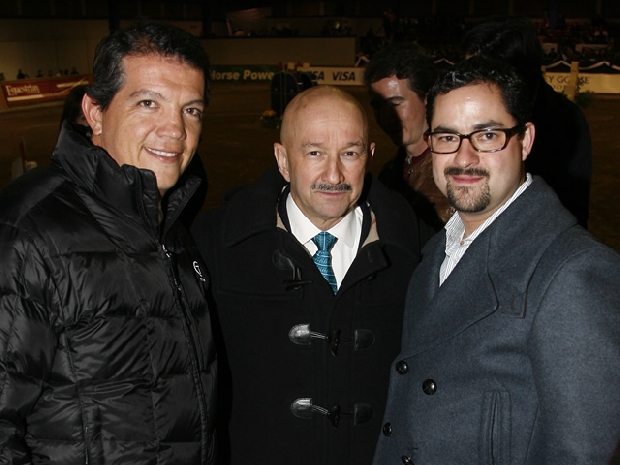
There is an equestrian thread as well. In December 2010, he was photographed at the Copa Scappino Tour Nacional Questro alongside former president Carlos Salinas de Gortari and Juan Cristóbal Salinas. He watched the show-jumping competition from the former president’s box and was reported chatting with him. The scene catches a public administrator between chapters of his professional career, at a sporting event rather than a ministry desk.
Competition records add something firmer than the photograph: in February 2026 he rode Chacana LS in a 1.40-metre class at Puebla’s CSI4*-W meeting. The result lists four penalties in the second phase and a time of 30.52 seconds. A show-jumping result is pleasingly specific. It records horse, rider, faults and time, leaving the reader wonderfully little room for corporate adjectives.
The next conversation is still about the system
A recent MexMoves interview with Eduardo García and Damian Fraser returned to financing infrastructure and energy projects in Mexico, the fund’s Mexico and Colombia focus, and the place of ESG standards in raising and investing capital. The conversation places Rodríguez Arregui back at the intersection where his career has spent so much time: projects needing money, investors needing a workable proposition, and institutions setting the conditions.
Viewed across three decades, the pattern is more interesting than a succession of titles. The economist became a consultant, a transport official, an administrator and a fund manager. The assets changed; the need to organize them did not. His present role gathers those experiences around investments whose performance unfolds over time, in services used by people who will never read the fund’s annual report.
That is the useful perspective his story offers. A terminal, a railway, a water system and a toll road all invite an opening photograph. Their real test continues in the ordinary business that follows. Rodríguez Arregui’s career keeps returning to that less theatrical interval, where management has to meet the promises made when the scissors were still in someone’s hand.