When Mustafa Siddiqui announced that he was leaving Blackstone, he had fourteen and a half years to account for. He could have made the farewell a catalogue of transactions. Instead, he named people: mentors, colleagues, partners and the team he was leaving behind. His sentence about what he would miss was almost disarmingly ordinary for a departure from a large investment firm. “But it’s the people I’ll miss the most.”
That was in 2024. In January 2025, he launched SQ Capital, a New York firm focused on private equity secondaries in the middle market. The change gave his own career a second chapter while putting him in the business of financing other people’s next chapters. An existing investor wants to leave. A manager wants to keep working with a company. Someone has to decide whether the story deserves more time, and what that time should cost.
It is an occupation with an unhelpful name. “Secondaries” sounds like a drawer for things that did not make the first drawer. In practice, it places the investor at a junction of ownership, price and timing. Siddiqui had already approached those questions from several directions. SQ would bring them together in a firm of his own.
A different seat at the table
His preparation included an economics degree from Harvard College, a master’s in regional studies from Harvard University and an MBA from Harvard Business School, where he graduated as a Baker Scholar. Economics and regional studies make an interesting pair: one asks how incentives work; the other invites attention to the place in which they work. His later career would involve businesses and investors across borders.
Before Blackstone came roles at McKinsey & Company, General Atlantic and Springbok Capital. He began his private equity career at General Atlantic in 2002 and joined Blackstone in 2009. Those moves took him through consulting, private equity and public markets before the long stretch that would make Blackstone the institution he called home in his farewell.
At Blackstone, he worked on energy investments. These were businesses whose value depended on assets, management and development over time. A company with production today and projects for tomorrow offers an investor several questions at once. What is earning money now? What still needs capital? How much confidence should the buyer place in a plan that reaches years beyond the acquisition?
Investing in companies
Investing in investment managers
Buying existing investment exposure
The company underneath the transaction
In 2016, Siccar Point Energy announced its acquisition of OMV’s UK business. Siddiqui, then a Blackstone managing director, supported the combination of near-term production from Schiehallion and longer-term development opportunities. The transaction expanded Siccar Point’s North Sea portfolio. His comments drew attention to the management team and its financial backing as well as the assets themselves.
That detail matters to the later story. An asset’s prospects depend partly on the people and resources around it. Oil fields do not turn a financial model into production merely because someone has formatted the spreadsheet nicely. Development has to happen. A buyer is making a judgment about a business’s capacity to turn a plan into work.
In 2018, Blackstone Energy Partners joined Blue Water Energy in backing Mime Petroleum in Norway. Siddiqui was named to join Mime’s board, alongside Kjell-Erik Østdahl. Again, the investment paired capital with an experienced operating team. Its geographical setting changed, but the investment problem had recognizable features: assess the opportunity, the people pursuing it and the resources required.
The next shift put Siddiqui a level above the operating company. He went on to lead Blackstone’s GP stakes business, which bought minority interests in private-market investment managers. Here, the business being evaluated was itself in the business of evaluating businesses. Private equity has a talent for making a sentence require a second reading.
Learning the people who pick the companies
By March 2021, a leadership change made Siddiqui the sole head of Blackstone’s Strategic Capital Holdings unit. He had previously co-led the GP stakes platform with Scott Soussa. The role put investment firms, their economics and their organization at the center of his work, following his earlier energy investing responsibilities across Europe, the Middle East and Africa.
A minority investment in a manager raises different questions from an investment in an operating company. The managers’ decisions, incentives and ability to sustain an organization become part of what the buyer is assessing. The buyer also gains a view of how different firms go about their work. Siddiqui later linked this experience to his understanding of middle-market private equity.
When he marked SQ’s first anniversary, he described having learned from middle-market firms during his GP stakes years. His account presented the new business as a set of deliberate choices about what to carry forward. A founder coming out of an established institution has an unusual editing task: experience supplies a great many pages, but the new firm still needs its own opening sentence.
“capturing it requires the judgment, skillset, and process to separate the good from the bad.”
Mustafa Siddiqui, commenting on his PE Forum conversation
An exit for one investor, an entrance for another
SQ’s January 2025 launch established two routes into its chosen market. It could buy existing private equity fund positions from institutional investors, including pensions and endowments. It could also invest in continuation vehicles formed to hold existing assets. Both involve investments already under way, though they place the buyer in different relationships with the sellers and managers.
In a fund-position sale, an investor transfers its interest to a new owner. The underlying fund continues, while the seller gains liquidity. A continuation vehicle rearranges ownership around a company or group of assets. A manager can keep working with the business while investors make decisions about whether to remain exposed or take an exit.
The appealing part is easy to describe: different investors can have different needs for the same asset. The difficult part is deciding what the buyer should pay. A seller’s timetable is information about the seller. It leaves a substantial amount of work to do on the business. An investment does not become attractive simply because someone else would like their money back.
Simplified ownership paths. Terms and investor choices depend on the transaction.
A blank sheet, with experience attached
Siddiqui has described the opportunity to build SQ’s team, process and technology together from the beginning. In a 2025 account of a secondaries panel in Chicago, he emphasized the freedom that came with starting from a blank sheet. That is a practical founder’s question: what does this particular investment job require, and how should the organization be arranged to do it?
His March 2026 conversation with Khaled Abou Zahr at PE Forum returned to the underlying companies. The discussion addressed judging assets within continuation vehicles and evaluating secondaries at the portfolio-company level. It also covered the role of data science and AI in combining a detailed review with speed. The appeal of technology here lies in helping investors examine the material in front of them.
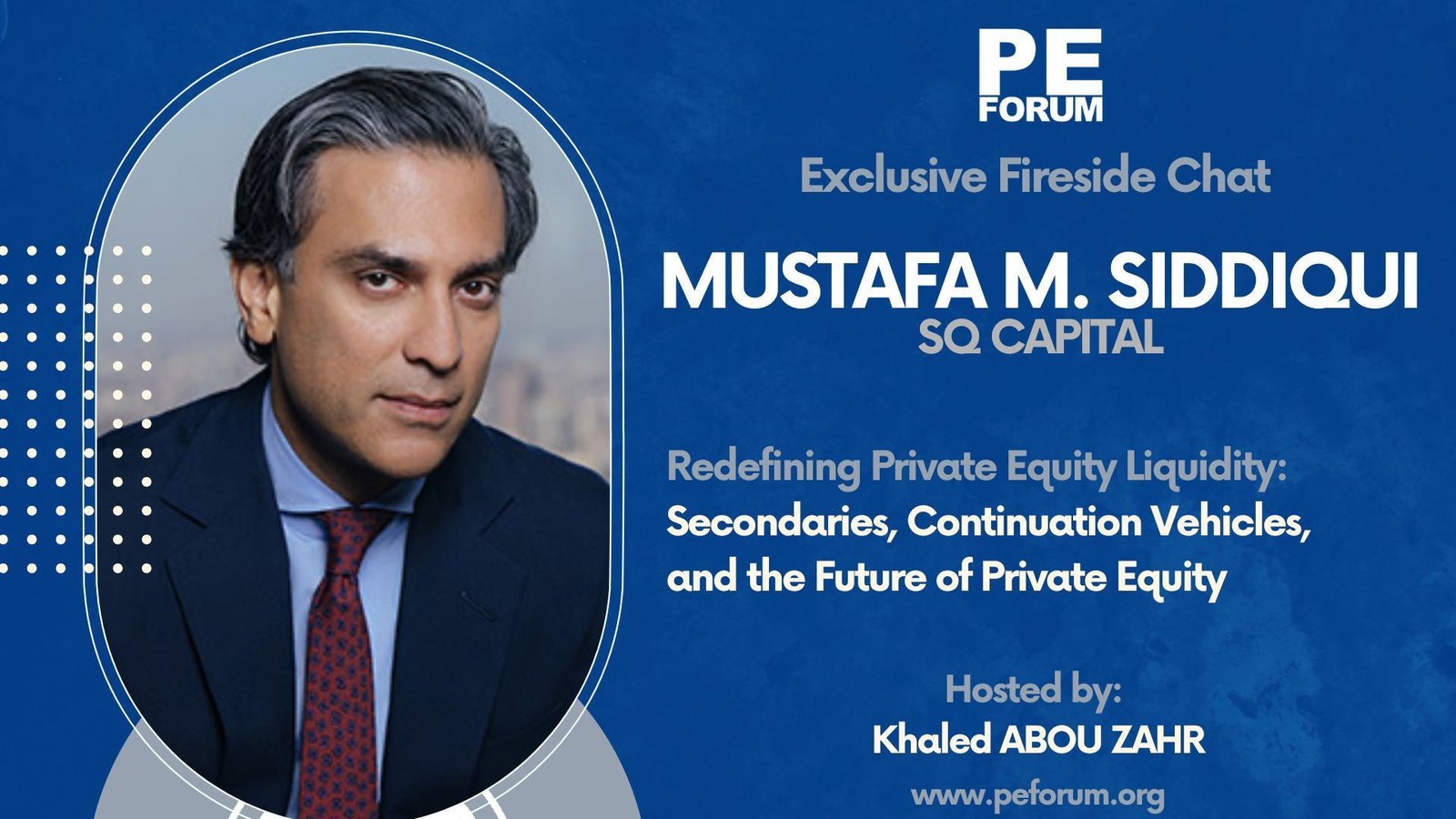
The conversation also points to a tension inside the strategy. A busy market offers choices, which makes discrimination more valuable. The existence of a continuation vehicle tells the buyer how an asset will be held. It does not settle whether the asset deserves the proposed price. Siddiqui’s argument puts that company-level decision at the center.
When the structure meets the business
By May 2026, SQ had invested in five transactions: two continuation vehicles and three LP-led secondary deals. One early reported transaction involved K1 Investment Management’s TeamDynamix investment. The reported continuation vehicle would extend K1’s ownership, with SQ as its lead buyer. It supplied a concrete example of the new firm entering a company’s story after the original investment.
A later example arrived in August 2026. Exponent announced an approximately €750 million continuation vehicle for H&MV Engineering, co-led by Apollo S3, Pantheon and SQ Capital. The transaction valued the business at €1.4 billion. H&MV works in high-voltage electrical engineering for infrastructure including data centres, electricity networks and battery energy storage.
Total vehicle size, with Apollo S3, Pantheon and SQ Capital as co-lead investors. This is the transaction’s size, rather than SQ’s individual commitment.
Here the financial structure connects to a recognizable job: designing, building and energising electrical infrastructure. The continuation vehicle extends an investment relationship around a business with further expansion plans. For Siddiqui, whose earlier work included energy companies, it also offers a new route into the capital needs of an operating company.
The second owner’s question
The fourteen and a half years at Blackstone matter because SQ began with experience attached. Siddiqui had worked with companies, managers and colleagues before putting his name to a new venture. His farewell recorded the human part of that education. His new firm gives the investment part another use.
There is an appealing symmetry in the move. He left an institution after a long stretch and built a firm that invests when ownership is ready to change. In both cases, continuity and a fresh start occupy the same page. The question for the investor remains concrete: what is worth carrying into the next chapter, and on what terms?