Eric Taylor had to call his father. He was giving up basketball for swimming, an ordinary school decision made rather less ordinary by the fact that basketball was his father’s sport. At Eaglebrook, where his father had also studied, the younger Taylor was beginning to work out which parts of the inheritance he wanted to carry forward. A family tradition can be a fine thing. It can also choose your afternoon activities before you have had much say.
Years later, Taylor remembered the switch as his first independent decision. Today, as the founder, chief executive and chief investment officer of Trident, he makes decisions about buying American small businesses. The distance between a swimming pool and an investment committee is considerable. The question of choosing your own direction survives the journey.
A familiar education, a smaller target
Taylor’s professional credentials are recognizable to anyone who follows finance: an AB with Honors from Harvard, the CFA charter, four years in Goldman Sachs’s Special Situations Group. His work at Goldman concentrated on lower and middle market companies. At Brightwood Capital, he became a credit portfolio manager and an equity originator, working in another corner of the market where actual operating businesses mattered.
Those roles gave him experience on both sides of a company’s financing. Debt and equity ask different questions of the same business. Both require an understanding of what generates cash, what could interrupt it, and what a management team can reasonably deliver. Trident, founded in 2017, kept his attention on established businesses while giving him a firm of his own.
He now oversees its daily operations, chairs its investment committee, and makes the final decisions on additions to the portfolio. The titles collect neatly on a biography. The responsibilities spread out: selecting investments, working with colleagues, and remaining accountable for what happens after the papers are signed.
The overlooked business has customers already
Trident’s search centers on profitable, family- and founder-operated businesses. These are companies with operating histories, customers and cash flow. Taylor’s proposition asks investors to pay closer attention to businesses that may have been running for years before institutional capital took an interest.
The current approach combines a network of operators with technology for evaluating and matching them. Trident calls its operator-evaluation engine OPER.AI. It describes a process intended to reduce bias in selection and connect suitable operators with opportunities in specific regions and industry niches. The human part remains substantial: understanding a local market, knowing an owner, recognizing the implications of an outdated system or an approaching succession.
It is easy to admire a company once somebody has made it legible to an investment committee. The harder task is finding it early, understanding what its owner has built, and deciding which changes would help. Taylor has chosen to make that search part of his firm’s identity. A spreadsheet still earns its keep. So does somebody who knows the neighborhood.
- EvaluateUse technology to assess operator fit.
- ConnectDraw on regional and sector knowledge.
- BuildSupport operations after acquisition.
An investment thesis with hinges
In early 2022, Taylor explained his thinking through an interior-door manufacturer in northeast Alabama. The company had demand for its product but difficulty staffing enough workers to make fuller use of manufacturing capacity. Anyone expecting a dazzling financial instrument was being asked to consider the laundry-room door instead.
The example gave his argument some useful weight. Recruiting from a wider pool and engaging a broader range of suppliers could matter directly to a company trying to grow. Taylor connected these possibilities with Trident’s aim of creating commercial value while improving opportunities in communities.
There is a reason the door is memorable. It is a product whose usefulness needs little explanation, made by a business facing a practical constraint. An investor can debate social outcomes in the abstract for hours. A factory needs people to turn up and make the next order. Taylor’s example put the two conversations in the same room, with the operating problem plainly visible.
The work behind the announcement
The following year, Taylor offered a more detailed account of Excel Interior Door. Since the January 2022 investment, he reported organic EBITDA growth of nearly 25 percent. EBITDA is a measure of earnings before interest, taxes, depreciation and amortization; the figure described that period’s operating progress, rather than an investment return or a prediction.
The supporting work was gloriously unglamorous. Trident and its partners installed a new HR manager, moved payroll and onboarding from paper to Paylocity, and engaged TCGI, a Black- and woman-owned technology consultancy, to improve the internal technology stack.
People feature in Taylor’s letters as well as systems. He thanked colleagues individually, including Nicholas Wood for challenging assumptions. That is a useful quality in someone working beside an investor. Convenience has never been much of a risk-control system.
“Thank you for asking the toughest questions at the most inconvenient times.”
Eric Taylor, thanking Nicholas Wood in his 2023 letter
Who gets the chance to buy?
Taylor grew up in Texas. He has described seeing financial disparities in his family and wanting to create access to capital and opportunity for aspiring Black and Brown entrepreneurs. “The revolution must be funded,” he said. It is a compact sentence with a decidedly practical noun at its end.
Business ownership requires more than encouragement. An aspiring buyer needs financial knowledge, advisers, a convincing transaction, and access to money. Taylor’s interest in widening that access gives his work a personal purpose alongside its investment objectives. It also makes ownership itself part of the story, rather than leaving attention entirely on the companies being acquired.
In 2021, Trident announced seed capital and anchor investments, with supporters including Bank of America, Moody’s and Robert F. Smith. The firm also established its American Dreams Advisory Board, drawing on figures such as Richelieu Dennis, Clarence Otis and Freada Kapor Klein. These relationships brought institutional backing and experience to a firm still early in its development.
The announcement followed Trident’s first divestiture in 2020. By October 2021, its legacy portfolio held four active investments. Taylor’s ambition was taking organizational form: a portfolio, investors, and an advisory network. A founder’s idea must eventually survive the less poetic business of building an institution around it.
Thirteen people at a wider starting line
In April 2023, Trident launched the American Dreams Fellowship. Its inaugural cohort consisted of thirteen fellows from eleven states, with experience across several fields, including business services, consumer products, transportation and logistics. The program ran a four-month educational curriculum and opened access to Trident’s network of partners.
By September, the first cohort had graduated. JPMorgan Chase supported the program; ViableEdu administered education modules, McGuireWoods served as an education partner, and ImpactAssets was the fiscal agent. Those names represent different pieces of the machinery needed to make an educational initiative function.
Taylor’s stated objective was to increase participation in private equity and small-business acquisition, including among independent sponsors and operating partners from overlooked backgrounds. The program approached that objective through instruction and connections. It gave prospective buyers a way to become more prepared for the conversations in which an opportunity either moves forward or stops.
Five entrepreneurs also received grants of $50,000 each. The curriculum addressed acquisition knowledge, while access to accountants, lawyers and other specialists helped participants develop deal packages they could take to investors. Money and professional preparation appeared together.
That pairing gives the fellowship a concrete purpose. A person may know an industry well and still need help turning that knowledge into an acquisition proposal. Another may understand finance and need relationships with people who can assess a deal’s legal or operating details. The program worked on the connections between those abilities. It offered tools for entering a demanding process, where confidence is useful and preparation is indispensable.
The operator gets a seat
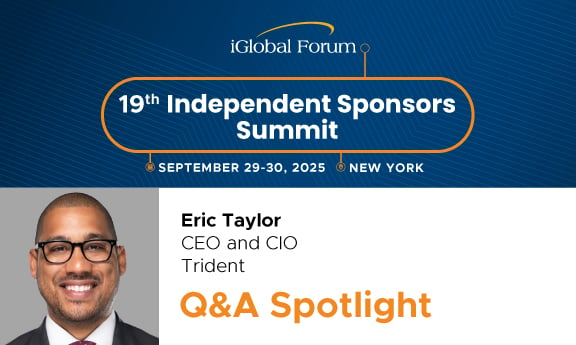
By September 2025, Taylor was making a pointed case for independent sponsors: specialists whose knowledge of a particular business or industry can guide an acquisition. He argued for giving these operators institutional capital and strategic support, then aligning governance and expectations from the start.
His phrase “transactional relationships create transactional results” conveys the danger of treating a partnership as a fee arrangement. He talked about a shared vision over five to ten years and about operators having a meaningful stake in the value they help create. That is his prescription for alignment, with the relationship beginning before the closing dinner.
A closing dinner, after all, is a short event. Running a company lasts rather longer. Taylor’s emphasis puts the operator’s experience and the investor’s resources into a working relationship that has to endure decisions, disagreements and the daily demands of growth.
Routes, meals, and the next chapter
The portfolio offers further glimpses of this everyday economy. In December 2024, Priority Courier Experts, backed by Trident and Bluejay Capital Partners, acquired NOW Courier. The Indianapolis business had been founded in 1986. Its president, Ryan Schwalbach, emphasized the importance of finding a suitable partner for a company that had been in his family for decades.
In December 2025, Trident announced an investment with SagePath Capital in The LunchMaster, a Hayward, California school-meal provider founded in 1994. The business served more than 140 K-12 schools and delivered approximately 40,000 meals daily. David De Souza became CEO, while Mike Giouzelis became chief operating officer.
Those transactions concern organizations with histories of their own. Taylor’s firm enters at a particular point in them, when an established business is preparing for another stage. The central challenge is to improve its capabilities while understanding the relationships that made it work in the first place.
His public conversations continued in July and August 2026, when he joined Jeff Roth of Bruin Capital on BDO’s Private Equity PErspectives podcast. The subjects included sourcing, early alignment and execution after a deal closes. Nearly a decade after Trident’s founding, Taylor was still talking about the patient work around the transaction.
The schoolboy’s swimming decision makes a fitting opening to this career because it was small enough to be recognizable. He chose a direction and made the call. His adult work asks who else might be ready for a different next chapter, and what resources would make that choice possible.