Don Hebb’s second career began with money from the institution where he had built his first. In 1990, he and Tim Weglicki founded ABS Capital with $20 million committed by Alex. Brown. After two decades in investment banking, Hebb was helping create a business that would invest directly in growing companies. The relationship between the two firms was close enough to fit inside three initials. Eventually, the new firm would need more room.
There is a particular attraction to a career with a clean turning point: the resignation, the new sign on the door, the first check. Hebb’s story offers something more interesting. Much of what mattered moved with him. Knowledge of industries. Experience with company leaders. An understanding of how businesses reach the capital markets. ABS gave that accumulated education another use.
Today, Donald B. Hebb Jr. is ABS Capital’s chairman emeritus and founding partner. The title comes after years as a banker, chief executive, investor, and director. Read those jobs together and a recurring question emerges: what happens to a company after it gets the money?
The banker who learned the business underneath the balance sheet
Hebb graduated from Kenyon College in 1964, completed his legal education at Harvard in 1967, and earned his Harvard M.B.A. in 1970. The sequence put liberal arts, law, and business into the same education. None of those credentials would make a particular investment work. They did give him several ways to examine an institution: its people, its obligations, and its economics.
He joined Alex. Brown in 1970. His subsequent responsibilities included heading Corporate Finance and serving as president and chief executive. T. Rowe Price’s biographies place his tenure as president and CEO from 1986 to 1991. By then, his work had reached beyond individual transactions into the organization of the bank itself.
One colleague’s recollection supplies the useful detail. Frank Bonsal, who later co-founded New Enterprise Associates, remembered hiring Hebb as Alex. Brown developed its business financing emerging technology companies. Bonsal described a practical requirement: underwriting needed research behind it. Hebb helped build the technology side. Before the money could be raised, somebody needed to understand what the company actually did.
This is an unromantic explanation for a consequential banking practice. An industry specialist can ask questions that a generalist may never think to ask. The customer, the competitor, the product cycle, and the reason a buyer might postpone an order all sit behind the financial statements. Learning those things takes work that does not appear on a transaction’s closing announcement.
Hebb helped develop Alex. Brown’s industry-specific investment banking units, including technology and media and communications. The organizational choice mattered. Expertise had a place to accumulate. People could return to the same sector with a longer memory, rather than treating each company as a fresh set of numbers.
Twenty million dollars, and a question of independence
ABS began inside that world of accumulated knowledge. Hebb and Weglicki had an initial pool of capital from Alex. Brown and a new institutional job to do. Providing equity changes the relationship with a business. The investment stays exposed to what comes next. A difficult expansion, an executive appointment, or an acquisition can become the investor’s problem as well as the company’s.
Hebb later explained that ABS initially financed recapitalizations and management buyouts for growing companies. Those are situations in which the financial structure of a business changes while the business itself must keep functioning. Customers still expect service. Employees still expect decisions. A transaction may be an event in the investor’s calendar; for the company, it becomes part of ordinary life.
“We needed more funds than it made sense for Alex. Brown to provide.”
Don Hebb, 2007
His explanation of ABS’s eventual separation was refreshingly practical. The firm’s requirements had grown beyond what its original backer should supply. Independence followed a need for capital. It is a small corrective to the temptation to describe every new financial firm as an act of rebellion. Sometimes an organization simply becomes too large for the arrangement that brought it into existence.
Hebb also identified what ABS had inherited: knowledge of capital markets for growth companies and an understanding of industry niches. Those are assets that resist a neat valuation. They reside in the questions people ask, the mistakes they recognize, and the colleagues they know to call. An investment pool can be replenished. That kind of experience takes longer to assemble.
There is also a change in timescale here. An investment banker works toward a transaction with an identifiable completion. An equity investor must keep evaluating the business after the documents are signed. The questions become less tidy: whether a plan still fits the market, whether the company has the right resources, whether management should change course. Those are ordinary questions of ownership, and they help explain the significance of Hebb’s move. His earlier work supplied experience of companies seeking money. ABS placed him on the side responsible for committing it. The continuity is knowledge of growing businesses; the difference lies in the responsibilities that follow a decision.
A tower, a board seat, a familiar face
A June 2009 investment gives those abstractions some steel and concrete. Tarpon Towers announced a $25 million equity commitment from ABS to acquire and build wireless communications towers. Hebb was among the ABS representatives named to join its board, alongside Deric Emry and Rob Tobin.
The management connections were already there. Tarpon CEO Ronald Bizick had been chief operating officer of SBA Communications, an ABS portfolio company. President William Freeman had previously been chief financial officer of another ABS portfolio business, System One Services. The announcement described ABS working with Bizick for a second time.
For an investor, a returning executive offers something a spreadsheet cannot: a working history. It does not eliminate risk. A tower still needs a useful location and customers willing to pay for space. But a prior relationship gives both sides experience of the people involved. They arrive with more to discuss than the introductory slides.
The funding also had a defined purpose. Alongside ABS’s equity commitment, a Tarpon subsidiary obtained a $20 million credit facility to support expansion. Equity and borrowing were separate pieces of the arrangement. Hebb’s board appointment placed him inside the company’s governance as that plan developed. The capital had work to do, and the directors had work to oversee.
Another seat at a Baltimore table
Hebb’s board responsibilities extended beyond ABS’s investments. He became an independent director of T. Rowe Price in 1999 and served as its lead director from April 2008 to April 2011. His committee service included executive compensation and nominating and corporate governance. These are the subjects that determine who runs a company, how leaders are rewarded, and how oversight operates.
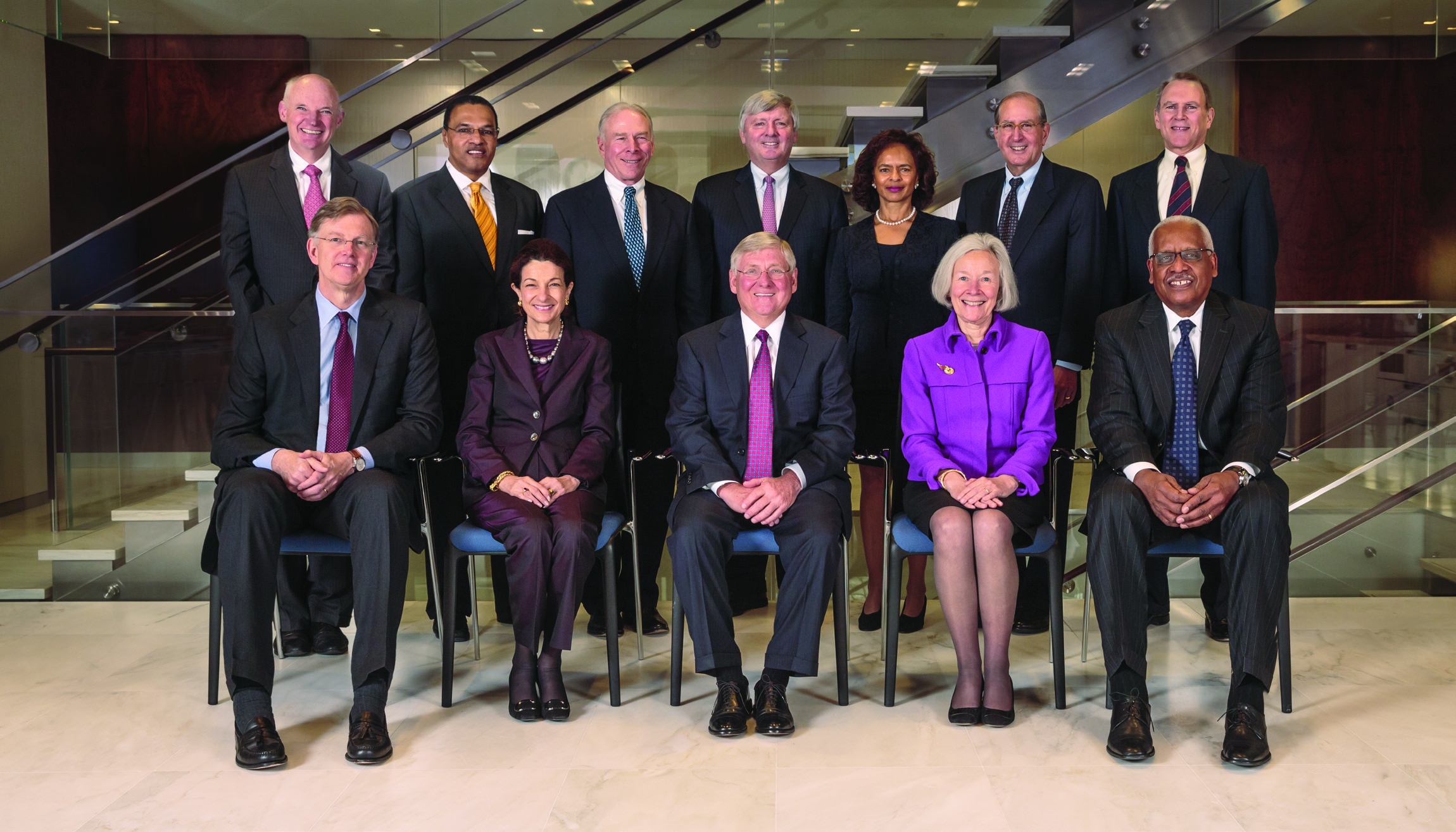
The dates give his lead-director term its own context: it began in 2008 and continued into 2011. That is a period requiring no invented boardroom scene to make it interesting. The responsibility itself is enough. A director with experience running a financial institution brought that background to the oversight of another one.
In 2015, T. Rowe Price asked Hebb to stand for reelection for an additional year under an exception to its usual retirement guideline. The stated reason was to retain his experience. It is a restrained institutional compliment, and a useful one. A board was making a specific decision about the continuing value of a colleague’s judgment.
Kenyon, and the fiction department
The college connection also continued long after graduation. Kenyon listed Hebb, class of 1964, among its trustees in its 2006–2007 catalogue. The entry paired his college affiliation with his work as managing partner of ABS. A biography can make education look like a stage left behind. Trustee service brings the graduate back into the institution’s continuing business.
Kenyon’s class records later listed him in its $25,000 to $49,999 giving band for both the 2019–2020 and 2020–2021 fiscal years. The exact gift totals are not the point of those published ranges. They document a relationship sustained across decades. The college remained somewhere he put resources as well as somewhere he had earned a degree.
Other public commitments include the Hebb Family Private Foundation, where tax records list him as a trustee, and Baltimore Center Stage’s capital campaign, whose donor list includes Sybil and Donald Hebb. These are modest entries in a long institutional record. Together, they widen the picture beyond the investment committee.
His professional biography permits one less solemn detail. He enjoys reading nonfiction, playing golf, and swimming. The golf comes with the parenthetical “plenty of fiction.” Anyone who has listened to an account of an almost excellent round will understand the distinction. Even a career spent examining other people’s numbers apparently leaves room for literary invention on the scorecard.
At ABS, his present role includes advising the firm. It is a fitting continuation of a career in which experience has repeatedly found another setting: from industry banking to equity ownership, from executive responsibility to board oversight. The change in title also gives the story a different pace, with the emphasis moving toward advice and continuity. The original $20 million belongs to the founding history. The longer story follows what Hebb brought with him, and the institutions that continued to make use of it.