- What it is: a shared inbox for SMS, email and supported social channels, connected to the tools a business already uses.
- What changed everything: customers tried to share personal authentication tokens, so Heymarket built proper team access.
- What it costs: annual plans start at $49 per user per month, with a two-user minimum and messaging usage billed separately.
- What to copy: study the unsafe workaround. It may be a more honest product brief than the feature requests.
The useful thing about an embarrassing text is that it leaves very little room for theory. Amit Kulkarni had bought a used coffee table from a local shop. The owner took his number, arranged delivery and completed the job. A month later, on a Saturday morning, Kulkarni received a message from the same man apologizing for being drunk the night before. It was meant for someone else.
Most of us would delete it and develop a short-lived sympathy for the sender. Kulkarni saw the business problem hiding inside the social mistake. The shopkeeper was using one phone for friends and customers because texting worked. It was immediate, familiar and did not require the buyer to learn anything. The tool was effective. The setup was reckless.
In 2015, Kulkarni and Manav Monga - veterans of Manymoon, a collaboration service acquired by Salesforce - founded Common Sun, the company behind Heymarket. Their first answer was clean and modest: give a professional a separate number, then add the small pieces of customer management missing from the phone's native message app. Lists. Templates. Reminders. Scheduling. A little context around the conversation. The recipient still got an ordinary text.

The wrong behavior was the right clue
The first version was essentially a mobile CRM for a single professional. Then customers began doing something they were not supposed to do: sharing their personal Twilio authentication tokens with co-workers. Security credentials are personal for a reason. But the customers were not trying to become amateur hackers. They were trying to share messages, contacts and templates so somebody - anybody - could answer the customer.
The visible failure
People mixed customer messages with personal texts. One stray message made the risk painfully clear.
The revealing misuse
Early users shared credentials because the solo product did not match how their teams actually worked.
The product turn
Heymarket added a shared inbox, assignments and common context without changing the customer's behavior.
This was the moment that changed the company. Heymarket could have added a warning dialog and continued polishing its solo app. Instead it treated the misuse as research. Within months, it had an inbox in which several employees could monitor a number, claim a conversation, hand it to a specialist and leave private notes. The customer saw a normal text thread. The business saw a queue.
You can't get as much done if you're chained to your desk.Amit Kulkarni, co-founder and CEO
The distinction sounds small until a customer asks a question the first employee cannot answer. With a personal phone, the request becomes a screenshot, a forwarded message or a desk-side interruption. With a shared inbox, ownership moves while the conversation stays put. Heymarket's product is not really the bubble on the screen. It is the handoff behind the bubble.
The invisible software around “hello”
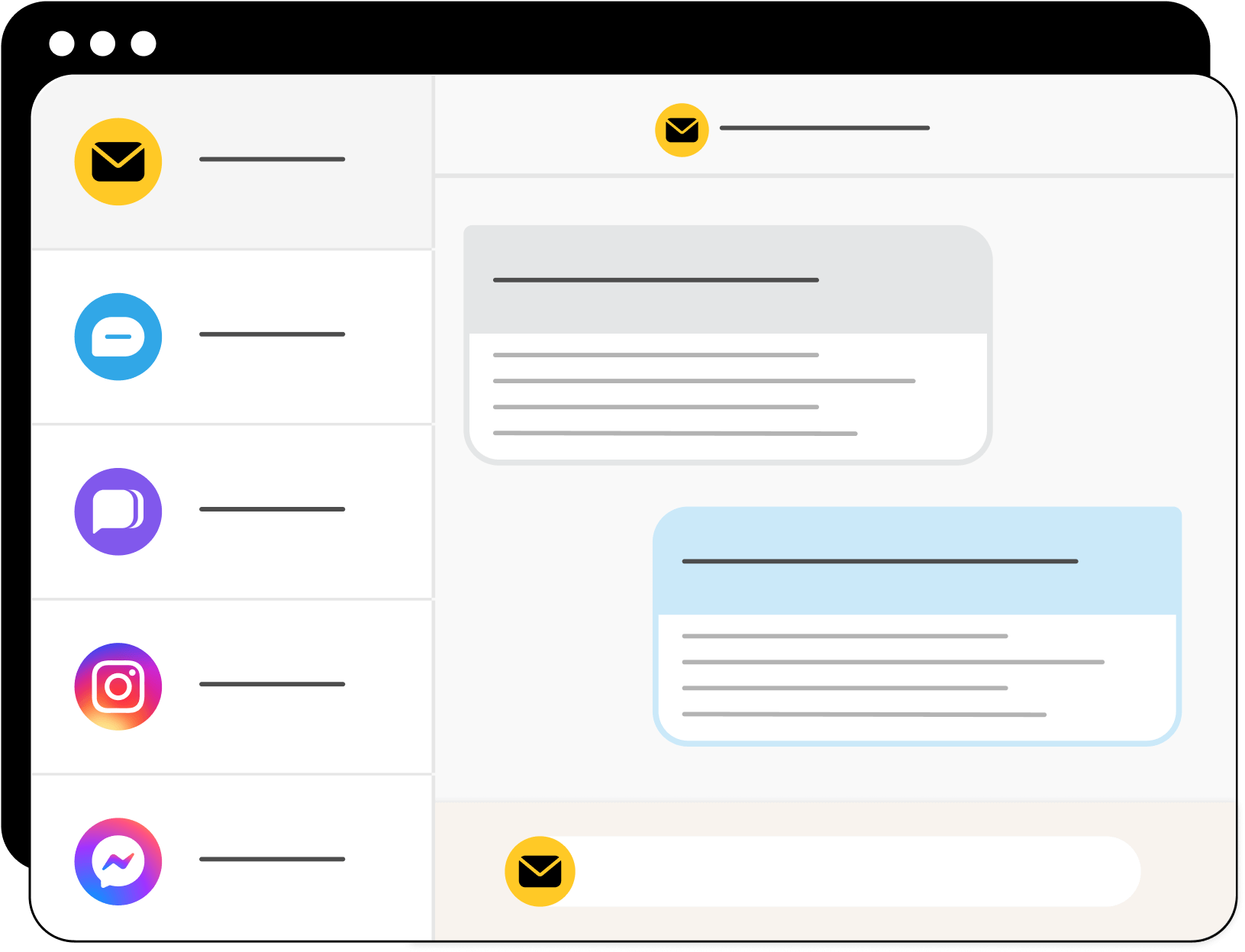
Heymarket has since widened the original idea. SMS and MMS now sit beside email, web chat, Facebook Messenger, Instagram Messaging, Apple Messages for Business and WhatsApp, with availability varying by plan. A team can schedule broadcasts, build multi-step automations, translate messages, summarize conversations, detect sentiment and pull customer fields from HubSpot or Salesforce. The higher tiers add APIs, reporting, roles, retention controls, hidden personally identifiable information and HIPAA enablement.
The company occupies a useful middle stretch of the market. It is more operational than a simple bulk-texting tool and lighter than a full contact center. Textline, Salesmsg, Podium, SimpleTexting, Birdeye and MessageDesk overlap from different directions. Podium wraps messages around reviews and payments. Salesmsg leans into sales workflows and calling. Heymarket's bet is that many teams chiefly need a secure, collaborative layer over the channels they already use.
The customers make the market legible. U-Haul reported a 60 percent response rate. Adorn Bridal said it cut time spent during in-person visits by half. F Street Lending reported saving 20 hours a week. Lighthouse said an agent could handle ten times the capacity and reached conversion rates as high as 24 percent. These are company-published case studies, not universal promises, but the pattern is consistent: faster replies, fewer duplicated efforts and more conversations per employee.
The math before the magic
Heymarket sells subscriptions per user, which makes the buying logic fairly visible. As of September 2026, annual billing put Standard at $49 per user per month, Plus at $99 and Pro at $199. Enterprise is quoted. Every plan starts with at least two users, and message usage is another line on the bill.
The starting commitment is therefore $98 a month before messaging charges. Email, campaigns, many integrations, advanced compliance and AI capabilities depend on tier.
That model works best when a reply is valuable enough to justify a paid seat: a sales lead, a rental applicant, a patient appointment, a delivery exception or a service customer who may otherwise call. It is less convincing for a solo operator who only sends occasional texts, a high-volume broadcaster hunting the lowest price per message, or a team that needs voice calling in the same native product. Compliance features also do not outsource compliance itself. Consent, message content, carrier registration and internal policy remain the buyer's work.
The original version cost $4.99 a month in 2016. The jump from that small utility to a two-seat business system says more about Heymarket than any list of features. The company learned that the valuable unit was not one person sending one message. It was a team maintaining one customer relationship without losing context.

Now the agent answers first
In 2025, Heymarket added email to the shared inbox. In 2026, it moved from AI writing aids - translation, reply tuning, summaries and sentiment - toward configurable agents that can answer questions, schedule appointments and enrich contact records. The company tested its own agent on its customer-support traffic. Real conversations, it argued, supplied the disorder a controlled demo could not.
That decision repeats the company's oldest instinct. Put the product where the awkwardness is. Watch what happens. Preserve an escape hatch to a human. An AI agent that knows documentation but cannot recognize a strange edge case merely recreates the original personal-phone problem at greater speed: the message gets delivered, but the context is wrong.
There is a copyable lesson here for any software company. Do not imitate Heymarket's feature list. Look for the spreadsheet passed between departments, the shared password, the group chat that acts as a ticket queue, the employee carrying two phones. Then ask what job that bad workaround is completing. Heymarket's customers answered that question before the founders did. They wanted one familiar door for the customer and many responsible hands behind it.
The accidental text was funny because the boundary failed. Heymarket became a business by rebuilding the boundary - personal and professional, customer-facing and internal, automated and human - without making the customer care how the machinery worked. The best infrastructure often has that quality. From the outside, it looks like someone simply wrote back.