Henal Patel was trying to keep up. Around 2004, before law school, he was learning to negotiate oilfield-services agreements from an experienced attorney. His notes needed a better home. He put the lessons into a chart, an early contract playbook. It was a modest solution to a stubborn problem: how to make a useful answer available when the same question came around again.
The chart deserves a place in the story of DocJuris, the company he later co-founded with Brian Ng. It gives the business an origin more recognizable than a sudden flash of entrepreneurial genius. A person had work to do. The instructions were difficult to absorb. He changed the way he kept them.
Today Patel is the Houston-based CEO of a company that has moved from contract negotiation software into a broader legal AI service. There are investors, enterprise customers and product demonstrations. Yet the early question remains an unusually good way to understand the business. What does the next person get to keep from the work the last person already did?
The chart came before the company
Patel’s route to the CEO’s chair ran through the work that software is supposed to help. His professional history includes legal operations and counsel roles at SilverBow Resources, Weatherford International and EDP Renewables. He studied at South Texas College of Law Houston from 2007 to 2010. His Texas law license dates to May 2011.
That sequence matters. Legal operations concerns how work reaches a team and moves through it. Counsel must also decide what the language means and what the business can accept. Patel’s background brought those two assignments together: organize the process, then take responsibility for the document passing through it.
A contract playbook sits at that junction. It records the positions a team prefers, the alternatives it can accept and the questions that require another conversation. The benefit is easy to appreciate. An experienced colleague cannot stand beside every reviewer, murmuring advice at precisely the right moment. A usable set of instructions can travel farther.
DocJuris dates its founding to 2018; Patel has described starting in late 2017 and releasing the main product in 2019. He became CEO, with Ng serving as CTO. The company’s division of responsibilities put the former legal practitioner and his technical co-founder on the same recurring assignment.
“Let me put this into some sort of chart.”
Henal Patel, recalling his early negotiation notes
A useful answer, before the redline
At Flex, the manufacturer, that assignment acquired a clock. Its procurement and supply-chain legal team handled thousands of complex supplier agreements. DocJuris initially worked with the team on nondisclosure agreements. Lead attorney Iringo Csifo-Nagy then explored a larger application with Patel: helping the business navigate more complicated supplier contracts.
The project examined contract volumes and turnaround times and developed customized playbooks. Its screening report could identify issues for business colleagues before the arrival of a fully redlined draft. The collaboration received ACC Value Champion recognition in 2023.
The memorable comparison was eight days against five minutes. Read carefully, it describes different stages of the work: the earlier turnaround for redlining a complex agreement, and the time to produce a screening report. It does not turn the rest of a negotiation into a five-minute errand.
An earlier view of the issues. Negotiation and final approval still follow.
For Patel’s story, the significance lies in the handoff. Business colleagues could begin addressing problems sooner. A lawyer’s knowledge became something another person could use while the legal process continued. The chart’s original ambition had acquired a larger audience.
There is a useful distinction here between producing a document and helping somebody proceed. A report can be brief and still arrive at exactly the right moment. A meticulous answer delivered after the next decision has stalled may have a different value. The Flex project made that timing visible.
The system that stayed unbought
Purolator offered a less cinematic test. The transportation and logistics company was changing its enterprise resource planning system. Contract generation needed to keep working through the transition. Earlier attempts at full contract lifecycle management systems had struggled with complexity, expense and integration.
DocJuris built an intake tool inside the existing environment to generate standardized agreements. The 2025 ACC-recognized project reported more than $300,000 in avoided purchase and implementation expenses for a new CLM. No additional staff were needed.
“The biggest challenge was balancing legal requirements with user-friendly technology,” Patel said. His advice was to examine the tools and processes already in place before committing to a wholesale replacement.
This is a revealing assignment for someone selling software. A customer may need a connection between familiar tools, a clearer intake process or a reliable document output. The interesting engineering can live in the joins. The invoice for an entirely new system is sometimes the item left out of the story.
For Patel, Purolator supplied another example of expertise becoming usable through a practical workflow. It also set a demanding measure of success: the business had to continue operating through a substantial systems change.
Purchase and implementation of a new contract lifecycle management system.
The founder at the demo screen
Patel has repeatedly taken the less glamorous seat in technology: the one in front of a product demonstration. In December 2021, he showed an automatic amendment-drafting capability. The task was narrow enough to be recognizable to a lawyer, and concrete enough for a viewer to examine.
An amendment sounds small until someone has to produce it correctly. Changes must become a document that another party can read, discuss and sign. The distance between deciding what needs changing and preparing the usable paperwork is a convenient place for time to disappear.
By April 2025, Patel was demonstrating another route into the work: DocJuris’s Email Agent, which generated contract reviews and markups through email. The entry point was deliberately familiar. A user could send the agreement from an inbox rather than begin with a tour of a new application.
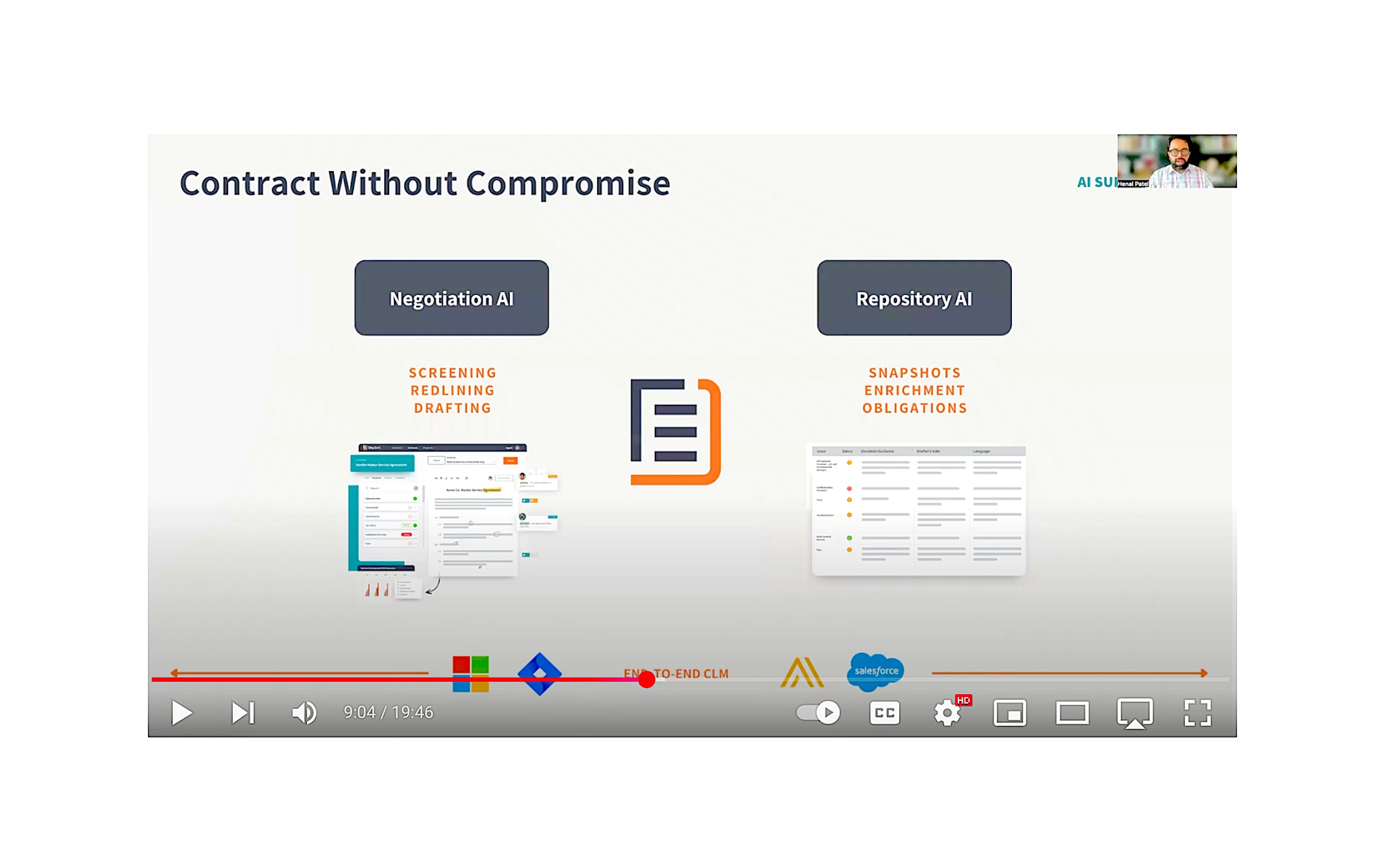
The demonstrations give his career a visible continuity. First an amendment, then an emailed review: each takes a recognizable unit of legal work and asks whether software can help finish it. The viewer can judge the returned document rather than rely entirely on the promise surrounding it.
There is an editorial pleasure in watching a founder explain the ordinary bits. A company presentation can soar over a process. A demo eventually has to land on a screen, a button and an output. The paperwork insists on being included.
Human judgment, with a view
On June 10, 2025, Patel joined the Skyline Insights discussion at Marina Bay Sands in Singapore, alongside counsel from Siemens and Weatherford. The setting supplied a rooftop view; the subject remained practical: how AI fits into negotiation, advocacy and contextual judgment.
The program included examples of automation’s limits, prompting techniques and ways to help teams develop their skills. That combination places the person using the software inside the argument about its value. Someone must know what the business wants, recognize an exception and decide when an apparently reasonable answer misses the point.
Patel’s public work now connects him with legal teams well beyond Houston. The company describes a global operation, and his appearances carry the same contract questions into different rooms. A February 2026 Legaltech Hub briefing again put him in the role of explaining the product and its use cases.
The geography has widened. The difficult part of the conversation remains close to the desk: who will use the result, and what will that person be able to do next?
A larger assignment arrives
Growth gave those questions a larger budget. DocJuris announced an $8 million Series A on October 1, 2024, led by Silverton Partners, with existing investors participating. The announcement put total funding at $11.2 million and named Siemens, Dell and FedEx among the companies using its tools.
At the time, Patel described plans to develop the platform around generative AI, expand customer success and grow the user base. Funding sits naturally in a founder’s biography, but the more revealing question is what assignment follows the money.
In July 2026, the answer was Workforce. DocJuris expanded beyond its contract negotiation application into a service for broader legal work, including IP research, regulatory risk and legal operations. Purpose-built apps were intended to return work for human review, with connections to enterprise systems.
The scope is appreciably wider than contract redlining. That makes the early playbook story useful again. A narrow task gives a team a clear place to test instructions and inspect a result. Broader work asks the company to preserve that usefulness across more assignments, data and decisions.
For Patel, this is the next chapter’s central tension. DocJuris has earned room to attempt more. Each new app still has to meet the person waiting at the other end of the task.
There is still pizza to make
Outside the contract discussion, Patel has offered some pleasingly ordinary details. In 2020, he talked about time with his children, making pizza and starting a backyard brick oven. He supported the Houston Rockets and named The Wire, Breaking Bad and The Boys among his television favorites.
Those details belong to that moment, rather than an invented portrait of his daily life today. They give the reader a person to place alongside the CEO at the demo screen: a parent with pizza plans, a basketball allegiance and work waiting upstairs.
The chart remains the more durable image. It began as a way to keep up with instructions. Now a company, a co-founder, customers and a growing team are working on ways to carry instructions into the next piece of work. The next contract will arrive soon enough. Patel has spent much of his career preparing something useful to meet it.
Follow the work
Interviews, demonstrations and the projects behind the story.
DocJuris website ↗Henal Patel on LinkedIn ↗The 2020 conversation with Zak Pines ↗Flex and DocJuris: the customer project ↗Purolator and DocJuris: the 2025 case ↗Watch: Patel’s 2021 amendment demo ↗Watch: Patel’s 2025 Email Agent demo ↗The February 2026 product briefing ↗The July 2026 Workforce announcement ↗