There is a 1985 Chevrolet Corvette inside the Tavus office. Not in the parking lot. Inside. The C4 belongs among the desks because Hassaan Raza, the company's co-founder and CEO, sees it as more than transportation. Its digital dashboard, early computers and spaceship silhouette preserve the hopes and constraints of another technological age. The car is an argument in fiberglass: every product tells on its maker.
Raza applies the same attention to Palm's doomed webOS, to Brutalist buildings, and to the old computers he collects in quantities that have prompted a colleague to joke about the office crossing the line from technology into archaeology. He likes machines with evidence on them. What did their designers believe? What did they miss? Which limit produced character, and which bad business decision killed a good idea?
This makes him a particularly fitting person to work on the question occupying Tavus: what should come after the text box? The company's answer is an interface that can see and hear, read timing and expression, remember context and reply with a face. Raza calls the field human computing. The phrase is grand. The daily work is exacting, measured in eyebrow movement, overlapping speech and the fractions of a second that separate a fluid exchange from two walkie-talkies with trust issues.
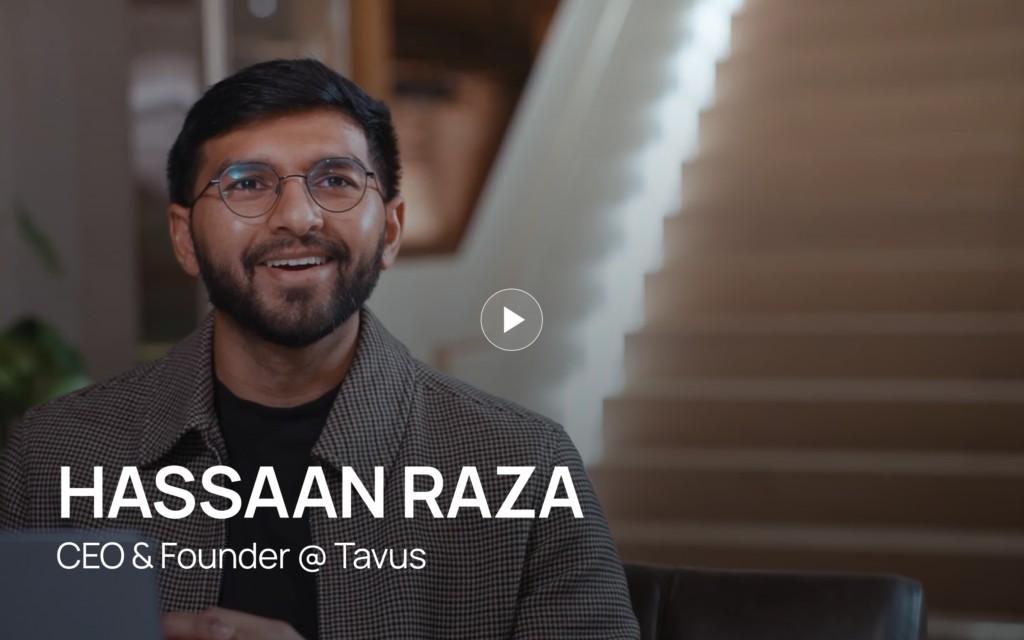
A career spent at the interface
Raza's route into this problem started early. On his personal site, he says he joined Hewlett-Packard at 16, an experience that nearly pushed his teenage self away from technology. He studied computer science at the University of Texas at Austin from 2015 to 2019. Apple followed in 2018, where he worked on security and operating-system projects for macOS in engineering and program roles. From 2019 to 2021, he worked at Google around Google Cloud and machine learning.
The titles matter less than the recurring position: between what the system can do and what a person experiences. Raza has done product work, but says software engineering was more his style because he likes building. In 2021 he and Quinn Favret co-founded Tavus and entered Y Combinator's Summer batch. Their first visible business made personalized AI videos. A salesperson could record once, then generate many tailored versions with the recipient's name and other details changed automatically.
The pitch worked. Meta and Salesforce were among the customers reported in 2024. Tavus trained a replica from recorded footage, then let software produce variations from scripts and CRM data. Forbes put Raza and Favret on its 2024 30 Under 30 list for Marketing & Advertising. That version of Tavus had momentum, revenue logic and the universal startup narcotic known as more integrations.
It also became a trap. After the company's Series A, Raza looked at the roadmap and saw a team drifting toward better AI sales tools. The work was commercially legible but emotionally vacant. He later said nobody on the team cared deeply about building sales tools. The personalized-video model had been a stepping stone toward a larger idea, and Tavus had begun furnishing the stepping stone.
“Our research directive, essentially, is that we build things that don't exist or aren't good enough.”Hassaan Raza, in conversation with 10 Minutes or Less
The pivot that went home
Tavus chose to leave that path and shed early customers. Raza describes the decision as a return to the founding vision rather than a conventional pivot. The company had always believed that the nuances of communication matter: seeing someone and hearing someone create forms of trust that a line of text does not. The scary part was explaining to investors why a company with customers wanted a different company.
One investor's verdict, as Raza recounts it, was concise: he had better be right. There is no spreadsheet that makes such a conversation pleasant. Yet the move produced a cleaner technical question. To make face-to-face software, Tavus needed more than a photorealistic mouth. It needed tightly connected systems for rendering, perception, audio understanding, memory and orchestration.
That is why Raza dislikes the word “avatar.” It can mean almost any digital face, while a face is only the visible fifth of the work by his estimate. Put a handsome rendering on a poor language-and-audio pipeline and the appearance raises expectations the system cannot meet. The result may feel worse, not better. Tavus instead talks about AI humans, a term meant to include the faculties behind the pixels.
The stack is deliberately vertical. Phoenix handles rendering. Raven interprets people, environments, gestures and expressions. Sparrow focuses on audio, emotion and conversational timing. Tavus says its PALs combine those models with memory and the ability to take actions. One component asks what was said. Another watches how the listener reacted. A third has to know when to begin speaking without behaving like a podcast guest who has lost the mute button.
Training for the pauses
The data problem is equally human. Raza says Tavus runs a studio to record two-way interactions: words, reactions, micro-expressions and emotional context. The internet contains oceans of one-way video, but many ordinary encounters are rarely recorded. In one interview, the hunt for missing first-date data turned into a joking proposal for a Tavus dating café, complete with tables and dinner. It was half brainstorm, half comedy bit, and a neat demonstration of how quickly a research constraint can become office theater.
Then there is speed. A generated answer may be intelligent and still feel obtuse if it arrives late. Tavus's conversational pipeline passes through video analysis, speech recognition, a language model, speech generation and rendering. Each wait compounds. The engineering target is not simply a faster benchmark; it is the tempo at which one person still feels another is present.
Capital followed the widening thesis
In November 2025, Tavus announced a $40 million Series B led by CRV, with participation from Scale Venture Partners, Sequoia Capital, Y Combinator, HubSpot Ventures and Flex Capital. The announcement paired the financing with PALs and newer versions of its models. The money was evidence that the return to research had found patrons. It was not proof that consumers will welcome expressive software into every corner of life. That question remains product work, cultural work and, inevitably, a matter of taste.
“We've spent decades forcing humans to learn to speak the language of machines.”Hassaan Raza, announcing Tavus's Series B and PALs
The useful ghosts of bad products
Raza's taste becomes clearest away from the fundraising. He studies corporate strategy failures and names Palm as a favorite. In his view, the Palm Pre and webOS were excellent products undermined by carrier choices, a weak developer ecosystem and other business decisions. Most founder lore studies survivors. Raza seems more interested in the machines history did not select, which are often more generous teachers because their flaws remain visible.
His personal writing project makes the point tactile. He writes essays on vintage computers, including an Apple IIe and a 1996 PowerBook 1400c, and assigns each piece an authenticity score based on how much was truly written on the old hardware. The exercise keeps the machines alive and forces him to experience their era. It also works, he jokes, as an anti-AI-written-content badge. The CEO of an AI company has designed a provenance system involving beige plastic and old word processors. There are less charming ways to make a disclosure.
The old machines impose friction. They slow editing, resist modern convenience and make every click announce its age. Raza does not treat that as pure defect. Constraints reveal the thinking embedded in an interface. This is the bridge between the hobby and Tavus: both ask how a computer teaches a human to behave. One looks backward at machines with opinions. The other tries to make future machines flexible enough to notice ours.
A company with a couch
Even the Tavus office became part of the thesis. After two years as a remote team, Raza and Favret found a San Francisco building with history and grit. Employees unpacked boxes, supplied favorite books, hung art and brought in 3D prints. There were plants, vintage computers, a workshop and places reserved for quiet. The most used piece of infrastructure was the couch in the corner.
Raza later wrote that a great space expands how people think and reminds them why they build. It is a revealing standard from someone working on invisible interfaces. Human communication is not only information moving between endpoints. It is room, timing, posture, silence, memory and the permission to sit on a couch without producing a status update.
Tavus's wager is that software can learn enough of that texture to become easier to meet. The hazards are plain: a rendered person can overpromise understanding, consent over one's likeness must be meaningful, and novelty is not intimacy. Raza has argued that people should control their replicas and that Tavus should retain responsibility for verification, including consent checks and human review. Those safeguards are part of the interface too.
The more delightful risk is strategic. A company can build a fine product and still become the next Palm Pre, admired later by collectors who explain how everyone got it wrong. Raza knows this. He keeps the cautionary tales nearby, along with the Corvette and the ancient computers. They are reminders that technology ages, categories shift and taste can outrun distribution.
For now, the work continues in the awkward milliseconds. A machine notices a raised eyebrow. It waits, perhaps not quite long enough. It answers. Somewhere in the office, a 41-year-old Corvette watches with a digital dashboard that once looked like the future. One suspects Raza would appreciate the symmetry, then ask what the machine's designers believed would happen next.