At his first technology conference, Maceo Cardinale Kwik found himself on the wrong side of the economics. A booth at Stripe Sessions was expensive, and he was too late to get one anyway. His first day produced about ten conversations and one meeting. Then he noticed the sidewalk. Attendees walked along it between the conference hall and the lunch gardens. A stream of potential customers, conveniently arranged in a line.
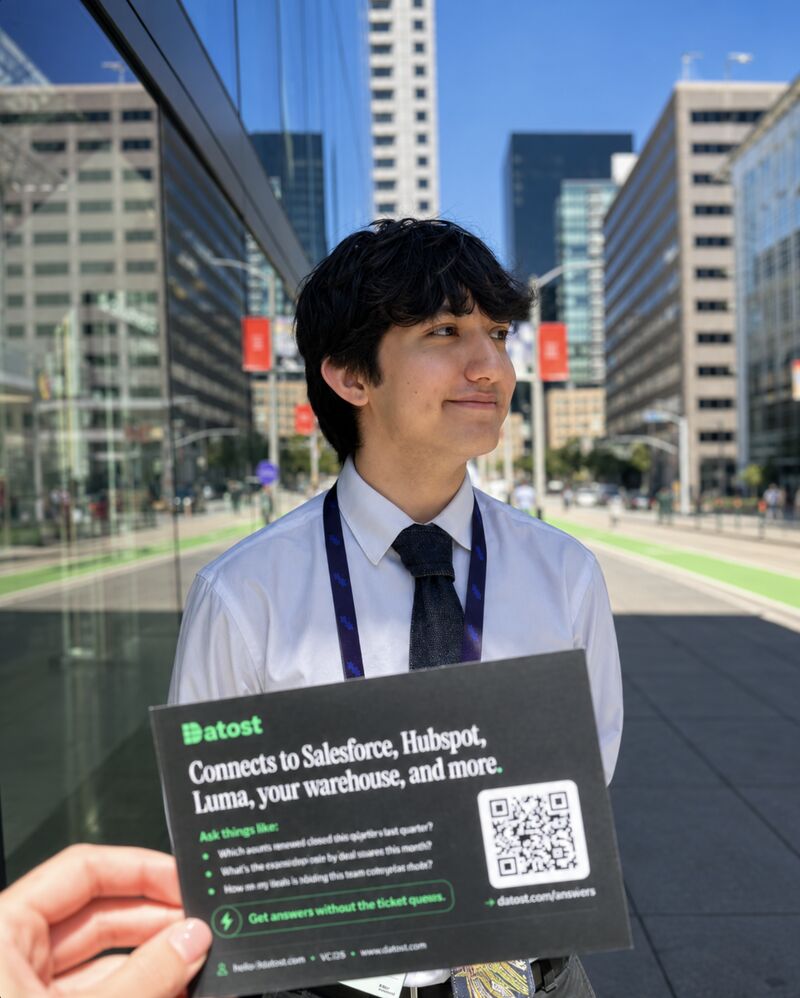
His answer involved two coolers, energy drinks from Costco, and postcards designed and printed that day. He positioned himself before lunch. In his telling, the roughly $400 experiment booked ten demos in one morning and led to a signed contract that day. Jason Wang had introduced him to the conference circuit; Pranav Bedi helped with the Costco trip. The equipment was ordinary. The placement did the work.
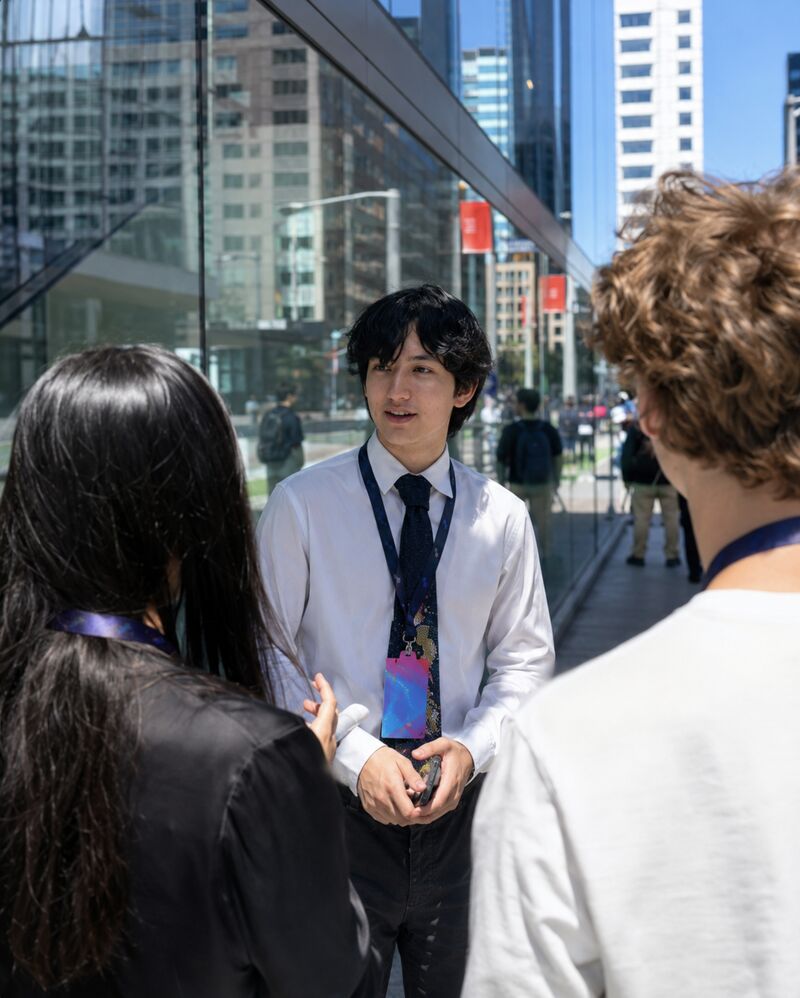
It is an appealing introduction to Kwik, partly because a cooler has so little interest in sounding visionary. He was selling Datost, the AI data analyst he had co-founded with Wang. Yet the episode also suggests a useful way to read his career: watch where he puts the machinery. Outside a conference hall. Inside a Slack conversation. Eventually, in a pair of glasses. The location keeps changing.
An interview question, taken home
Before the company, there was a student trying to work out what kind of programmer he wanted to become. Kwik grew up in Brooklyn. At nineteen, studying computer science at Virginia Tech, he started a public coding blog to practise Markdown and record his progress. He wrote that summarizing what he learned and teaching it to others helped him understand it. He also admitted he had yet to find a field that held his interest enough to become a job.
The first entry, dated October 19, 2023, begins with an interview that had gone badly. Asked to sort a dependency graph, he had struggled. Afterwards, he returned to the question and explained it through college prerequisites: which courses have to come before which others? The post works through the problem he had failed to solve, rather than quietly removing the failure from view.
Two days later, he described a competitive programming practice session. Knowing algorithms in theory had not made him quick at implementing them. He began drawing out problems and considering data structures before writing code. The change was small enough to be useful: spend a little longer understanding the task before spending much longer debugging the answer.
The student was capable of making fun of the whole enterprise. After promising a distinctive blog, he conceded that its premise was familiar and asked readers to let him imagine for a moment. That early uncertainty matters. The later founder did not begin with a tidy origin story about knowing his destiny. He began with questions, a disappointing interview, and a public place to put the next attempt.
A drawing grid belongs on this résumé
Kwik began his university studies at Penn State, then completed his Virginia Tech computer science degree in two years, with a 4.0 GPA and summa cum laude honors. His engineering work included SimonComputing and, later, Traba, the industrial staffing marketplace. Alongside those jobs, his projects ranged well beyond a single commercial category.
Consider Grid Expand, a drawing assistant that puts a configurable grid over a reference image. Artists can crop a composition, work through individual squares, mark progress, and print references. The premise is modest and physical: help someone move an image onto paper. There is something pleasing about a programmer making software whose eventual destination is a pencil.
His portfolio also includes interactive mapping of cultural movements across the twentieth-century Afro-Atlantic world, a cellular automata simulator, and logistics software. These projects ask different things of a screen: show a journey, make a rule visible, coordinate a task. They give the hardware turn some context without making it seem inevitable. A collection of experiments can remain a collection of experiments.
In September 2024, he was one of four creators of NestQuest at VTHacks 12. The team built a tool to help graduates compare cities, including user authentication and saved information. Their account of the weekend includes a database change, deployment, and the difficulty of making the front end and back end communicate. It is a student project with the recognizable texture of software work: ambition, adjustments, and something you can actually demonstrate.
Away from work, Kwik lists fencing, bouldering, science-fiction reading, and vintage thrifting among his interests. The books become relevant later, when he explains the pivot. The others can simply be interests. A person is allowed to climb a wall or buy an old jacket without supplying a metaphor for entrepreneurship.
The question waiting in Slack
At Traba, Kwik encountered a problem with a clear audience. The company had data, but too few analysts to answer every business question promptly. A colleague needed a number; getting it required SQL skills or someone else’s time. The decision could arrive before the answer. He built Datost on nights and weekends while still working there.
The product placed an AI analyst inside Slack. Its distinguishing idea was to learn the company’s definitions before producing a query. A phrase such as churn risk carries assumptions that may be scattered across documents, conversations, and code. Datost maintained a semantic layer to collect that meaning. When it could not resolve a term, it could ask for clarification. Another model reviewed the answer.
Datost joined Y Combinator’s Spring 2026 batch. The founders reported a 75.2 percent score on BIRD-Interact, compared with 33 percent for Claude Opus 4.6 alone in their comparison. The evaluation involved 600 ambiguous questions across 22 PostgreSQL databases. Those numbers describe a particular test. They also explain why the team had something concrete to discuss with customers on that sidewalk.
Kwik’s April 8 engineering article shows how much of the job lay below the sales pitch. The old system bundled the whole request into a Slack-specific worker. Supporting Google Chat and a web interface meant duplicating logic. He described replacing it with shared execution machinery and separate adapters, so the same work could reach different interfaces.
He also described deleting a 715-line formatting pipeline once Slack could accept the Markdown his assistant already produced. It is an unusually satisfying engineering anecdote: an improvement measured partly in code that no longer needs to exist. Before considering a different kind of computer, Kwik was already dealing with a more mundane question about computers: how much unnecessary work happens between an answer and the person reading it?
The chart was going up
By July 28, 2026, Kwik was describing a decision that reversed the expected ending. He said Datost had reached $400,000 in annual recurring revenue in eight weeks, and he had stopped developing it the previous month. Annual recurring revenue is a run rate; the figure does not mean $400,000 had been collected during those eight weeks. There was traction, by his account, and he chose another direction.
The following day, he added the image of a chart drawn in his notebook when the company crossed that run rate. He had wanted to build because of science fiction. Enterprise workflows were proving saleable, but they were not the future that had drawn him toward engineering. He was considering the next decade, and could not see himself spending it on this product.
“Revenue is not a reason,” he wrote. The sentence is blunt enough to invite disagreement. Revenue gives a business room to operate, and customers have good reasons to care about continuity. His decision is interesting precisely because the number cannot settle it. A working product and a founder willing to keep working on it are separate requirements.
The company later clarified that Datost Inc. was continuing while the analytics product was no longer actively developed. Wang was continuing that product direction with his brother Michael at Lark. Kwik was pursuing glasses, initially under the name ED1TH. The shared starting point had led to different next chapters, rather than requiring both founders to want the same future.
“Revenue is not a reason.”
Maceo Cardinale Kwik · July 29, 2026
An annual revenue run rate, followed by a change of direction.
Something useful in the corner of your eye
The current project is E1O, short for E1 Optics. Kwik leads it from San Francisco, and Datost Inc. operates it. The proposal is camera-free AI glasses with a private display and a phone companion app. The intended uses include following coding agents, catching up on email, and bringing a useful cue into view while a person is doing something else.
Leaving out the camera is central to his choice. The glasses are meant to give the wearer information without making everyone around them a subject of recording. That decision narrows what the device can do. It also makes the product easier to explain at a table: the display is for the person wearing it.
The current demonstrations make room for quite ordinary moments. Review an email draft, then approve sending it. Check on a coding task while the work runs on a connected Mac. The website labels its hardware images as concepts and its display examples as firmware layouts with illustrative content. Early access is gradual, with no public launch date announced. The ambition has acquired practical conditions.
When Kwik announced the earlier glasses pivot, he said he had worn prototypes in public for months without anyone noticing. He planned to head to Shenzhen for the next version and document the process. “I have no idea what I’m doing,” he wrote. It is a disarming admission from someone who had just chosen a more complicated thing to make.
There is a line from the student taking an interview problem home to the founder taking a new problem toward a factory. It runs through work he has tried, explained, sold, and reconsidered. The cooler experiment found customers by paying attention to where people walked. E1O asks what useful computing might look like when its user can walk away from the desk. This time, the answer has to fit on a face.
Keep following the experiment
Projects, writing, and conversations with Kwik.