Andrew Chung's company began with a mismatch. Around the table, his team could talk for hours about what users had said, what the product had taught them, and which new idea deserved a trial. Then someone had to turn all of that into a post. Conversation, lively a moment earlier, became a blinking cursor with excellent posture and no useful suggestions.
Chung kept noticing the same thing. Writing that could hold attention felt oddly unlike speaking to another person. The material existed. The ideas were warm. The workflow cooled them down. His question was almost childlike in its directness: if talking is easy, why not build something that listens and writes?
That question became Typa, the San Francisco company Chung co-founded and now leads as CEO. Typa describes itself as a content engine, but the phrase undersells the choreography. It learns a person's cadence and perspective, maintains a knowledge base as that person's thinking changes, turns voice notes or calls into drafts, and keeps the final act of publishing behind an approval tap. The software does the fetching, arranging, remembering, and waiting. The point of view is meant to remain human.
“If talking about stuff is this easy, why couldn't we build something that listens and writes for you?”Andrew Chung, on Typa's origin
Before the ghostwriter, a prompt engineer
Typa was not the first version of the company. Chung and co-founder Junyoung Park started Weavel in 2023. They were early enough in the generative AI cycle to discover that a promising demo and a reliable product were distant cousins. Model outputs shifted when a prompt changed by a word. Teams spent hours tuning instructions without a clean way to tell whether the new version was actually better.
Weavel's answer was Ape, an open-source prompt engineering system that logged model interactions, assembled evaluation data, and iteratively improved prompts. Its launch pitch was proudly technical: reduce cost and latency, improve performance, and replace intuition with repeatable tests. The repository later grew beyond the initial product into a library for benchmarking prompt-optimization techniques.
The work matched Chung's academic interests. At Seoul National University, he studied electrical and computer engineering and joined the AttentionX research group. With Park and other collaborators, he examined how large vision-language systems could be adapted with far fewer trainable parameters. Their 2023 workshop paper reported that a low-rank technique could match full tuning of a model component while training under 2 percent of the parameters. A fuller version appeared in Findings of EMNLP in 2024.
There is a straight line from that research to Typa, though it bends in public. Both projects ask how to get more useful work from a system without retraining or rewriting everything around it. The unit changed. Weavel optimized the instruction. Typa considers the entire path from raw thought to finished distribution.
A founder story with the edits left in
Chung entered Seoul National University in 2020. By his own account, college was a sequence of ideas followed quickly by prototypes. In 2023, he took leave in his junior year to build full time. Over the next two years came Weavel, more than 10 LLM products, research, a modest fundraise, Y Combinator, and a move to San Francisco.
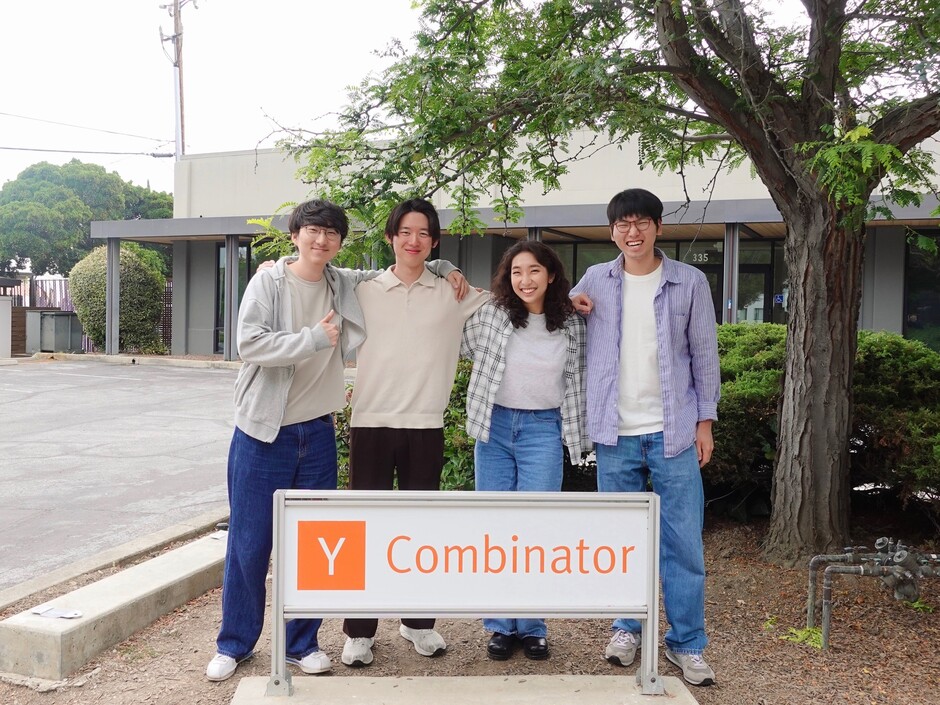
Acceptance into YC's Summer 2024 batch gave the company a recognizable milestone, but Chung's telling is refreshingly untidy after that. The team pivoted. Then it pivoted again. Weavel eventually became Typa. He spent the following year shipping, interviewing users, and using the product on the company itself. In mid-2025 he began posting consistently about the work. He says the momentum changed after that.
- Electrical and computer engineering at Seoul National University, with venture and AI research groups.
- Leave from university, the founding of Weavel, and a NeurIPS workshop paper.
- Ape launched as open source, Weavel entered YC S24, and the research expanded into an EMNLP paper.
- Continued pivots, extensive dogfooding, the move toward Typa, and a new habit of building in public.
- Typa presented as one system for voice, knowledge, drafting, collaboration, analytics, and approval.
The pivots matter because the company did not abandon its technical muscle. It redirected it. Prompt evaluation became part of a larger operating problem: founders and small teams were cobbling together notes, general-purpose chatbots, design software, calendars, and engagement spreadsheets. The expensive part was not producing a sentence. It was maintaining context across the whole relay race.
The phone call as interface
Chung is unusually frank for the CEO of a writing product: he gets writer's block. His workaround is to call Puff, Typa's AI ghostwriter. He talks through a recent challenge, a detail from a demo, or an event he attended. Structure is optional. The agent turns the conversation into a draft that can be edited and approved.
The phone matters less as a novelty than as a clue. It meets a founder during a walk, between meetings, or in any moment when speaking is possible and opening another dashboard is not. Typa also works through iMessage, Slack, and the web. Each route tries to catch an idea near the moment it occurs.
The Typa loop
The company's website puts a conspicuous boundary around the last step: nothing posts without the user. That is partly a product safeguard and partly an editorial philosophy. A useful assistant can suggest an angle and carry context. It cannot own the consequences of a person's public voice.
The difficult part of AI content is rarely the first draft alone. Memory, feedback, collaboration, timing, distribution, and approval are separate jobs. Typa's bet is that their value appears when they become one continuous loop.
Dogfood with a side of spreadsheets
Chung's preferred product method is aggressive curiosity. He uses early-stage tools, saves interaction patterns, and moves between products that solve a particular interface problem well while he codes a counterpart in Typa. His public shorthand is practical: explore widely, save patterns, prototype end to end, ship, observe, refine.
This is less glamorous than the mythology of solitary inspiration. It is closer to a chef eating widely and then returning to the kitchen with a notebook. Chung argues that product engineers should understand the front end, back end, service tradeoffs, and user journey. Taste, in this view, is accumulated attention.
The company also serves as its own test account. In one week, Chung said a four-person team spent about 30 minutes on a content effort that produced more than 500,000 impressions, 2,000 followers, and 500 saves. In a later launch post, he said he personally saved more than 10 hours per week and that the whole team was creating content without adding a writer.
Those are company-reported experiments, not universal promises. Their real interest is diagnostic. Typa's team is measuring a workflow it uses every day, then turning the friction into product decisions. The founder becomes customer, operator, and test case, occasionally all before lunch.
“Your voice, your ideas, your stories.”Andrew Chung, describing what remains human
The international founder's unfair advantage
Chung has also made his move from Korea to the United States part of the thesis. An international founder arrives without the inherited network that makes a new market feel familiar. Relocation, rebuilding, and operating across language and culture create difficulty, but also a narrative that explains persistence more vividly than a line on a resume.
For Chung, telling that story is not a decorative marketing exercise. It is a route to trust. The founder who is busy building, selling, and hiring may have no spare 10 hours for weekly composition. Typa is designed to let the experience travel while the founder keeps working.
There is an elegant tension here. Chung is building automation for one of the least automatable parts of a company: why anyone should care about the people behind it. His answer is to automate the surrounding labor while protecting the peculiar details. The machine remembers. The person decides what matters.
A system for unfinished thoughts
Chung's career is still early, and Typa is still an active, small company. The useful shape of the story is therefore not a victory lap. It is a set of linked experiments. Academic work asked how to adapt a model efficiently. Weavel asked how to improve prompts systematically. Typa asks how to move a real idea through research, drafting, collaboration, and distribution without bleaching out its owner.
The next test is whether the product can preserve that promise as more voices, teams, clients, and channels pile into the system. A living knowledge base must know what changed. A learned voice must resist easy cliché. An agent must help without becoming overeager. Approval must remain meaningful rather than ceremonial.
For now, Chung's sharpest insight fits on a sticky note: people often do not lack stories. They lack a tolerable route from experience to expression. He found his route in a phone call, a research habit, and several pivots whose seams remain visible. The blank page may keep its elegant reputation. It no longer gets the first word.