Retail once rewarded the person who could secure the right patch of shelf. The shelf now moves while everyone is asleep. A product can lose search rank, run low on inventory, burn advertising money or drift out of compliance before the Monday meeting has found its first coffee. Commerce has become a system of signals, and the executive question is no longer merely what happened. It is what should happen next, who should act and how quickly the rest of the company can learn.
Harshal Nimawat works close to that question. As Chief of Staff to the CEO at CommerceIQ, he sits inside a company built around the idea that ecommerce teams need sales, retail media and digital-shelf data in one operating view. It is a role at the seam of seams: strategy beside execution, software beside consumer goods, a chief executive's priorities beside the hundred small decisions that determine whether priorities survive contact with Tuesday.
His route to Mountain View has the compact geometry of an operator's education. There was IIT Bombay, then Mastercard, then an MBA at the Wharton School. At Wharton he joined finance, fintech and private-equity circles, served as a Student Life Fellow and became a Leadership Venture Fellow. The last role involved an eight-day sailing expedition in the British Virgin Islands aboard a 45-foot boat. His current job puts him beside a founder steering a retail AI company. Sometimes a metaphor has the decency to arrive pre-assembled.
systems, payments, capital, operations
completed
sailing vessel
An education in connected systems
IIT Bombay is a fitting first coordinate for a career that would keep returning to complicated systems. The institution appears in Nimawat's undergraduate record, while the exact degree is less important here than the habit its name suggests: look for dependencies, constraints and feedback loops. Modern commerce is full of them. A price change affects demand. Demand affects inventory. Inventory changes the wisdom of an ad bid. A search algorithm notices the result and quietly rearranges the store.
Mastercard added another scale of complexity. Nimawat worked there before business school and, in 2018, volunteered in the company's STEM program, helping school students through mini-projects and encouraging their curiosity about technical careers. The detail is modest, which is precisely why it is useful. Careers do not only accumulate titles. They accumulate occasions to translate. Explaining a system to a student and explaining a trade-off to an executive are not the same task, but both punish fog.
Payments also offer a particular view of technology. The best infrastructure disappears into the action it enables. A card tap lasts a moment; behind it is a network of institutions, rules, risk controls and software. Retail AI has a similar ambition. The user wants an answer, a recommendation or an action. The machinery beneath it must reconcile data that arrives from different places, at different speeds, with different incentives.
The reality-check instinct
When Nimawat applied to business school, he wrote publicly about the adviser who helped him. His praise was revealing in its emphasis. He valued method, clarity, honesty and the ability to puncture a fantasy before it reached an admissions committee. “There were times when he gave me the much-needed reality check,” Nimawat wrote. This was not a boast about perfect instincts. It was appreciation for correction.
“There were times when he gave me the much-needed reality check.”Harshal Nimawat, on the adviser who helped shape his Wharton application
That appetite matters in an operator's work. A strategy can be elegant and still fail because a customer behaves differently, a team lacks time or a data stream tells an inconvenient story. Reality checks are the small mercies of execution. They turn an idea from something admired in a document into something that can withstand a calendar.
Wharton gave Nimawat more rooms in which to practice that adjustment. His activities crossed investing, finance and fintech, alongside the more human machinery of student life. He described a passion for investing on his professional profile. Investing and operating look at a company from different elevations: one asks where value may compound; the other asks what must be fixed before lunch. A chief of staff is often required to hold both views without becoming dizzy.
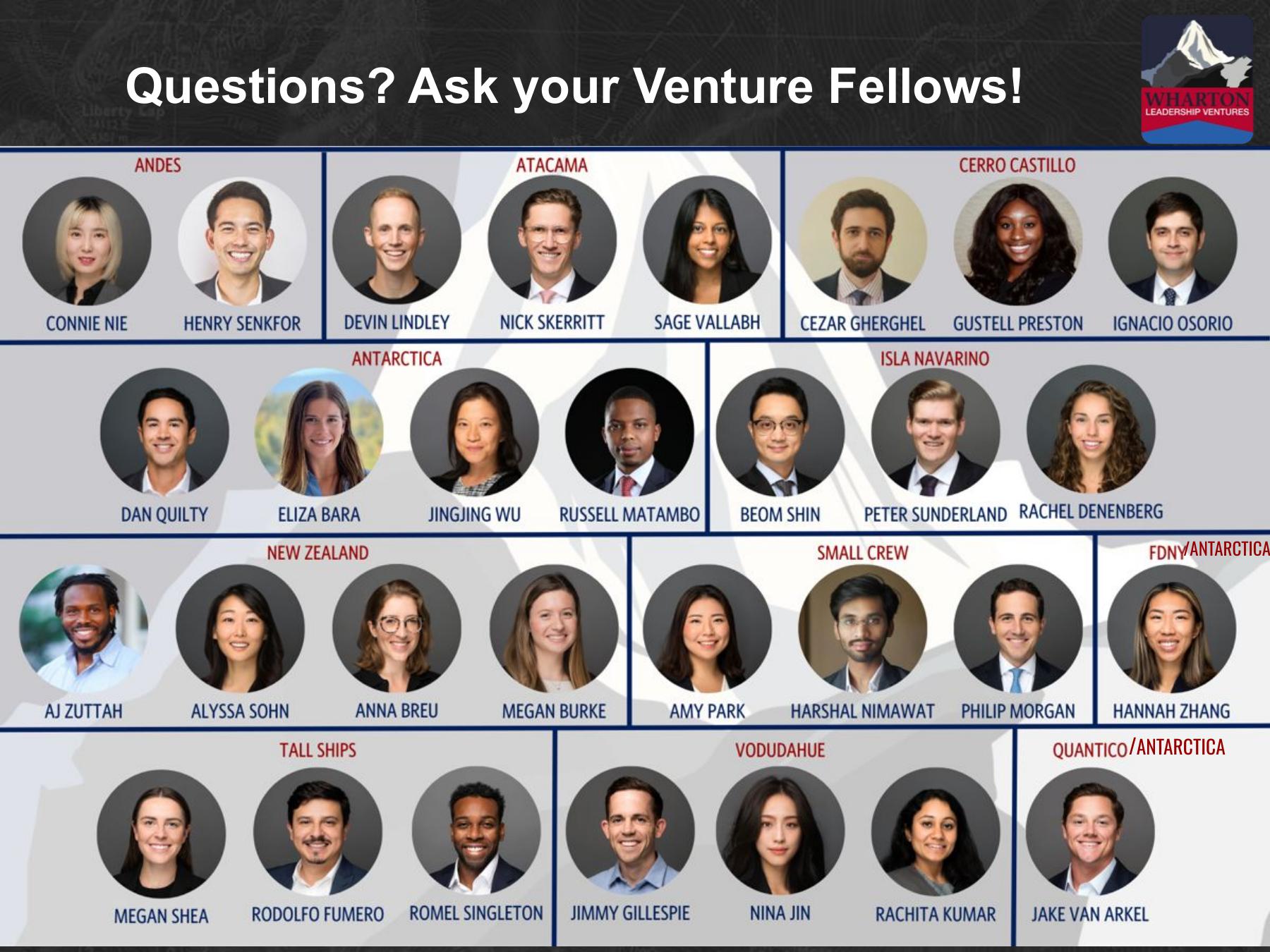
A boat with no spare conference room
The small-crew venture made leadership physical. The program described tactical sailing, racing, navigation, steering and close-quarter communal living. The boat was not a nautical off-site with better catering. It was a moving system in which communication, timing and the condition of the crew all affected the route. Twenty participants were expected to learn and operate in an environment where the wind retained final edit.
Nimawat was one of the Venture Fellows leading that expedition. The role did not make him captain of every decision, nor does teamwork require a single heroic figure. Small-crew sailing works because people understand their responsibilities and continue updating one another. The helmsman cannot negotiate with the wind. The crew can only read it, adjust and keep the boat useful.
A company is not a sailboat, despite the enthusiasm of leadership literature. Employees may object if asked to sleep beside the quarterly plan. Yet the trip offers one precise lesson for executive operations: conditions change faster than formal reporting cycles. Someone must notice. Someone must connect the observation to a decision. Someone must make sure the decision reaches the people whose hands are already occupied.
operating
context
The seat beside the CEO
CommerceIQ describes retail as increasingly algorithmic. Its platform brings together sales, media and digital-shelf information, then uses specialized AI agents to recommend or automate work across ecommerce teams. It tracks the practical objects of retail life: products, bids, content, stock, price and share of voice. The technology may be sophisticated, but its promise is domestic. Fewer spreadsheets. Earlier warnings. Less money spent advertising an item that cannot be bought.
The chief-of-staff role is well placed to see the organizational version of the same problem. Companies also have scattered signals. Product sees one failure. Sales hears another. Finance notices the cost. A customer describes the consequence in language nobody used internally. The CEO receives all of it, often after each account has been compressed into a slide.
Nimawat's background gives him several dictionaries for that room. IIT offers the language of systems. Mastercard supplies the language of infrastructure and scale. Wharton brings finance, investing and the negotiated work of a community. The sailing venture adds a more saltwater vocabulary: course, crew, weather, correction. The useful accomplishment is not possessing the words. It is helping people discover they are discussing the same obstacle.
This is where breadth earns its keep. A wide resume can be decorative, a collection of handsome stamps in a professional passport. In the CEO's office, range becomes valuable only when it reduces the company's tax on complexity. Can a question reach the right owner faster? Can a trade-off be stated cleanly? Can a decision preserve enough context that the next team does not have to rediscover the entire argument?
Chiefs of staff occupy an odd place in corporate storytelling. They are close enough to strategy to see its first draft and close enough to operations to watch the grammar break. Their contribution is rarely a single product bearing their name. It appears in sequence: the important conversation happens before the deadline, the disputed metric gets a definition, the decision returns with an owner attached. When the work succeeds, the organization feels less accidental.
At an AI company, that sequencing has an extra wrinkle. Software can compress the time between observation and recommendation, but speed makes context more valuable, not less. An alert without context becomes noise. An automated action without a shared goal becomes an efficient mistake. CommerceIQ's own product language emphasizes unifying signals before applying action. The organizational equivalent is a room that agrees on the problem before admiring the solution.
Nimawat's place beside the CEO therefore connects neatly with the company's product thesis. Both concern orchestration. One joins retail signals so teams can act across sales, media and shelf. The other helps executive attention move across a company without dissolving into a tour of disconnected emergencies. Neither job is glamorous at every hour. Coordination has never photographed as well as invention. It is still how invention reaches a customer.
Learning to steer
Nimawat is still in the early public chapters of his operating career. That makes the shape of the path more interesting than a premature legend. He has moved through institutions that see decisions from markedly different angles, then chosen a role where angle-changing is part of the daily work.
There is something pleasingly unfashionable in that. The loudest conversation around AI concerns what the machine can do alone. CommerceIQ's field is full of automated alerts, recommendations and actions, but the commercial outcome still crosses teams. It still asks someone to decide what matters. It still rewards a person who can keep technology, capital and operating reality in the same sentence.
The sailboat returns one final time. Steering is not the power to command the sea. It is the discipline of reading what changed, choosing a response and making the adjustment with other people. Nimawat's journey from payments to business school to retail AI has kept him near systems that behave exactly this way. The water grows more algorithmic. The work remains human enough to require a crew.