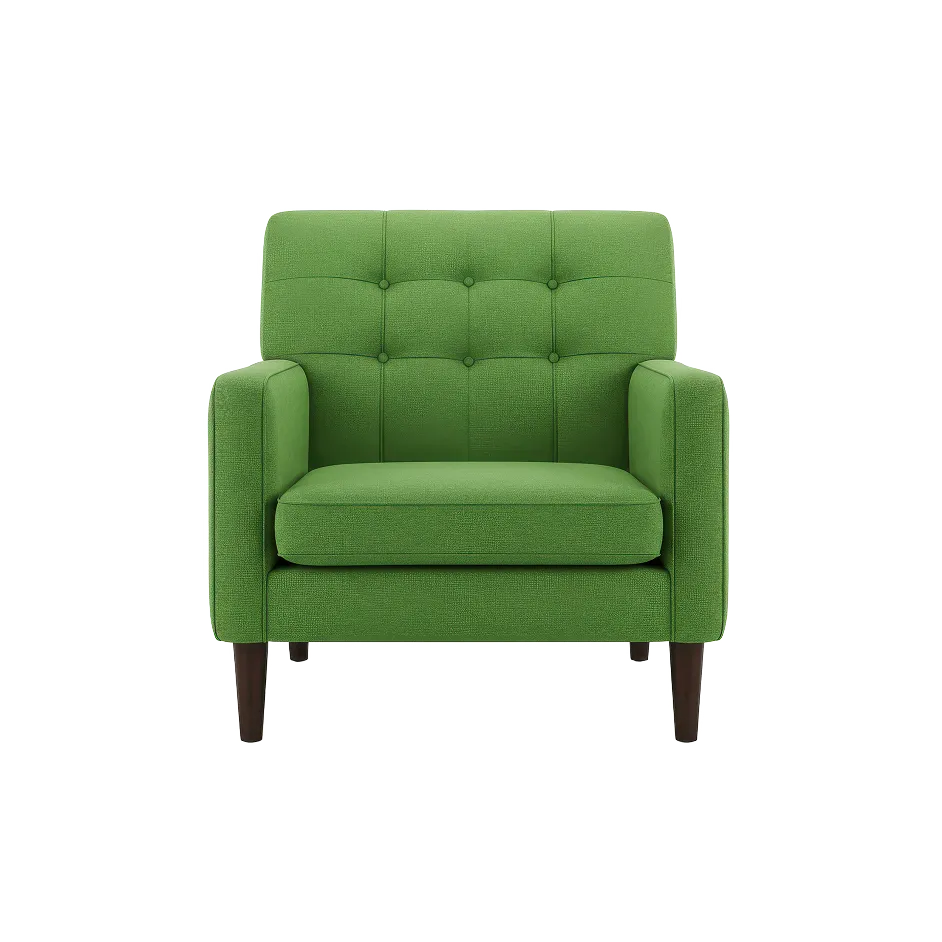
The trouble with selling a sofa online is that the buyer cannot sit in it. The trouble with selling ten thousand sofas online is that someone must still photograph every color, angle and room setting. A customer wants to know whether the green is olive or lime, whether the arms look bulky beside a small table, whether the fabric has a texture at all. The catalog manager wants to launch on Tuesday. The photography studio would like a few more weeks.
Nfinite entered this argument with a digital model. Build a faithful 3D version of the object once, and the same object can be rendered against a white background, placed in a living room, spun through 360 degrees or used in augmented reality. The studio no longer has to receive the sofa each time someone wants a new photograph. The company’s early Google Cloud case study described those visuals as ten times cheaper than traditional photography for its customers then. That figure is a historical claim, not a current price list, but the underlying appeal remains easy to understand: a reusable model makes each additional view cheaper.
- Nfinite audits product pages for missing and noncompliant visuals.
- It makes replacement imagery with AI, CGI and reusable 3D assets.
- Retailers, brands and suppliers use it across large catalogs.
- The new question is which image improves the page, rather than how many images a team can make.
01 / The hingeFrom making images to finding gaps
For years, product imagery was treated as an output: commission a shoot, approve files, upload them and count them. Nfinite’s present pitch begins later, after the page is live. Does the retailer require a hero image with a particular background? Is the scale obvious? Is the product shown in use? Did the vendor supply five near-identical angles while omitting the one view that explains an important feature? A product page can contain images and still fail its job.
The company calls its current system a Visual Intelligence Platform. It connects catalog data from spreadsheets, product information systems and asset libraries; checks live pages against retailer and brand requirements; ranks the gaps; generates suitable images; and monitors whether the page stays compliant. This is a more demanding claim than “we can render a nice kitchen.” It turns image production into a recurring inspection and repair cycle.
That order matters. A generator can make infinite pictures of a drill. An audit can tell a team that the drill’s chuck, battery or dimensions are the unanswered questions. In an enterprise catalog, making every possible image is a lavish way to avoid choosing. Nfinite’s argument is that the choice itself can be software.
02 / The customerOne model, many shop windows
Lowe’s offers a useful example of the original proposition. In Nfinite’s case study, the home improvement retailer used CGI to expand sparse product pages into richer trays of packshots, lifestyle scenes, 360-degree views and videos. A straightforward 2D supplier image becomes the starting point for a 3D model, which can then appear in a bathroom, on a patio or against a plain background. The method addresses the awkward economics of large assortments: each new physical setup is labor, logistics and time; each new digital view can reuse a model.
Nfinite names retailers and brands including Lowe’s, Amazon, Walmart Canada, Staples, BUT and Conforama. Its own site says it has more than 100 customers and has processed over 10 million SKUs. Those are company figures, and they describe scale more than outcome. They do show the kind of buyer Nfinite is designed for: an organization with enough listings that manual checks and one-off shoots become a system problem.
The business is enterprise software with visual production services. Customers buy access to a platform and a workflow built for their catalogs and requirements; Nfinite does not publish a simple per-image price. Its rivals include photography studios, internal CGI departments, standalone AI image tools and digital shelf analytics software. Nfinite’s distinction is the coupling: score the page, decide what matters, produce the fix and check the result in one system.
“We simply can’t audit content manually at scale anymore.”
03 / The experimentFifteen thousand images, one useful comparison
The company’s account of a Castorama program is unusually specific. A pilot began in summer 2025 by identifying missing visuals against the French retailer’s standards and generating the assets with AI. Nfinite says the work expanded across Kingfisher in September. Between February and March 2026, it produced 15,000 images for 5,000 priority products. Castorama then compared April year-over-year revenue growth for those products with growth in their product categories. The enhanced products were 2.2 percentage points ahead, according to Nfinite.
That comparison is a promising signal, not a clean experiment proving that an image caused each sale. The products were chosen as priorities, and category benchmarks cannot eliminate every difference between them. Still, it gives the work a harder test than a before-and-after gallery. The operational lesson is also portable: inspect live pages, pick specific missing information, create a limited set of assets and measure those products against a relevant baseline.
Where would that method struggle? A small catalog with excellent existing photography has little to audit. A product whose appeal depends on an unpredictable physical quality - the feel of a fabric, the exact color of a natural stone - still demands careful source data and human review. AI can generate a plausible room faster than it can guarantee that a finish is faithful. For Nfinite, visual accuracy is both the selling point and the hardest constraint.
04 / The second lifeWhat else a digital twin can teach
Alexandre de Vigan, Nfinite’s founder and CEO, has described the founding vision as digitizing the world in 3D. Retail was a sensible first market because online shoppers have to judge physical things from flat screens. Nfinite’s early work even included consumer room design, with AI helping decorators place furniture in a virtual home. The enterprise platform launched in 2021; a $100 million Series B led by Insight Partners followed in 2022, with US Venture Partners participating. Nfinite said the round took total funding to about $130 million.

The 3D library has acquired a second possible use. In January 2026, Nfinite announced a collaboration with Getty Images to transform selected 2D imagery into structured 3D scenes for physical AI training. A product image for a shopper needs to look convincing. Training data for a machine needs more: geometry, material, lighting and spatial relationships. The same basic skill - turning a flat picture into a modeled world - now serves two markets with very different standards of success.
For the retail customer, the attraction remains humbler. A missing scale shot can leave a buyer guessing. A missing view can send a question to customer service or a sale to another tab. Nfinite’s cleverest move may be to make those absences visible to the people who manage millions of images. The picture that matters most, it turns out, is often the one no one has noticed is missing.