A customer calls the power company. Somewhere in the conversation, a problem with a bill becomes a conversation about a problem with life. The representative can listen. The representative can express sympathy. But once the call ends, what can the representative actually do?
That was the practical gap described in Hallmark Business Connections’ case study of Evergy, formerly KCP&L. Its service representatives wanted to follow through when customers mentioned illness, difficulty or something worth celebrating. Their tools largely stopped at the telephone. Hallmark offered another tool: a card.
- Personalized paper cards, backed by ordering and mailing tools.
- Built for customer care, retention and employee recognition.
- The proposition: make a thoughtful follow-up easy enough to happen.
The call ends. The relationship does not.
In that implementation, representatives chose from 50 cards for 17 occasions, including Spanish-language options. They could use a prepared sentiment or write their own, then click send. Hallmark handled printing and mailing. Crucially, representatives had discretion over when to use it. A moment noticed during a conversation could become something tangible afterward.
The published results make the experiment interesting: 89% of card recipients gave the utility the highest approval rating, and 94% of employees said the program gave them a feeling of personal accomplishment. These are vendor-published case-study results, not a guarantee for the next utility. But they point to two audiences for the same envelope: the person receiving it and the employee finally able to do something.
The company behind this arrangement is the business-to-business operation of Hallmark. It sells greeting cards to organizations that want customers to stay, employees to feel appreciated and messages to survive the trip from sender to recipient. Its client page lists brands including State Farm, Aetna, Cigna, PetSmart and Walgreens. Hallmark says it serves thousands of clients, including more than half of the Fortune 100.
The machinery of a small gesture
A birthday card looks simple. Sending the right birthday card across a business with many employees, locations and customer records introduces a remarkable number of chores. Someone needs the address. Someone needs approved wording. Someone must order, print, stamp and mail it. Each chore offers a place for good intentions to stop.
Hallmark packages that work in three ways. Break Through is its direct-mail offering for marketing campaigns. Connect provides a branded portal for an organization’s card program, with permissions, reporting and optional customer-relationship-management integrations. Care gives frontline service teams a quick way to send a card after an individual interaction.
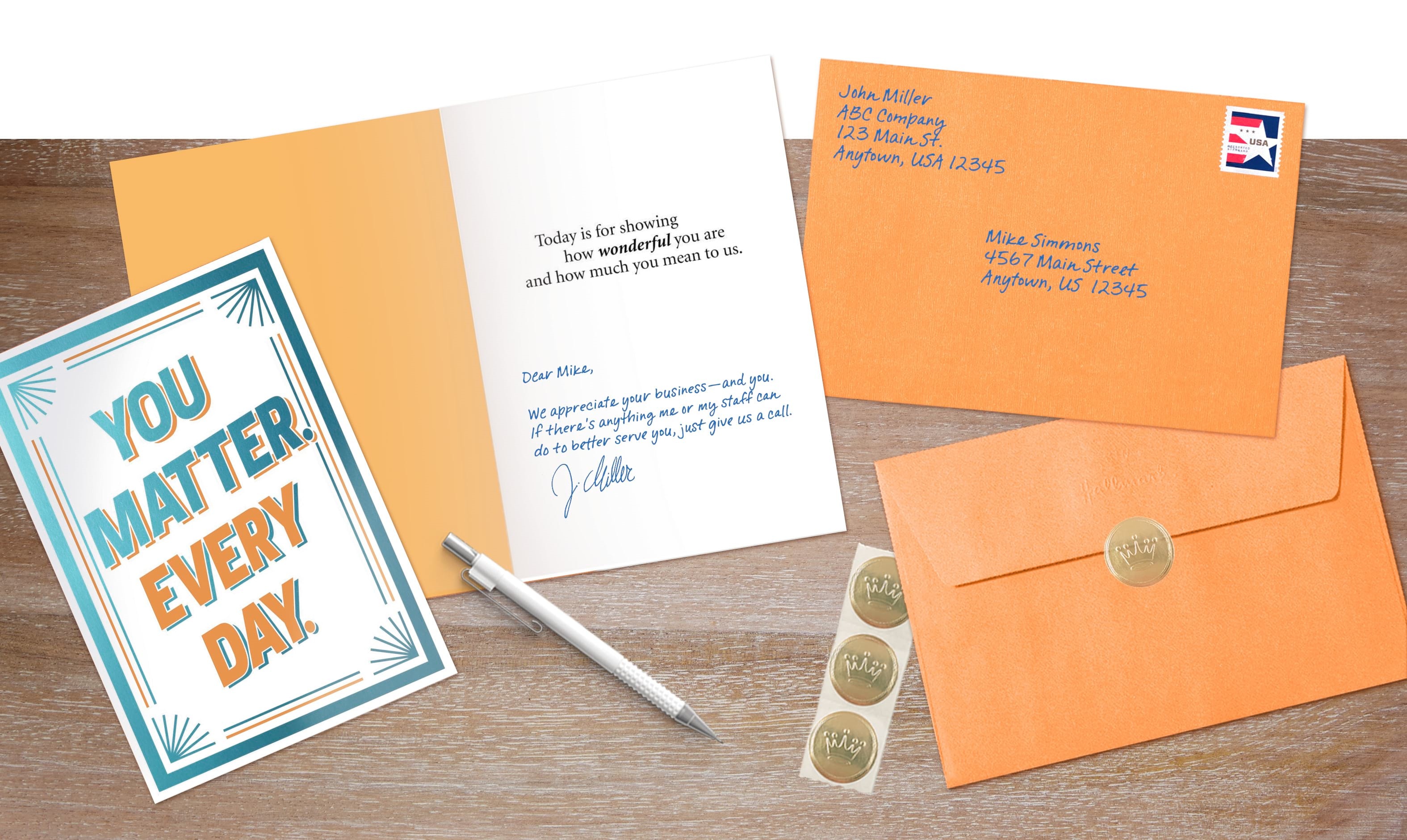
Connect can even digitize a person’s handwriting for repeated mailings. That detail neatly captures the business: something associated with individual effort becomes reproducible. The message still needs a reason to exist. Software can reproduce a signature; choosing an appropriate moment remains a human responsibility.
Here, Hallmark occupies a particular corner of the market. A printer can produce paper. An email platform can trigger a message. Hallmark combines a familiar consumer brand, professional writers and artists, business personalization and fulfillment. The recognizable envelope is part of the product, alongside the less photogenic permissions screen. For a distributed sales team, that combination offers a practical compromise: local employees can respond to individual relationships while the company keeps some control over what gets sent under its name.
“It’s amazing what a card can do.”Patrick McCullough, president
The same operating philosophy appears in its description of work inside the company: collaboration, recognition and room for growth. Those are the employer’s stated priorities. More concretely, the service it sells gives an employee a small decision to make and removes much of the administrative work that follows.
What goes in the envelope - and the budget
The entry point can be an ordinary online order. At the time of research, the Festive Cake Slice Birthday Card listed at $2.25 each for 25 cards, $1.99 at 100 and $0.99 at 1,000. Those are card prices. Postage, addressing and envelope upgrades require their own arithmetic.
At the campaign end, Break Through advertises full-service touchpoints from $0.55 for mailings above 7,500, subject to a quote. That headline rate belongs to a different service configuration; it should not be treated as an all-in substitute for a small online order. Connect advertises unlimited users without user charges, while the wider program still needs commercial scoping.
The business model joins physical goods to the work of sending them. Buyers pay for cards and relevant services, while corporate programs add planning and coordination. For a customer-care manager, the purchase decision is also about staff time: how many steps stand between hearing something important and acknowledging it?
Nor does paper have to fight email. One published retail example used a custom thank-you card containing a limited-time offer, followed by two emails reinforcing the same offer. The useful idea is continuity. The envelope attracts attention; subsequent messages make acting on it easier.
A narrower business, a useful experiment
In June 2019, Hallmark Business Connections sold its incentives operation to InComm. The greeting-card business remained with Hallmark. That documented change explains today’s emphasis better than treating the company as a general employee-rewards platform. Its center of gravity is a physical message, supported by digital ordering.
For a business borrowing the approach, start with one moment employees already recognize: a new customer, a work anniversary or a difficult service conversation. Give a small team suitable cards and permission to choose. Compare outcomes with a similar group receiving ordinary follow-up, counting postage and staff time alongside response and retention.
The conditions matter. An outdated address wastes the gesture. A deadline tomorrow calls for a faster channel. A sympathetic card cannot repair an unresolved billing error. Hallmark’s most transferable idea is operational: make the appropriate follow-through easy. The envelope earns its place when there is something worth saying inside.