There is a peculiar instant in every bank merger when the grand strategy arrives in somebody's kitchen. It comes in an envelope. The logo is unfamiliar. The letter mentions a new routing number, a branch that will close, a weekend when the app may go dark. Somewhere, a customer begins to wonder whether moving banks would be easier than reading page two.
This is where MKP communications inc. lives. The New York agency does not arrange the merger. It arranges the explanation - the thousands of small, timed encounters through which a merger becomes real. A legal notice here, a welcome package there, an email for the people overseas, a message inside online banking for everyone about to need a new password.
The firm was formed in October 1994 by Hillary Kelbick and Susan Michaelson, two former senior vice presidents at Wilcox Associates. Their first major assignments were not gentle introductions to agency life: First Union with First Fidelity, then Bank of Boston with BayBank. By 1997, First Union had named MKP its single Vendor of the Year. The niche came first. Three decades of elaboration followed.
The real productA map of human confusion
An ordinary advertising brief asks what a company wants people to feel. A conversion brief starts with what will happen to each person, on which date, in which channel, under which rule. MKP's public work reads less like an ad reel than a set of air-traffic-control logs.
For the Huntington-TCF integration, nearly a year of work involved hundreds of communications to 1.5 million customers across four lines of business. MKP created an overall plan organized by audience, timing, channel and message, then added a digital touchpoint calendar. A small visual device - overlapping hexagons borrowed from Huntington's identity - marked each related communication. The language changed as the integration advanced. The customer did not need to memorize the plan; the plan needed to remember the customer.
The conversion message machine
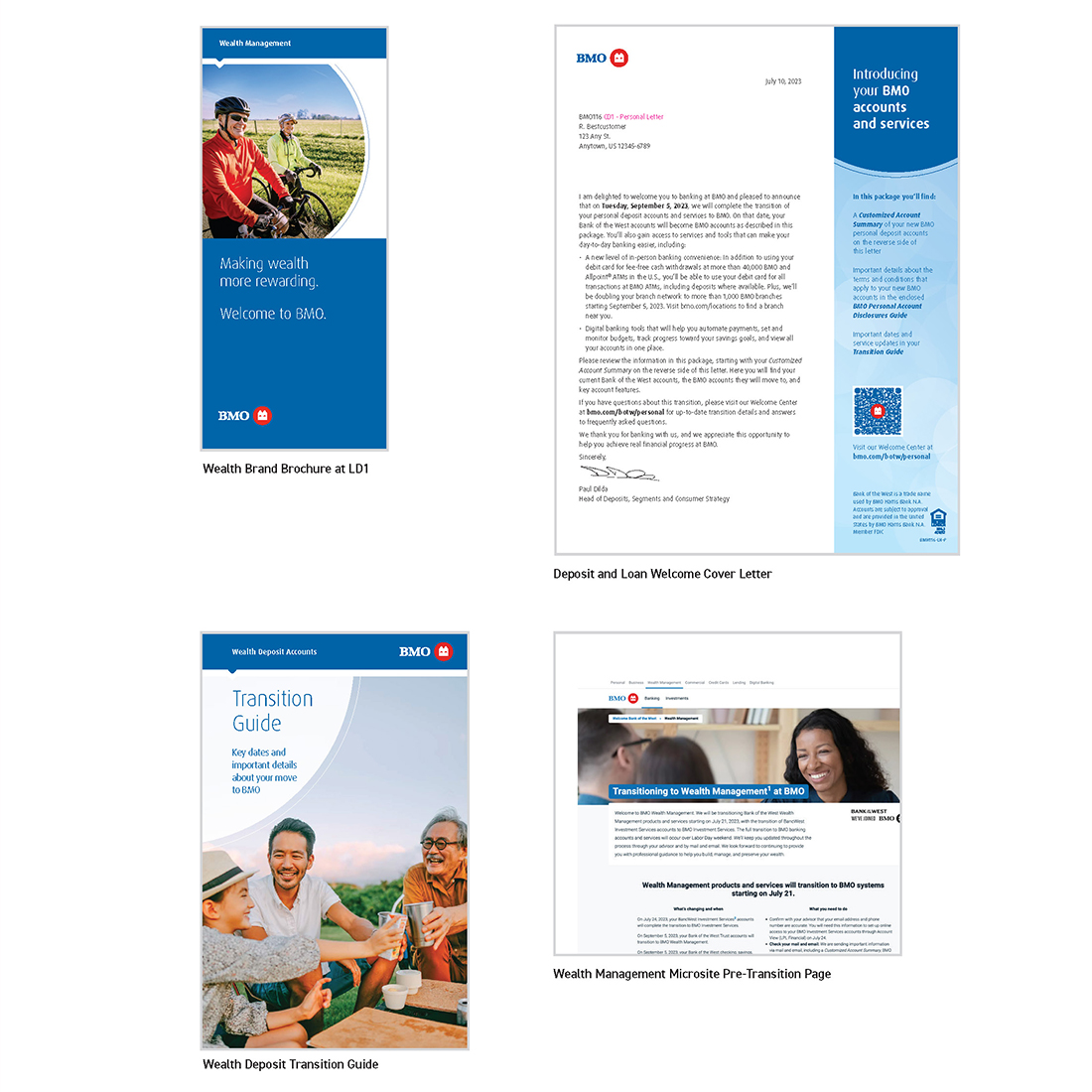
That method becomes more revealing when the audience is nearly one million digital-banking users, as it was during the BMO-Bank of the West conversion. Some customers had special circumstances and high-impact changes. Two-thirds did not. MKP separated the latter group and used a streamlined self-mailer for reminders, dates and temporary outages. Segmentation was not decoration. It reduced the weight and cost of communication for people who needed less, while preserving tailored letters for people who needed more.
“One size rarely fits all.”MKP on communications strategy
What changed the planThe regulator moved the date
Plans become valuable when facts refuse to cooperate. In the WSFS-Bryn Mawr Trust merger, 34 branches were due to close. Customers needed 90 days' notice, but regulatory approval was still pending. MKP wrote the first communication around anticipated dates and said plainly that the integration and closures depended on approval.
Then approval was delayed. The legal close, systems conversion and branch closures all moved. A second letter confirmed the revised dates, followed later by personalized product-change information and disclosures. What failed first was not the message but the calendar. The useful move was to treat uncertainty as information rather than bury it under confidence. Matter-of-fact language gave the program room to change without making the first letter look evasive.
Not merely merger mailThe agency hiding inside the specialist
MKP's narrow market contains a broad production system. The company sells communications strategy, legal and change communications, data-driven marketing, direct mail, digital content, sales promotion, media and advertising. It develops creative, manages print and mailhouse work, builds microsites, creates training materials and checks variable data. Its customers range from community institutions to names including Fifth Third, BMO, Huntington, First Citizens, Webster and Burke & Herbert.
The advantage is not that MKP can make an ad. Many agencies can. It is that the same team can consider the legal disclosure, the customer-data file, the envelope, the email journey and the bank employee who will answer the resulting phone call. The business model is specialist professional services, sold through customized projects and ongoing agency relationships. The scarce commodity is accumulated judgment: knowing which tiny operational detail will become a large customer problem.
Its data work points in the same direction. For a First Citizens home-finance campaign, customer information trained models that ranked propensity for mortgages, home-equity products and improvement loans. Four base letters became 36 versions; audience clusters also influenced the photography. Personalization here meant more than printing a name. It meant deciding which offer deserved the paper.
A small, telling metricFifty-five seconds with a bank brochure
When BMO legally acquired Bank of the West, many international customers already preferred email. MKP adapted the legal-close letter for them and turned a printed brand insert into an interactive brochure. According to the agency's case study, each personal-banking customer viewed it twice on average and spent 55 seconds reading it.
Fifty-five seconds is not a cinematic triumph. It is more useful than that. It suggests that customers will pay attention to complicated financial information when the format respects how they already receive it. The shift from print insert to interactive brochure was not digitization for its own sake. The audience's location and habits changed the channel.
A merger is announced once. A customer experiences it dozens of times.
The transferable partWhat another team can copy
- Map impact before writing copy. Start with what changes for each audience, not the announcement the organization wants to make.
- Say what is staying the same. Reassurance is concrete: existing checks still work, the branch is open, the deadline is unchanged.
- Give uncertainty a sentence. Conditional dates are safer than false certainty when regulators or systems control the calendar.
- Spend complexity where it matters. Reserve elaborate versions for customers with distinct impacts; give everyone else the simplest complete explanation.
- Make channels reinforce one another. The envelope, inbox, website, app and branch staff should feel like parts of one conversation.
This approach depends on clean customer data, early access to operational decisions and cooperation among marketing, compliance, technology and frontline teams. Without those conditions, elegant segmentation becomes precisely targeted confusion. Nor is the machinery proportionate for every assignment. A minor product promotion does not need an 18-month command center.
But in high-stakes change, MKP occupies a useful middle ground. Management consultants can design the integration. Large agencies can introduce the brand. Internal teams know the institution. MKP's position is between them, where an operational fact must become a sentence and that sentence must reach the right household before conversion weekend.
Bank mergers will continue to be described in assets, deposits and efficiencies. Customers will continue to judge them by smaller units: the clarity of a date, the working of a password, the distance to a branch. MKP's long bet is that the fine print is not peripheral to the deal. For the person opening the envelope, it is the deal.