Guy Edri went to Hollywood to meet the studios. The next day, he visited Walts, an independent online retailer. Then he was off to New York. In his account of the trip, the pleasure came from the variety: a television operating system could put him in a room with people from entirely different businesses, all with something to bring to the same screen.
“I love my job !!!!!” he wrote. Five exclamation marks. Corporate communications departments have survived on fewer for an entire financial year. Edri followed the enthusiasm with a business principle: VIDAA worked with these partners without competing against them. His job, as he described it, was to help their businesses work on his platform.
That combination - exuberance in public, restraint in the business model - offers a useful way into Edri’s career. He is a co-founder of VIDAA and its chief executive, based in Tel Aviv, building a business whose product sits inside other companies’ televisions. The work is partly software, partly distribution and partly the repeated act of persuading people that an invitation really is an invitation.
The invitation inside the television
VIDAA’s origins require two clocks. The television operating system dates to 2014. The separate business was spun out of Hisense in 2019. Edri’s own executive history runs through that transition: he served as president of VIDAA USA from January 2018 until April 2023, then became CEO in May 2023. A product, a corporate entity and an executive career rarely keep identical time.
By the time American consumers began encountering more VIDAA televisions on retail shelves in 2023, the company had already spent years working elsewhere. Europe, Asia and Latin America gave it room to develop. Edri explained the sequence in 2024 from his home in Tel Aviv: the United States was crowded, so the company had concentrated on other markets first.
The proposition was practical. A television manufacturer could use a developed operating system rather than assemble an entire streaming environment itself. Content services could gain distribution. Viewers could get their programmes through an interface built into the set. Hisense provided the early hardware foundation; other manufacturers could join it. Each participant had a different reason to say yes.
The neutrality promise matters because a platform’s partners can also become its competitors. In 2024, VIDAA’s stated strategy was to avoid making its own television sets or programming its own linear content streams. This left space for manufacturers and content businesses to participate without immediately helping a direct rival build the same product.
There was still a commercial engine. Licensing and advertising on the home screen were part of the business. Openness did not remove the need to earn money. It made the boundaries around earning it part of Edri’s pitch. For a company asking to live inside somebody else’s hardware, those boundaries were a product feature in their own right.
A promise gets a shareholder
Vestel supplied a concrete test. In September 2024, the Turkish manufacturer announced a 4.64 percent stake in VIDAA. The partnership connected a company that made televisions with a company that wanted its operating system distributed through more of them. Edri presented the deal as a continuation of the promise made when VIDAA was established: partners would be welcome.
The arrangement moved into an operational phase in July 2025. Vestel brought manufacturing reach and a portfolio that included its own and licensed brands. VIDAA brought the software platform and relationships with content, advertising and technology partners. The appeal was reciprocal. One side gained distribution for software; the other gained a platform for the devices it sold.
It is tempting to describe platform building entirely in terms of scale. This deal is more revealing when seen as a relationship. A manufacturer was prepared to become a shareholder in a platform associated with another manufacturer, Hisense. Edri’s promise of openness had to function across those overlapping commercial interests. The handshake carried rather more weight than a launch slogan.
His regional work followed the same pattern. In August 2025, he met Hisense ASEAN leaders with Stella Soh, the business development director for Asia and the Middle East. Their agenda included local market priorities and expanding availability in Southeast Asia. A global operating system still needs people who understand what belongs on television in each place.
The remote control has a constituency
Consider the difference between adding another service and making a television easier to use. In September 2025, VIDAA, Hisense and Deutsche Telekom’s MagentaTV announced an integrated Operator TV. The arrangement brought live television, streaming services and connectivity into the set, removing the need for an external box. The practical ambition was fewer obstacles between the viewer and the programme.
That is an unglamorous ambition with a large constituency. Anyone who has negotiated a television, an input menu and a separate box before finding the evening’s programme can appreciate the appeal. Edri’s part in the announcement was to emphasise access without complexity. Here, the evidence for his philosophy was a product arrangement rather than another prediction about the future.
There was a more personal example in his recollection of working with Freely. Edri said the agreement had surprised people because VIDAA gave up some monetisation power. His explanation was that the viewer’s experience came first. He also singled out Martin Harvey, formerly of Freely, as someone he had learned from and a friend whose retirement would not end the relationship.
It is Edri’s account of a tradeoff, and it should be read that way. Still, the detail matters. Commercial strategy becomes easier to understand when someone identifies what they were willing to concede. He described a benefit for viewers and a cost to the platform, then attached a person’s name to the memory. Business partnerships, in this telling, have a life beyond the agreement.
Three words, several arguments
In 2026, Edri gave his position a deliberately plain expression: “TV is TV.” At StreamTV Europe in Lisbon, he addressed fragmented distribution, inconsistent measurement and the relationship between advertising prices and audience engagement. The phrase brought these problems back to the thing people actually used. Industry categories can multiply rather faster than the furniture in a living room.
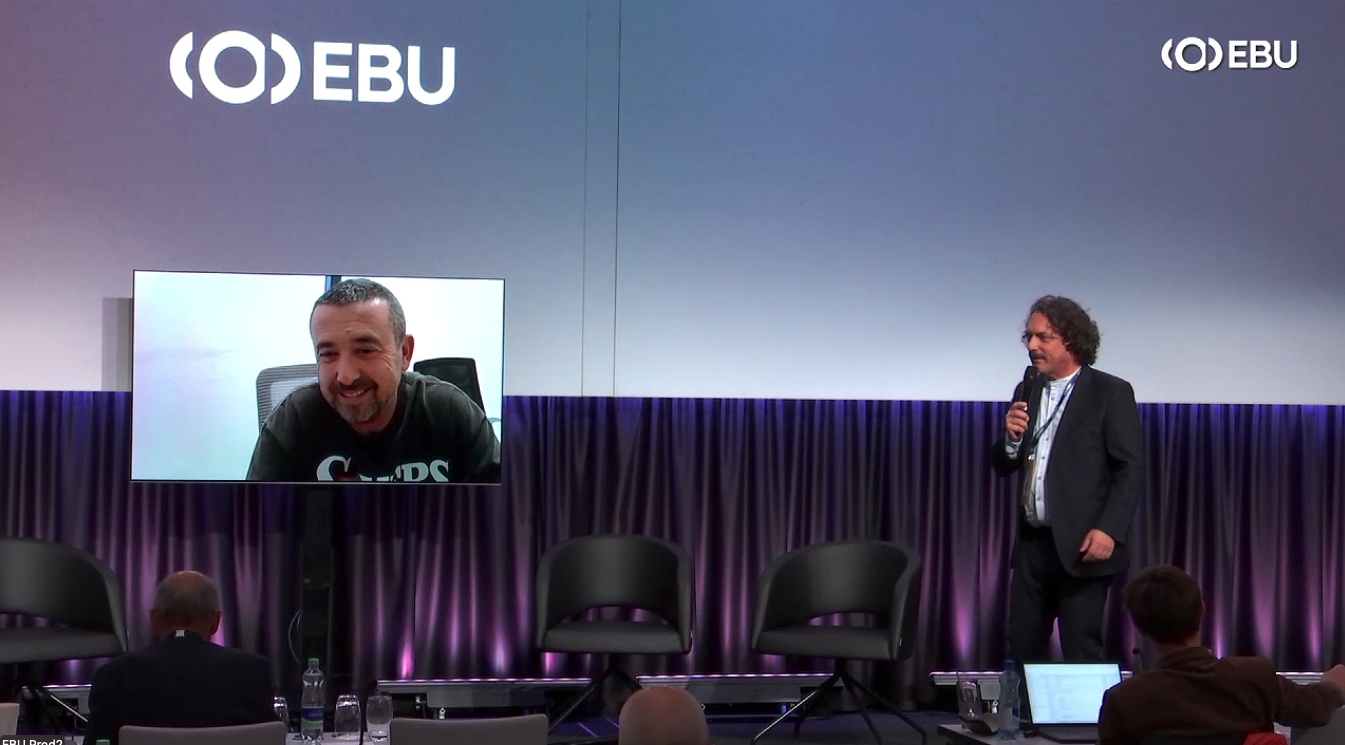
At EBU Horizons in May, the argument had a particular audience: Europe’s public broadcasters. Edri emphasised the continuing value of their news, cultural programming and national events. His invitation was for them to work with the platform so their content remained visible. The operating system could help determine whether familiar programming was easy to find in an increasingly crowded environment.
There is an evident commercial interest here. Better relationships with broadcasters can improve a platform’s offering. There is also a recognisable viewer problem. A programme can be available and still be inconvenient to reach. Edri’s emphasis on discoverability places the operating system between those two truths, with responsibility for making the route shorter.
“If the user experience is not good, nothing else matters.”Guy Edri, June 2026 interview
The public style is direct. His posts praise partners and teams, record meetings and move quickly to the next destination. They give the impression of someone who enjoys the social work of a platform business. That is an impression drawn from what he chooses to publish, rather than a claim to know his private character. The enthusiasm, at least, is there in black and white.
Counting what the household watches
The next piece of his argument concerns measurement. In February 2026, V Index was described as a forthcoming tool for combining information about linear television and streaming use. The initial focus was Europe, the Middle East and Africa. Once again, Edri’s geographic sequence began beyond the United States, where established measurement companies already had strong positions.
The proposed view was broader than a single channel or application. It could bring together when a television was used and how viewing moved between services. That does not mean every programme inside every app becomes visible to the operating system. The distinction matters: opening a service and identifying the exact content watched within it are different kinds of knowledge.
A shared viewing environment.
Discovery · viewing context · measurement
Conceptual illustration of Edri’s stated approach; no audience data plotted.By September, Edri was preparing to take the discussion to London. He announced DisrupTV for November 11 and invited the industry to reconsider measurement, advertising, discovery and the operating system. In his account, VIDAA then reached more than 50 million households across more than 500 brands. Those were his company’s stated figures, with households as the unit he wanted people to notice.
The event remained ahead of him at the time of this profile. An announced summit is an invitation to judge an argument; it cannot establish whether the argument will be adopted. For Edri, the coming test is whether a platform can turn its own understanding of television into a language that broadcasters, agencies and advertisers are prepared to share.
A bigger job for the same screen
The company now calls itself V, while VIDAA continues as the operating system brand. Its leadership page lists Edri as CEO and chief product officer. His professional responsibilities also extend beyond that business: in April 2026, he became an independent director of Max Stock. The titles describe an operator whose work includes both running a platform and serving on another company’s board.
His ambition for the screen extends beyond choosing the next programme. Music, commerce and other household uses figure in his plans. These are aspirations with products and partnerships still to prove, rather than reasons to declare the living room transformed. A television earns its place in a home through what it helps people do, one ordinary evening after another.
That brings Edri back to the visits, dinners and conversations behind the interface. His business depends on people with competing priorities agreeing that there is room for them on the same screen. The software may be hidden inside the television. The work of keeping that invitation credible is anything but invisible.