The most important software in your living room is the software you barely notice. It wakes when you press one button, remembers the Wi-Fi password, opens the football, and politely gets out of the way. VIDAA built its position on that vanishing act. The Linux-based smart-TV system first appeared on Hisense sets in 2014; a separate company backed by Hisense and other investors followed in 2019. By July 2026, the business said its software reached more than 50 million connected devices and more than 400 brand partners.
Then the quiet company changed its name to a single loud letter. VIDAA became V, while VIDAA OS began evolving into HomeOS. The television menu was no longer being pitched merely as a tidy shelf for Netflix, YouTube and local broadcasters. It was now an “intelligent gateway” for entertainment, gaming, shopping, payments, AI assistance and home control.
That sounds like the customary tech-industry urge to put a platform inside everything. Here, however, there is a credible wedge: the television is already installed, already shared and already commands attention measured in hours. V does not need to persuade the family to buy a new gadget. It needs to make the old rectangle useful between episodes.
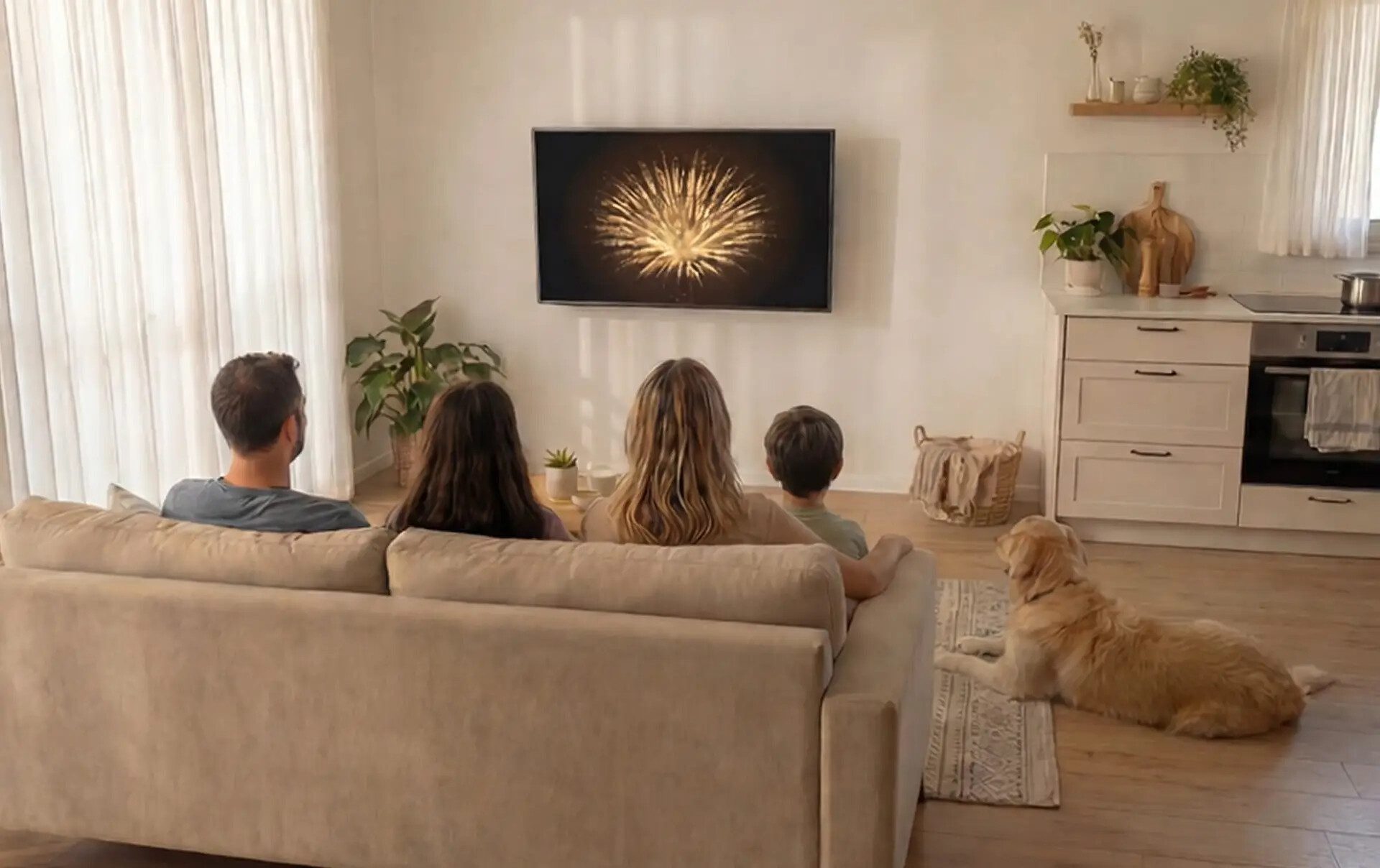
The remote control is the distribution strategy
VIDAA's customers are not just viewers. Television manufacturers use it to ship a complete smart product without building an operating system or surrendering the experience to Google, Roku or Amazon. Content services use it to reach households. Retailers get training, demo modes and, in V's current pitch, a shared per-device revenue model. Advertisers buy home-screen and streaming placements. The person on the sofa receives the finished bundle with the television.
This is why the B2B2C label matters. A consumer may never choose VIDAA from a download menu. The choice is made upstream - by Hisense, Toshiba, Loewe, JVC or another hardware brand - long before the box reaches a store. Every set sold becomes a durable distribution point. Software updates, app promotions and free channels can extend the commercial relationship years beyond the one-time hardware purchase.
The television-platform flywheel
The product has been engineered for the awkward reality behind glossy screens. V says content partners may need to support four hardware platforms and two browser environments. HomeOS accepts HTML5, native and hybrid apps; the company supplies test hardware and partner engineers. That flexibility is less photogenic than an AI assistant, but it is the core competence. A premium television and an entry-level set cannot be assumed to have the same chip, memory or life span.
Longevity has become part of the sales pitch. Eligible Hisense models running VIDAA are promised as many as eight years of updates, an unusually legible answer to the common fear that a smart television will outlive its app support. The promise has limits: HomeOS eligibility still depends on the processor and system architecture, so not every older VIDAA set will receive the new environment. That is sensible engineering and awkward marketing. It also exposes the category's central bargain. A television platform must keep improving without making yesterday's hardware unusable. V cannot simply behave like a phone maker and assume the household replaces the screen every few years.
“The best products fade into the background.”VIDAA's stated product philosophy
The first crack was the app shelf
A television operating system can be quick, elegant and secure, yet still fail the Friday-night test because one desired app is missing. That was VIDAA's first visible weakness. Its global relaunch in 2020 listed Netflix, Prime Video, YouTube, DAZN, Rakuten TV and others, but Disney+ was not announced for supported Hisense and Toshiba sets until late 2021. Even today, app and feature availability depends on model year, hardware and country.
The response was not to become a loose Android clone. VIDAA kept the lightweight system and attacked the catalogue market by market. The app store now advertises more than 1,000 options. CANAL+ expanded across Central Europe, Southeast Asia and French-speaking territories. Max, Crunchyroll, VEVO, NBA League Pass and scores of regional broadcasters followed. The free VIDAA TV Channels service packages live and on-demand programming, while VIDAA Kids uses Kidoodle.TV to create a family-safe corner with profiles, time limits and parental controls.
This local depth is the meaningful difference from competitors, not a magical interface flourish. Google TV offers an enormous developer ecosystem. Samsung and LG control premium television fleets. Roku and Fire TV bring familiar streaming brands. VIDAA's argument is that an OEM can get speed on varied hardware, regional services and more control over the customer relationship. It works best where manufacturers want independence and where local programming matters as much as the global five apps.
Reported connected-device reach
The $60 million clue
The cleanest explanation of the business model came from an investor, not a product demo. In 2022, ad-tech company Tremor International - now Nexxen - committed $25 million to VIDAA. In August 2025 it added $35 million, bringing the total to $60 million for roughly 6 percent of outstanding shares. That percentage implies a valuation around $1 billion, though neither company announced it as a formal valuation.
The money came with commercial plumbing. Nexxen secured exclusive access to VIDAA automatic content recognition data in specified markets and, under the expanded agreement, exclusive rights to monetize VIDAA's connected-TV and native display media in North America through at least 2029. ACR can recognize what an opted-in television is displaying, supporting audience planning, targeting and measurement across screens.
This answers the “what did it cost?” question as far as public numbers allow: $60 million in strategic outside capital from one ad-tech partner, plus years of integration work whose internal cost is undisclosed. It also shows what changed the center of gravity. VIDAA had spent years building distribution; Nexxen's follow-on marked the turn from installing the pipes to selling what flows through them.

OEMs need software. Streamers need distribution. Retailers want recurring value. Advertisers want measurable attention. VIDAA sits where those needs overlap - and where viewers can reject the entire arrangement if the experience gets noisy.
HomeOS raises the stakes - and the risk
At CES 2026, the rename supplied a new vocabulary. V is the company and platform brand; HomeOS is the evolution of VIDAA OS. Existing accounts, subscriptions and apps were meant to continue. HomeOS introduced a broader roadmap: Vivi for AI assistance, Vpay for payments, Vshops for commerce, cloud gaming, connected devices and ambient experiences.
The first major proof arrived in July, when Xbox Cloud Gaming began rolling out to compatible 4K televisions and projectors from the 2024, 2025 and 2026 ranges. A controller, internet connection and Game Pass subscription can replace the console. A month later, V and Teads announced a global HomeScreen advertising agreement through 2028, including an exclusive 10-day Black Friday and Cyber Monday takeover spanning roughly 30 markets.
Those two deals neatly frame the opportunity and the danger. Xbox makes the television more useful without adding hardware. A home-screen takeover monetizes the same privileged surface. The business wins only while the second does not poison the first. Televisions are not phones. They sit in shared rooms, last longer and are bought with an expectation of calm. V's stated ambition to stay out of the way is therefore more than a design preference; it is a constraint on revenue.

The copyable playbook - with conditions
There is a useful strategy here for founders who do not own a household brand. Start at the neglected layer. Optimize for the weakest hardware you must support, not the best machine on your desk. Let established partners carry distribution. Make localization a product discipline rather than a translation task. Then add recurring services only after the installed base is real.
What another company can copy
- Win a channel partner before spending heavily on consumer acquisition.
- Turn hardware fragmentation into expertise customers would rather rent than rebuild.
- Pair global anchors with local services that larger platforms overlook.
- Use the installed base to layer recurring revenue onto a one-time sale.
The conditions are unforgiving. This playbook does not work without patient capital, reliable over-the-air updates, leverage with major content owners and hardware partners willing to share control. It weakens when consumers prize a giant app ecosystem or sideloading over speed. It fails outright if advertising makes the television feel hijacked, if older sets cannot receive promised improvements, or if ACR measurement runs ahead of clear consent and regional privacy rules.
VIDAA's original trick was making complicated television software feel simple. V's new job is harder: add more businesses without making the product feel busier. If HomeOS can connect the house while behaving like the old remote - obvious, dependable and mostly ignored - the single-letter rebrand will make sense. If it cannot, viewers know exactly how to turn a smart television back into a dumb screen: plug in somebody else's box.
Explore and watch