When Dick Lippin returned to Penn State in 2013 to receive an alumni award, he had a particular landmark to show his family. It was the site of his student job: counting people entering the library with a hand-clicker. A publicist returning in triumph could have chosen a more flattering stop on the tour. Lippin went back to the counting.
The visit came after roughly thirty years away from campus. He was receiving the Service to Society Award, recognition for a career and a record of giving back. Yet the small job had retained its place in his memory. He even joked that it might furnish material for a future award. The entertainment business produces elaborate origin stories. His came with a click.
There is something appealing about that choice of souvenir. A person entering a library is a very modest unit of attention. Decades later, the founder of The Lippin Group would be working with companies whose business depends on attracting it. The distance between the two jobs is considerable. The connection makes a useful place to begin.
A psychology graduate goes to Wall Street
Lippin graduated from Penn State in 1968, having studied psychology. His early professional life took him to Wall Street; his later one took him to Los Angeles. He began his public relations career at Harshe-Rotman & Druck in New York. Finance, behavior and communication all appear in the story before the company bearing his name.
That combination matters. Entertainment publicity is easy to picture as a procession of premieres, announcements and famous faces. Investor relations asks a different question: what does this information mean for a business? Lippin's background gave him a route into entertainment through that question. It also helps explain why his firm's work encompasses corporate strategy as well as the public life of a television show.
He founded The Lippin Group in 1986. The business developed across television, music, film, licensing, merchandising and new media. Its geography expanded to Los Angeles, New York and London. Those are distinct working worlds, with different clocks and different audiences, even when everyone is discussing the same piece of entertainment. A campaign that travels needs more than a change of address.
Penn State
is founded
as commencement speaker
The forty-year interval between the firm's founding and 2026 contains several versions of the entertainment industry. Lippin has remained in the communications business while the means of distributing entertainment have changed around him. Longevity is easy to celebrate with an anniversary. The less ceremonial question is how a business keeps making itself useful.
Twenty-five years at the same party
In January 2012, Lippin was already discussing a quarter-century of communications work for NATPE, the television industry market. That is an unusually useful detail in his story because a trade gathering has to justify itself repeatedly. Buyers change. Sellers change. The reasons to travel, meet and make a deal change with them.
At the time, he welcomed new buyers arriving from digital businesses and believed the market had recovered. Here was a veteran of the gathering looking toward the people coming in. The library clicker has a distant professional cousin: knowing who has just entered the room, and understanding why their arrival matters.
His connection with industry institutions extends beyond a single market. He has served with the Paley Center for Media, the Hollywood Radio and Television Society and Penn State's Rock Ethics Institute. He recorded a NAMM oral history interview in January 2016. These associations put his working life at the intersection of entertainment businesses and the organizations through which their people meet.
An institutional relationship carries a different rhythm from a launch. There are repeat encounters, shared memories and a reasonable chance that people will remember whether the last conversation was helpful. Such settings offer a fairly stern test of a communications adviser. A fresh introduction can be arranged. A reputation has to survive the next meeting.
Five hours with Merv Griffin
One of Lippin's recollections gives those professional relationships a more intimate scale. While working with Merv Griffin on matters involving Jeopardy!, he was invited onto Griffin's private plane for a trip from Los Angeles to Orlando. The flight provided more than five hours to talk. Lippin asked what Griffin remembered most about his career, then spent much of the journey listening.
He remembered the talk show host's humility and his positive accounts of the people he had known. He also noticed Griffin's care with confidences. The conversation offered a view of entertainment history without turning private relationships into gossip. For a publicist, that is a detail worth remembering: an absorbing storyteller can still know what to leave out.
Lippin wrote about the encounter in 2007. The famous name supplies the sparkle, but discretion supplies the point. It is an anecdote about listening to somebody who had spent much of his own career listening to other people.
The people who stay
One way to understand Lippin's business is to look at the careers that accumulated inside it. When Don Ciaramella retired in 2023, he had spent thirty-five years at the firm. He had joined in 1988, only two years after its founding, and led its New York office while working on corporate entertainment and media communications.
Lippin's farewell dwelt on Ciaramella's professionalism, honesty and standing with clients, colleagues and journalists. The emphasis is revealing. Public relations is conducted among groups whose interests do not always agree. A colleague who can retain the respect of all three has done something more demanding than produce a pleasing announcement.
Later that year, Lippin created an Office of the Chairman with three managing directors: Matt Biscuiti, Kevin Broderick and Katie Fuchs. Each had already spent more than a decade at the agency. Their remit included daily operations and growth strategies, while they retained their client responsibilities. Lippin would have more time for strategic matters and the TLG Connect consulting practice.
The arrangement gives the founder's story a useful complication. A company named after one person still needs other people to exercise judgment. By promoting colleagues with long histories inside the firm, he placed operational responsibility with executives who already knew the work and its relationships. Succession in everyday decisions can be more consequential than the photograph on an anniversary announcement.
“Deliver on what you promise.”
Dick Lippin, on choosing and serving clients
His own description of client selection is plain: stay within the firm's expertise, keep commitments and consider how a prospective client will treat the staff. It is a practical list, with room for the employee's day as well as the client's ambition. An agency's next account becomes somebody else's Monday morning.
A music award with a family history
At the 2026 NAMM Show, Lippin received the Believe in Music Award. In his response, he pointed to a thirty-year relationship with NAMM and dedicated the honor to his late wife, Ronnie. She had brought the organization into the agency's client roster. The acknowledgment put her work at the center of an occasion celebrating his.
That distinction deserves to remain visible. A firm's history can become compressed into its founder's biography, particularly when the founder's surname is above the door. Here, Lippin described the relationship as something Ronnie had begun and the company had continued. A client anniversary became a way to remember whose judgment had started it.
The award also connects with his appearance in NAMM's oral history collection ten years earlier. One encounter preserves a professional account; the other recognizes a continuing relationship. Together they give the music side of his career a longer shape than an awards-night caption can hold. There is work before the handshake, and work afterward.
What happens before anyone has a client?
Lippin's interest in ethics has an institutional life of its own. He and Ronnie established the Richard B. Lippin Lecture in Ethics at Penn State. His reason was personal: he felt that the honesty and integrity he remembered from growing up were too often absent from business. Rather than leave that as a complaint, they helped create a place to examine it.
The lecture has welcomed figures including Bryan Stevenson, Salman Rushdie and Melanie Killen. Its subjects span business, technology, science and questions of justice. The breadth is part of the point. Ethical decisions do not arrive neatly marked as a separate department's responsibility. They turn up inside the work people already do.
The 2026 program listed Ted Chiang on generative AI and art. For someone whose professional life sits among entertainment, media and technology, that topic lands close to home. It brings a question about creative work into the same university setting where Lippin has supported a continuing conversation about responsibility.
His support also reaches a much younger audience. Since 2013, the Lippin Family Fund has backed Penn State's Child Study Center in designing and evaluating programs for children aged three to seven. The work addresses social and emotional skills alongside moral and ethical behavior. The age range is the striking part: well before a first job, much less a first executive title.
In 2017, Penn State named him an Alumni Fellow, a lifelong distinction that also carries an invitation to share professional knowledge with students and faculty. Recognition and participation are joined in that arrangement. The graduate comes back with experience; the university asks him to put it into conversation.
Back on campus, looking forward
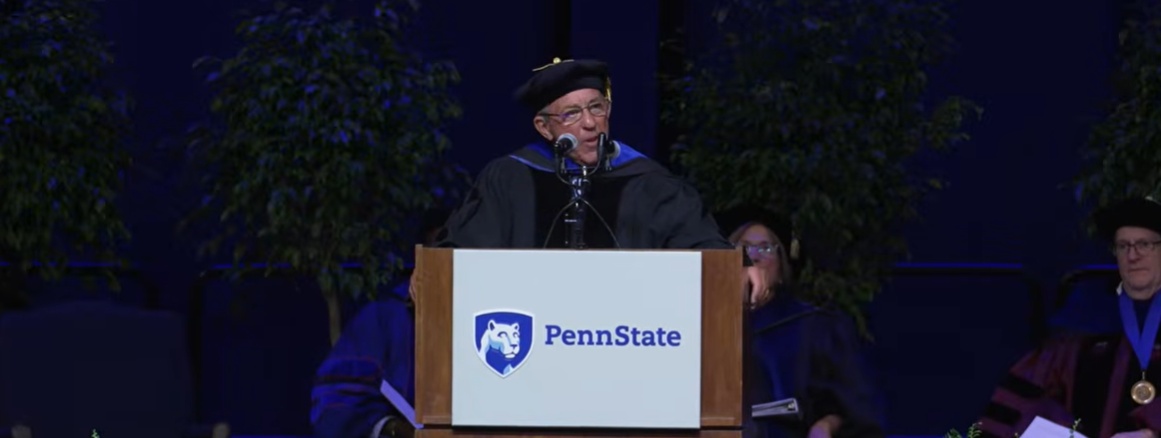
In May 2026, Lippin returned as commencement speaker for Penn State's College of the Liberal Arts. His company shared the address, describing his reflections on student life, building the firm and the lasting effects of ordinary moments. The graduate of 1968 now had a class of graduates listening to him.
The timing gave the appearance an extra resonance. Earlier that year, he had written an essay asking whether Hollywood was dying. He acknowledged how far the industry had moved from the one in which he built his career, while retaining reasons for optimism. An anniversary year can invite comfortable recollection. His public question was considerably less comfortable.
His company's present consulting offer gives a practical counterpart to that concern. TLG Connect arranges introductions, advises businesses and creates occasions for people to meet in person. The emphasis fits a career spent among companies, markets and industry organizations: understanding an industry includes understanding how its people encounter one another.
There is a temptation to make the library clicker predict all of this. It did no such thing. A student counted visitors; years later, an alumnus remembered the job with affection. The more interesting continuity is his willingness to keep that ordinary task in the story, even after he had acquired rather grander things to discuss.
By 2026, Lippin could look back on forty years of his own firm, long working relationships and a sustained commitment to ethics education. He was also asking what happens next to Hollywood. The question leaves him where a communications adviser can still be useful: paying attention to the people arriving, and thinking carefully about what they came for.