Halli sold his company, and then the projects began multiplying. A restaurant with a cinema. A building full of artists. Songs that had been waiting since he was a teenager. Somewhere in the middle of all this, the distinction between a career and a collection of enthusiasms became rather difficult to maintain.
Haraldur “Halli” Thorleifsson had founded Ueno in Reykjavík in 2014. Twitter bought it in 2021. In a familiar version of this story, the sale would be the climax, followed by a photograph somewhere sunny. Halli kept finding things to make. By 2025, he had also decided to reopen the agency.
The interesting part is what happened between those two versions of Ueno. His work acquired doors, communal tables, recording equipment and an audience that sometimes needed a ticket. Follow those projects and a particular designer comes into focus: someone who wants to know how an idea feels once other people are allowed inside.
A kitchen table with international ambitions
His education offered several possible careers. At the University of Iceland he completed degrees in philosophy and finance, then pursued economics without finishing the dissertation. He supported himself through design. By his own account, the decisive introduction came in a finance course, when an information technology assignment required him to make a simple web page.
There was something pleasingly immediate about putting a thing into the world. He learned through experiments with motion and code. Working in Iceland also made him a generalist: branding, sales, strategy, copy and production could arrive on the same desk. The job titles came later.
In 2007, he moved to New York to work with Cuban Council. Freelance work and time in San Francisco followed. When he established Ueno, the starting point was his Reykjavík apartment. He describes a kitchen-table business with about a thousand dollars in the bank. Its work eventually reached clients including Google, Apple and Airbnb, with offices in Reykjavík, San Francisco, New York and Los Angeles.
Growth also meant learning how people work together. The freelancer’s habits could only carry a company so far. Hiring and shared values became part of the design problem. A business needed ways to behave when its founder was busy doing something else.
“Culture is something that’s lived and experienced every day.”
Halli, on building Ueno
The client on the other side of the desk
Twitter’s acquisition gave Halli a chance to change his relationship to the work. An agency makes something, hands it over and trusts someone else to keep it alive. He wanted to stay with a product inside a large company, through the decisions that follow the presentation.
“I needed a new challenge,” he wrote later. He created and led an innovation team at Twitter. His account of that period includes work on new products, branding and the organization itself. Ueno’s sale had moved him from serving a client to living with the consequences alongside one.
His departure in 2023 became public through an exchange with Elon Musk over whether he still had a job. Musk apologized and offered him a return. Halli ultimately chose to leave. The episode brought attention, but it makes a poor boundary for a life already extending into several other kinds of work.
- 2014Ueno begins in Reykjavík
- 2021Twitter acquires the agency
- 2023Halli leaves Twitter
- 2025Ueno opens again
One hundred entrances, then another city
Ramp Up gave him a problem with an unusually legible answer. An entrance could have a step, or a ramp. The change could be seen, used and counted. He began with a target of one hundred ramps in Reykjavík, bringing together his own funding, the city and other supporters.
That first target was reached in eight months, four months ahead of schedule. The project expanded across Iceland. The early decision to choose a number mattered: a promise to improve a city can float around indefinitely; a promise to build a hundred things eventually requires someone to count.
The work later crossed borders. In January 2026, Ramp Up announced agreements for four hundred ramps in Ukraine: two hundred in downtown Lviv and two hundred in the Kyiv region. A 2025 pilot in Lviv preceded the announcement. Funding came in large part from Jack Dorsey and Iceland’s Ministry for Foreign Affairs.
Announced January 26, 2026. Targets, rather than a completed-build total.
The practical vocabulary suits him. An idea needs partners, money, a place and a route to completion. Here, the result becomes part of the street. People can get on with an ordinary afternoon without first negotiating the building.
A room, a meal, someone to ask
Haus deals with a different kind of separation. Creative people can spend a working day alone, even in a city full of other creative people. In 2022, Halli helped fund and assemble the team behind a nonprofit community in Reykjavík, working with the city to establish its first location above the Reykjavík Art Museum.
Hafnar.haus offered a place to work and reasons to meet. Demand arrived quickly. In his account of the expansion, Halli described closing the waiting list after it approached five hundred people. Hlemmur.haus followed in 2025, adding another location near Hlemmur.
Today his project description puts the community at almost four hundred members across six thousand square metres. Studios sit alongside shared facilities for photography, recording and meetings. There are communal lunches, exhibitions, workshops and performances. The offer includes the useful possibility of knowing whom to ask.
At Haus.fest in June 2026, studios opened to the public for an afternoon of music, workshops, exhibitions and games. Halli spoke about collaboration. It was an argument the building could help demonstrate: people from different disciplines were already there, making things within calling distance.
His mother’s name above the door
Anna Jóna carried another kind of connection. Halli created the restaurant, bar and cinema in memory of his mother, Anna Jóna Jónsdóttir, an artist and costume designer. He had grown up across the street from the building. It was a place they both loved.
He remembers her as funny and inventive, someone who could make something from almost nothing. Giving the place her name put a private attachment into public use. People could eat, talk and watch a film in a space whose reason for existing began long before its first booking.
That chapter also changed. In May 2025, chef Sigurður Laufdal’s Lóla took over the restaurant space, which Halli built and owns. The cinema remained part of the setting. The distinction matters when following his work: the project called Anna Jóna belongs to the story, while the restaurant operating there acquired a new name and direction.
The songs waited thirty years
There is a second tribute in his musical name. Önnu Jónu Son means Anna Jóna’s son. He began writing songs as a teenager but says he was too shy to record them. Roughly thirty years passed before he released his first album, The Radio Won’t Let Me Sleep.
He worked with directors from different countries to make a video for each song. A website brought the visual album together. The designer had found a project that could accommodate sound, film and the web without requiring him to pretend they were separate interests.
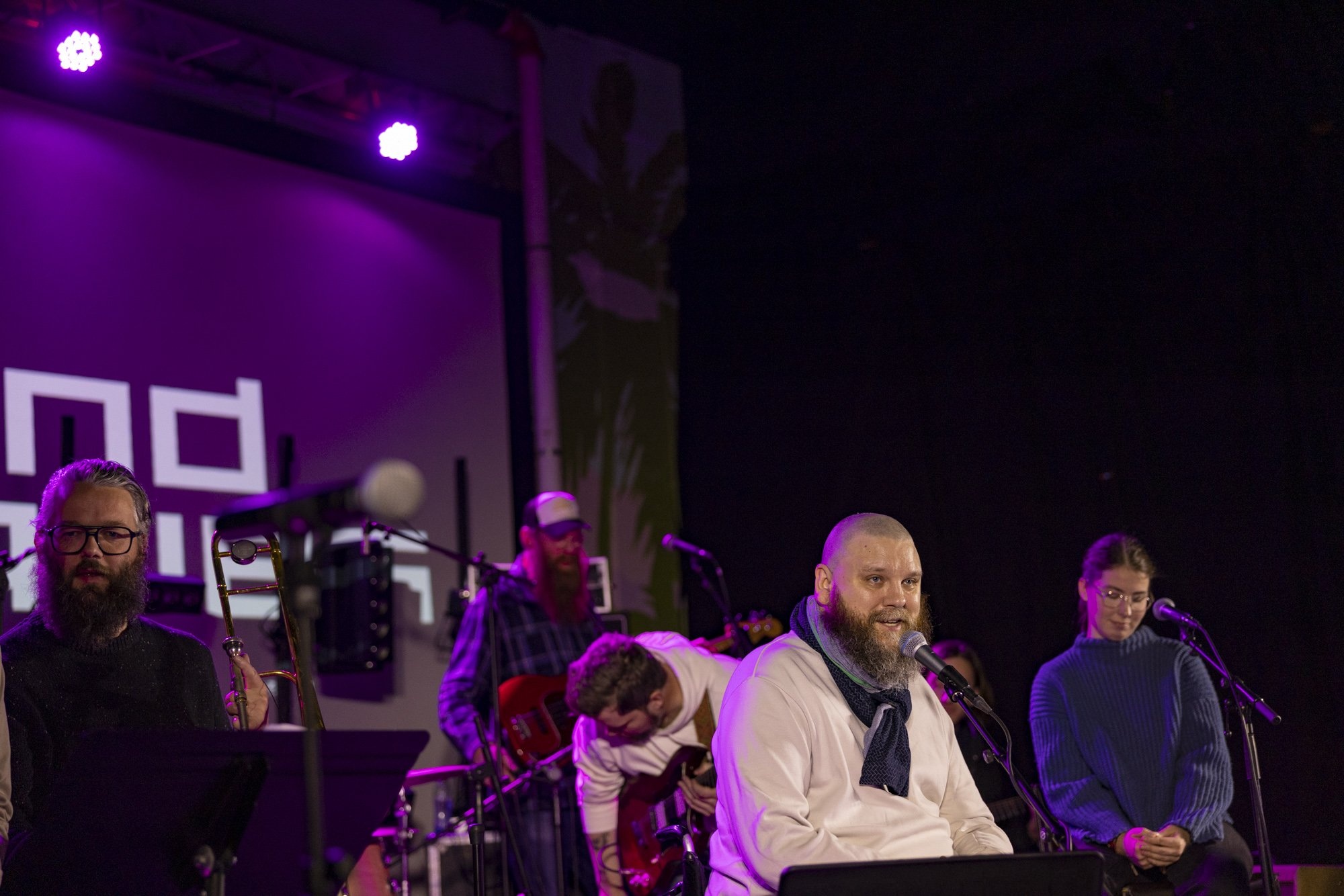
One musical connection began with a Christmas present. At fifteen, he received a CD by Kristján Kristjánsson, known as KK, and learned guitar because he wanted to play the songs. Years later, he and his wife repeatedly listened to Ólöf Arnalds while expecting their first child. He eventually recorded his own song, Öll Þín Tár, with both musicians.
A teenager learning someone else’s chords could hardly have scheduled that outcome. It gives his crowded working life a more personal scale. Some projects grow out of a commission; others begin with a record you cannot stop playing.
Take the conversation outside
His podcast, Let’s Walk, takes conversations out into the city. After making an Icelandic programme, he began interviewing creative people in English as he travelled. Guests include Andy Richter, Matt Dillon, Seth Godin, Valeria Luiselli and Fly By Jing founder Jing Gao.
Halli gives the origin story an appropriately dry flourish. “And, as a white man with a beard, the natural next step was to start a podcast.” The joke prevents the project from arriving dressed as a revelation. He wanted conversations, and found a way to keep having them.
Other ventures let him contribute without always being the central performer. At Indó, he became a lead investor and worked on the bank’s brand and core product. He also co-owns Reykjavík Orkestra, a recording studio at Harpa whose clients include the BBC, Netflix and EA Games. These roles involve other people’s expertise, with room for his own.
Back to the kitchen-table question
In 2025, Ueno returned as a boutique agency working with a small selection of clients. The announcement described the appeal of helping an idea become real. After restaurants, studios, music and conversations, that part of the job still interested him enough to begin again.
By July 2026, he was discussing the return in a CAPTN OffScript interview, alongside the experience of watching people use products. An attractive presentation can only tell a designer so much. Someone trying to do an actual task supplies a different kind of verdict.
The reopened agency fits into the life that preceded it. Halli has spent these years making spaces for work, company and performance, then seeing what people do with them. A kitchen table was enough to start the first Ueno. The second arrives with a good deal more experience of the rooms beyond it.
Keep following the work
Projects, conversations and a few open tabs worth keeping.
- Halli’s website and project archive ↗
- Ueno: the reopened studio ↗
- Inside the Haus community ↗
- The visual album: Önnu Jónu Son ↗
- Let’s Walk: conversations on the move ↗
- The July 2026 CAPTN OffScript interview ↗
- Watch: Halli with Snorri Björns (Icelandic) ↗
- Watch: Eigin konur interview (Icelandic) ↗
- A 2014 conversation about his design beginnings ↗
- The album, track by track ↗