The pianist had a distribution problem. Tony Chen was putting performances on YouTube, but uploading a video did not make an audience appear. As East West Bank later told his story, the aspiring musician began teaching himself algorithms, data optimization and media buying. Getting people into the room became more interesting than the recital. That discovery sits behind Channel Factory, whose business depends on a detail advertisers can easily overlook: the room matters, too.
- The job: choose suitable video environments, then buy and optimize the advertising.
- The buyers: brands and agencies running YouTube, social and connected-TV campaigns.
- The useful idea: measure the value of the placement, not just its price.
01 / A bargain with a hidden bill
Imagine buying a luxury watch advertisement beside a video that undermines everything the watchmaker wants to convey. The viewer might fit the demographic perfectly. The placement might be inexpensive. The association would still be peculiar. Channel Factory sells technology and services for making those decisions before the money is spent, combining content analysis with campaign execution.
Its starting point is a distinction between safety and suitability. Safety establishes a floor: avoid harmful material. Suitability asks whether this particular environment makes sense for this particular advertiser. A video can clear the first test and fail the second. Contextual targeting adds another question: does the subject or mood make the message more relevant?
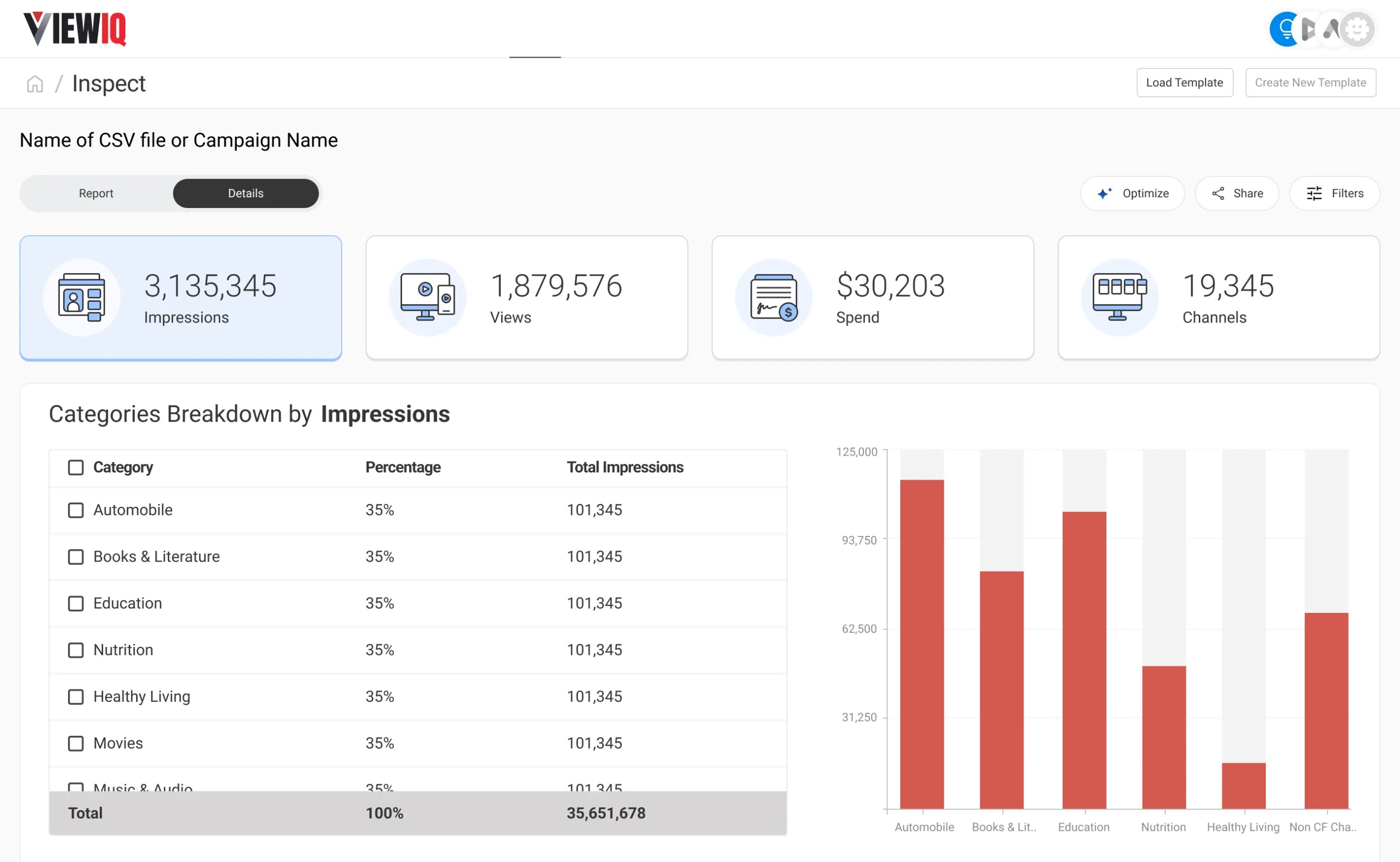
ViewIQ is the content-intelligence component. It classifies videos and helps build inclusion lists of channels and videos an advertiser wants to buy against. ActivateIQ handles buying, testing, optimization and reporting. The combination matters. A classification sitting in a spreadsheet protects nobody until it changes where the campaign actually runs.
The customers are brands and the agencies buying on their behalf. In its Glenfiddich case study, Channel Factory describes working with DDB Mudramax to align placements with the whisky brand’s positioning, reporting 92% average watch time. A Vodafone case study published in October 2026 reports 13% ad-recall uplift on Meta and an 85% YouTube completion rate for Women’s Champions League placements. These are different measures, and neither should quietly become a claim about sales.
Channel Factory’s public summary of PwC verification procedures reports a 23% reduction, generating up to 12% cost savings in the evaluated work. A reported result, not a universal forecast.
02 / The filter that filtered out people
There is a catch in teaching software what to avoid. It can become very good at avoiding the wrong thing. Channel Factory executives have described how early industry keyword blocklists excluded LGBTQ+ material and content from minority creators. A word associated with controversy could trigger exclusion even when the video’s purpose was thoughtful, useful or celebratory.
“We used data for bad,” chief strategy officer Phil Cowdell said in a discussion the company shared. His point concerned the consequences of blunt screening. The attempt to protect advertisers could also deprive suitable creators of advertising money. A safety mechanism had become a distribution problem for someone else.
“We used data for bad.”
Phil Cowdell, on early keyword blocking
The response is to specify what deserves inclusion. Channel Factory’s Conscious Business Program organizes media choices around inclusive marketing, sustainability and civic society. Lists become a way to direct spending toward suitable creators and subjects. The practical lesson is available to any buyer: audit the exclusions, inspect the videos behind them, and ask which voices a seemingly neutral rule has removed.

03 / From a list to a buying desk
Channel Factory occupies the space between the platform’s own advertising controls, an agency’s buying desk and specialist verification software. Its proposition joins selection and execution. It also works with neighboring specialists: a 2020 partnership with Integral Ad Science combined curation and optimization with verification. Its Comscore relationship adds predictive-audience capabilities to YouTube targeting.
Advertisers can use self-service tools, managed services or arrangements built around guaranteed campaign outcomes. This is a technology-and-services business, with human campaign expertise alongside automation. For a buyer, the commercial question is the total cost of getting the agreed result, including media and service charges. An outcome guarantee is useful only when the outcome and measurement are clearly specified.
The expansion received outside backing in April 2025, when Truelink Capital announced a significant investment. The stated agenda included additional markets, more platforms and further AI development. Financial terms were undisclosed. That investment belongs in a different column from the company’s claim to serve more than $2 billion in ad campaigns: media handled is not company revenue.
- 01DefineBrand rules & objectives
- 02CurateSuitable videos & channels
- 03ActivateMedia buying & optimization
- 04ReviewPlacement & outcome data
04 / The next screen, the same question
In October 2026, Channel Factory announced a premium connected-TV intelligence layer, extending classification into streaming environments through metadata, genre and mood. It also introduced AI Slop Detection, a five-tier system designed to distinguish low-quality, monetization-driven material from useful AI-assisted work. The interesting choice is to grade quality rather than treat the use of AI as an automatic disqualification.
AERO, short for Agentic Execution for ROI, pushes the operating model further: agents interpret brand rules, build lists, adjust buying and assemble reporting. The ambition is to carry contextual decisions through a campaign with less manual coordination. The company is increasingly selling an operating process, alongside its knowledge of video.
For buyers, the test should remain specific. Compare a contextual plan with the existing approach, define the outcome in advance and inspect placement-level reporting. Narrow lists can constrain reach; higher-quality environments can cost more. Neither sophisticated classification nor a completed view can rescue an unpersuasive offer. Channel Factory’s useful provocation is to make the surroundings part of the decision. Chen once needed people to find his video. His customers need their ads to find a fitting home.
Keep watching.
Explore the tools, campaign stories and conversations.