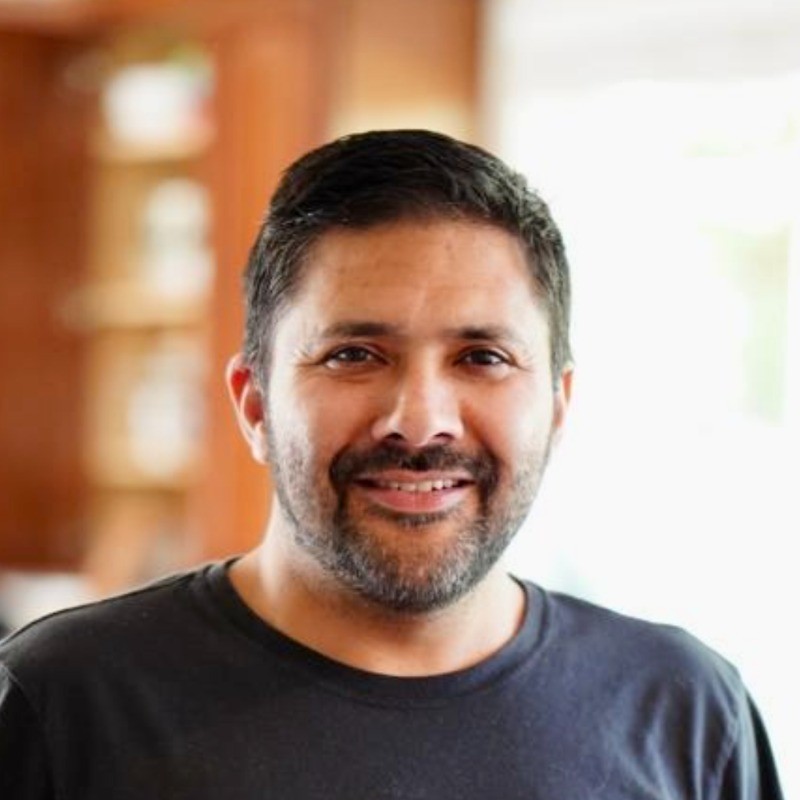
The Engineer Who Wouldn't Leave Code Review to Chance
In Amritsar, the city built around the Golden Temple, Guritfaq Singh studied computer science at Guru Nanak Dev University. He went on to become an engineering and product leader at Alegeus Technologies, a healthcare payments company where he ran teams, shipped software, and learned what it actually takes to keep large codebases clean under pressure.
He watched the AI coding wave arrive. Copilot, then ChatGPT, then a dozen more. Developers were suddenly writing code faster than any team could review it. The bottleneck shifted. Code generation got faster. Code review stayed exactly as slow and manual as it had always been.
In early 2023, Singh co-founded CodeRabbit alongside CEO Harjot Gill - an engineer with two prior exits, including the sale of Netsil to Nutanix in 2018. The thesis was straightforward: if AI is going to write code at scale, something has to review it at scale too. Not a linter. Not a static analyzer. A reviewer that actually understands context, logic, and intent.
CodeRabbit launched and immediately became the most-installed AI application on GitHub and GitLab. That isn't a category win. That is a signal from two million development teams that they had been waiting for exactly this.
As Co-Founder and COO, Singh handles the operational infrastructure behind that growth - the systems, the people, the product rhythm that lets CodeRabbit process 13 million pull requests without breaking stride. While Gill runs company direction and fundraising, Singh is the one making sure the machine doesn't seize up on its way to scale.
In August 2024, CRV led a $16 million Series A. The round included Flex Capital, Engineering Capital, and a notable angel: Datadog CEO Olivier Pomel - a signal from someone who runs observability infrastructure for the world that CodeRabbit was solving a real problem the right way.
By September 2025, Scale Venture Partners led a $60 million Series B. NVIDIA's venture arm, NVentures, joined the round. The valuation: $550 million. Total capital raised: $88 million. The company was growing 20% month over month and had crossed $15 million ARR at the time of the announcement.
Then came 2026. By April, CodeRabbit had reached $40 million ARR. That is 700% year-over-year growth. Groupon had reduced its review-to-production time from 86 hours to 39 minutes. Another customer cut code review time by 70%.
The numbers are striking. The detail that matters more is what Groupon's 86 hours tells you - not that code review was slow, but that it was so slow it was structurally blocking the shipping pipeline. CodeRabbit didn't speed up a process. It removed a constraint that had been silently throttling software teams for years.
In early 2025, Singh announced the CodeRabbit IDE extensions - bringing the platform out of pull request workflows and into the editor itself. VS Code. Cursor. Windsurf. A developer could now get AI code review the moment they stopped typing, not hours after they opened a PR. It was the difference between feedback and reflection.
More than 100,000 open-source projects now run on CodeRabbit. The platform serves 8,000+ paying customers, including Chegg, Mercury, Life360, Abnormal Security, and Sisense. The company employs around 170 people. Singh graduated from a Punjabi university in Amritsar and is now running operations for a half-billion-dollar company headquartered in San Francisco, backed by NVIDIA.
That is a particular kind of arc - one built not on proximity to Silicon Valley at the start, but on a clear-eyed diagnosis of where software teams were actually breaking, and the willingness to build something that fixed it from first principles.