The juice business was supposed to subsidize the jazz. In 1980, Greg Steltenpohl and his friends needed a way to pay for a life organized around music. They squeezed oranges, sold the juice and used a Volkswagen van to get it to customers. The arrangement had an appealing simplicity: oranges in the morning, music at night. Then the day job developed an audience of its own.
Steltenpohl played saxophone in an experimental band. His eventual business career would include a public company, a second beverage venture, international expansion and a financing round measured in hundreds of millions of dollars. Yet the musical beginning matters. He kept returning to questions a musician would recognize: How do you find a receptive audience? How much structure does invention need? When should you change the tune?
His two best-known companies, Odwalla and Califia Farms, were separated by thirty years at their founding. One began with fresh juice. The other began with fresh juice too, before taking a turn toward almonds. Steltenpohl had a particular aptitude for discovering that the business he could build was slightly different from the one he had set out to make.
A different kind of California education
Before the van, there was a prospective naval career. Steltenpohl grew up with a father who worked as an engineer for the defense industry. He considered the Naval Academy, then changed direction after a senatorial interview. Stewart Brand’s Whole Earth Catalog opened up other possibilities: making things, thinking about nature, and finding practical connections between people and their surroundings.
He studied environmental science at Stanford. California supplied an education outside the classroom as well. Its landscapes became a lasting reference point for his thinking about food and business. Decades later, when he chose a name for Califia, he would return to the state and the legend behind its name. Geography had become part of his vocabulary.
Odwalla supplied a rather different kind of instruction. Founded in Santa Cruz in 1980 by Steltenpohl, Gerry Percy and Bonnie Bassett, it grew from a small juice operation into a business that went public in 1993. Even the name carried a musical attachment: Odwalla came from the repertoire of the Art Ensemble of Chicago. A supermarket refrigerator was an unusual place to encounter avant-garde jazz.
Coca-Cola acquired Odwalla in 2001 for $181 million. Steltenpohl later spoke candidly about his dissatisfaction with the loss of the founders’ vision. The sale belongs in his story because of what followed: an enduring concern with who owns a company, what those owners expect, and how long a founder’s intentions can survive a change of hands.
The fruit failed the beauty contest
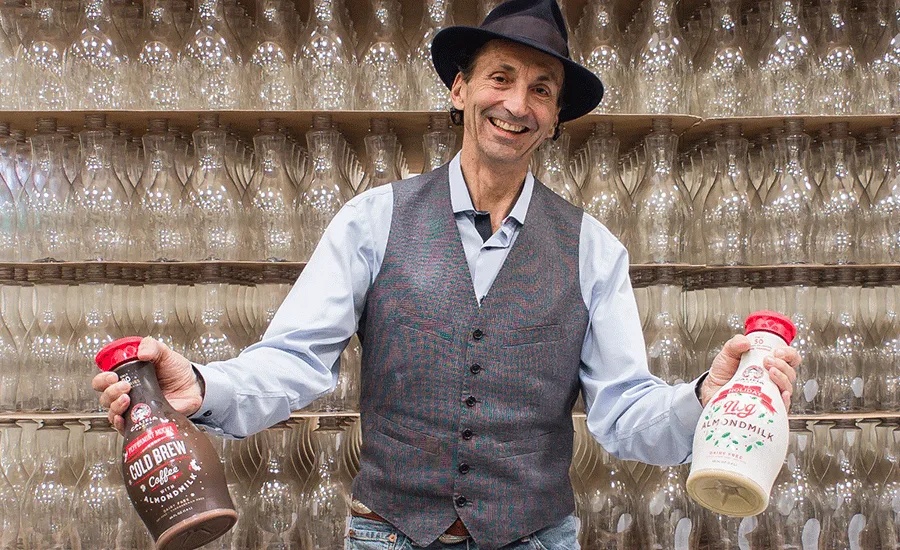
Califia’s opening problem was wonderfully specific. The growers behind Cuties mandarins had fruit that shoppers would reject for its appearance. It could still become juice. Steltenpohl partnered with Sun Pacific, the California farming group, and the business began producing tangerine juice in 2010. A cosmetic problem had acquired a commercial use.
There was a catch. Tangerines are seasonal; factory equipment is expensive throughout the year. The production line sat idle for substantial stretches. Steltenpohl was already making almond milk at home, and he wondered whether the equipment could produce it during the gaps. Califia introduced almond milk in 2012. Whole Foods subsequently asked for a national sales program.
The sequence helps explain the company better than a polished origin myth could. An effort to use overlooked fruit created a manufacturing operation. The operation needed more work. Another ingredient offered it. Califia’s eventual identity emerged from attending to those constraints, with enough flexibility to let the answer change.
Steltenpohl also kept starting things between his two familiar brands. He co-founded the Interra Project in 2000 and Adina for Life in 2004. His career contained detours and experiments alongside the names that became widely recognized. By the time Califia arrived, he had accumulated considerable practice at beginning again.
- 1980Odwalla begins in Santa Cruz
- 1993Odwalla goes public
- 2010Califia starts with citrus
- 2012Almond milk joins the line
The bottle had to make the introduction
A new beverage has to secure attention before it can earn a second purchase. Steltenpohl gave the container part of that job. Califia studied old milk bottles, their shapes and the associations they carried. The resulting curved bottle offered a familiar visual reference for a different drink. Someone could understand where it belonged before reading the label.
The name did similar work. Queen Califia, a fictional queen in a Spanish novel published in 1510, was the company’s chosen muse. Her connection to California let the brand combine a story, a place and a recognizable figure. Steltenpohl’s interest in design extended from the contents to the vessel and the tale wrapped around it.
His ambitions extended across the refrigerated case, too. Milk could lead a shopper toward creamer, then butter. Each new product could draw on experience with an earlier one. This required a name and an appearance broad enough to accommodate expansion. A bottle of almond milk was an introduction to a company with more than one thing to sell.
He understood that pleasure counted. Califia developed drinks such as Mango Chile Lime Agua Fresca and Classic Cinnamon Horchata with Almondmilk, responding to tastes he thought deserved more attention. The Specialty Food Association recognized him with its 2016 Business Leadership award. His work joined environmental intentions to the ordinary business of making something people would choose.
Put the baristas on the guest list
Coffee gave that approach a demanding test. A plant milk has to behave as well as taste right when someone steams it, pours it or adds it to coffee. Califia cultivated close relationships with specialty coffee shops and their baristas. These were people who would notice shortcomings immediately, often while holding a pitcher.
Oat Barista Blend launched in 2019. Steltenpohl described the coffee community as a place where new tastes and uses developed, and where success could help a product reach a wider public. There was a practical logic to the relationship: win the confidence of people who use the product professionally, then let their work make the introduction to everyone else.
The company also published Pour Over, a print magazine about coffee and plant-based culture. It launched in 2018, giving space to the people and relationships behind a cup. For a beverage company, a magazine is quite a long label. For Steltenpohl, it offered another way to connect the drink to the culture around it.
That interest was consistent with the music at the beginning. He remained drawn to creative communities rather than treating creativity as something confined to product development. Coffee offered an unusually convenient meeting place for agriculture, design and daily ritual. It also offered customers who had strong opinions, which can be useful even when inconvenient.
“We just have to keep talking to each other.”
Greg Steltenpohl, 2019
Enough structure to keep improvising
The musician’s problem returned as Califia grew. In a 2017 conversation about its development process, Steltenpohl described the tension between too much system and too much experimentation. Excessive structure could drain the enterprise of energy. Unrestrained invention could put ideas beyond the company’s ability to turn them into products. He wanted room to play inside an operation that could deliver.
Manufacturing helped create that room. Califia’s vertically integrated operation allowed it to move between developing a drink and getting it onto shelves. By late 2017, its range included more than eighty individual products across categories. The variety made the operational question unavoidable: every promising idea eventually needed equipment, ingredients and a route to a customer.
Scale brought capital as well. In January 2020, Califia announced a $225 million Series D financing. By then, its drinks had reached beyond the United States. The brand had entered Australia in late 2017; its British launch that year included the London Coffee Festival and retail distribution. The neighborhood van had become a very distant reference point.
Series D financing for the company’s next stage of innovation and growth.
Steltenpohl resisted the idea that selling to a larger company was the necessary destination. He argued publicly for the value of an independent business devoted to plant-based products. Ownership mattered to the choices a company could make. His earlier experience gave the concern weight; the later company gave him another opportunity to work through it.
He could be equally frank about his own management. He acknowledged that an admired recommendation had led him to hire someone who fitted the company poorly. He also admitted that aligning stakeholders around Califia’s mission remained unfinished work. Listening and giving other people authority were lessons he was still learning. The founder who wanted people to try something different had to leave space for colleagues to do the same.
The next beginning belongs to somebody else
In September 2020, Califia announced Dave Ritterbush as its new chief executive. Steltenpohl retired as CEO and continued on the board as an executive director. The transition put an experienced food-industry operator in charge of the company he had started a decade earlier.
Steltenpohl died in March 2021. The work associated with his name continued through an award announced the following year. The Greg Steltenpohl Pragmatic Visionary Award supports entrepreneurs working toward a more plant-centric food system. Its title gives equal billing to an idea and the effort required to make it useful.
In 2026, the award divided $100,000 among three ventures, including Just Soup and Colorado’s Roaring Fork Mill. Two seed grants of $25,000 and one momentum grant of $50,000 directed the money toward businesses at different stages. His son Eli helped announce the recipients. A concern that had occupied one founder was becoming starting capital for others.
There is an appealing continuity in that. Steltenpohl began with a small business intended to make another kind of work possible. Decades later, money awarded in his name serves a similar purpose for people with different projects. The scale has changed. The useful question remains: what could someone make, if they had a little more room to begin?
Keep the conversation going
- Califia Farms: the company’s story
- Greg Steltenpohl on LinkedIn
- From juice to almond milk: a founder interview
- The Art of Manufacturing: listen to the conversation
- Watch: interview clips with Elysabeth Alfano
- Watch: the Odwalla B Movie
- 2026 award: Eli Steltenpohl’s announcement
- Coffee, creativity and manufacturing: a video conversation