Before Greg Adelson became the chief executive of Jack Henry, he spent thirteen years learning how its money moved. He arrived in bill payments, took charge of a larger payments business, became chief operating officer, then president. By the time he took the top job on July 1, 2024, he had already been responsible for much of what the company sold, built and kept running. The promotion changed his title. The machinery was familiar.
That apprenticeship matters because his customers cannot treat technology as a pleasant experiment. They are banks and credit unions. Their customers expect money to arrive, balances to make sense and payments to work while everyone gets on with something more interesting. A banking app earns very little applause for opening correctly. It does, however, attract an attentive audience when it fails.
Adelson’s working life has unfolded inside that bargain: making complicated financial systems useful enough to disappear into an ordinary day. Now he leads a Missouri company trying to modernize the technology behind community finance while preserving the relationships that made those institutions worth choosing in the first place.
An accounting degree, then the plumbing
Adelson holds a bachelor’s degree in business administration, in accounting, from Texas State University. His earlier executive roles took him through several corners of payments: chief revenue officer at Regulus, chief operating officer at FSV Payments and National Processing Company, and president of ChoicePay. The jobs placed him in the business of moving money well before his responsibilities expanded to the broader banking software stack.
There is a useful distinction between selling a financial service and operating one. A sale has a moment of completion. An operating system has tomorrow morning. Adelson’s career repeatedly put him on the side responsible for tomorrow morning, where a promising idea still needs processes, people and an answer for the customer with a problem.
He joined Jack Henry in 2011 as group president of iPay Solutions, its online bill-payment business. In 2014, he became general manager of JHA Payment Solutions. The move widened his view from a particular customer task to the connections among payment products. It also established the pattern of his progress through the company: a larger field of responsibility, built around work he had already done.
Thirteen years with the same boss
David Foss is a central connection in Adelson’s Jack Henry story. Foss preceded him as CEO and became executive board chair when Adelson succeeded him. Their handover followed years of shared work rather than an abrupt introduction between a new chief executive and a business waiting to explain itself.
In a 2024 investor conversation, Adelson described Foss as the only boss he had reported to during his thirteen years at the company. He also described their alignment on employees, customers and shareholders. For an incoming CEO, that is a particular sort of preparation: repeated exposure to both the decisions and the reasoning behind them.
His growing remit had made the preparation practical. As COO, he oversaw products and business units spanning core systems, digital banking, lending, payments and financial crimes. His appointment as president in January 2022 added leadership of the recently created Digital and Technology Office, headed by Ben Metz. A payments executive had become responsible for how a much wider collection of technologies fitted together.
Among the initiatives associated with him were the creation of the PayCenter payments hub, the acquisition of Ensenta and the One Jack Henry program, intended to improve the company’s operating and service model. These are different kinds of work: a product, a transaction and an organizational effort. Together, they help explain why the succession was presented as the continuation of a strategy he had helped build.
When his CEO appointment was announced, Adelson put his ambition plainly: “I am passionate about continuing the strategic journey that we are on today”. Continuity can sound modest in a corner office. In a business whose customers depend on continuity every day, it carries rather more weight.
Four words that have to survive the meeting
Adelson organizes his leadership approach around transparency, consistency, collaboration and communication. The words are ordinary enough to fit on almost any office wall. His explanations give them some teeth. Transparency includes telling colleagues and customers what they need to hear. Consistency includes making processes dependable and giving employees room to move between groups. Collaboration means bringing different parts of the company into the same problem.
Communication is where the other three become visible. In a February 2024 interview, he linked access to information with the motivation to tackle the next problem. It is a practical argument for sharing information: people can contribute more intelligently when they understand what needs doing.
“The more people that are in the know, the more they’re motivated to solve whatever the next problem is.”
Greg Adelson · February 2024
In April 2026, his second CEO roadshow visited six company connection hubs and included a livestream for remote employees. It reached more than 4,000 associates. He shared updates and fielded questions. The numbers give a sense of the distance a chief executive has to cover to make direct communication more than an invitation buried in an inbox.
A roadshow cannot, by itself, prove that a culture works. It does reveal a choice about where to spend executive time. Adelson has chosen to put himself in front of employees as well as investors. For someone managing a company built from many products and teams, the internal audience has plenty of relevant questions.
The front door moved onto a screen
The customer version of that problem is integration. A bank may have relationships measured in decades and technology assembled across several generations. Its account holders still expect a coherent experience. They do not organize their patience around the supplier chart.
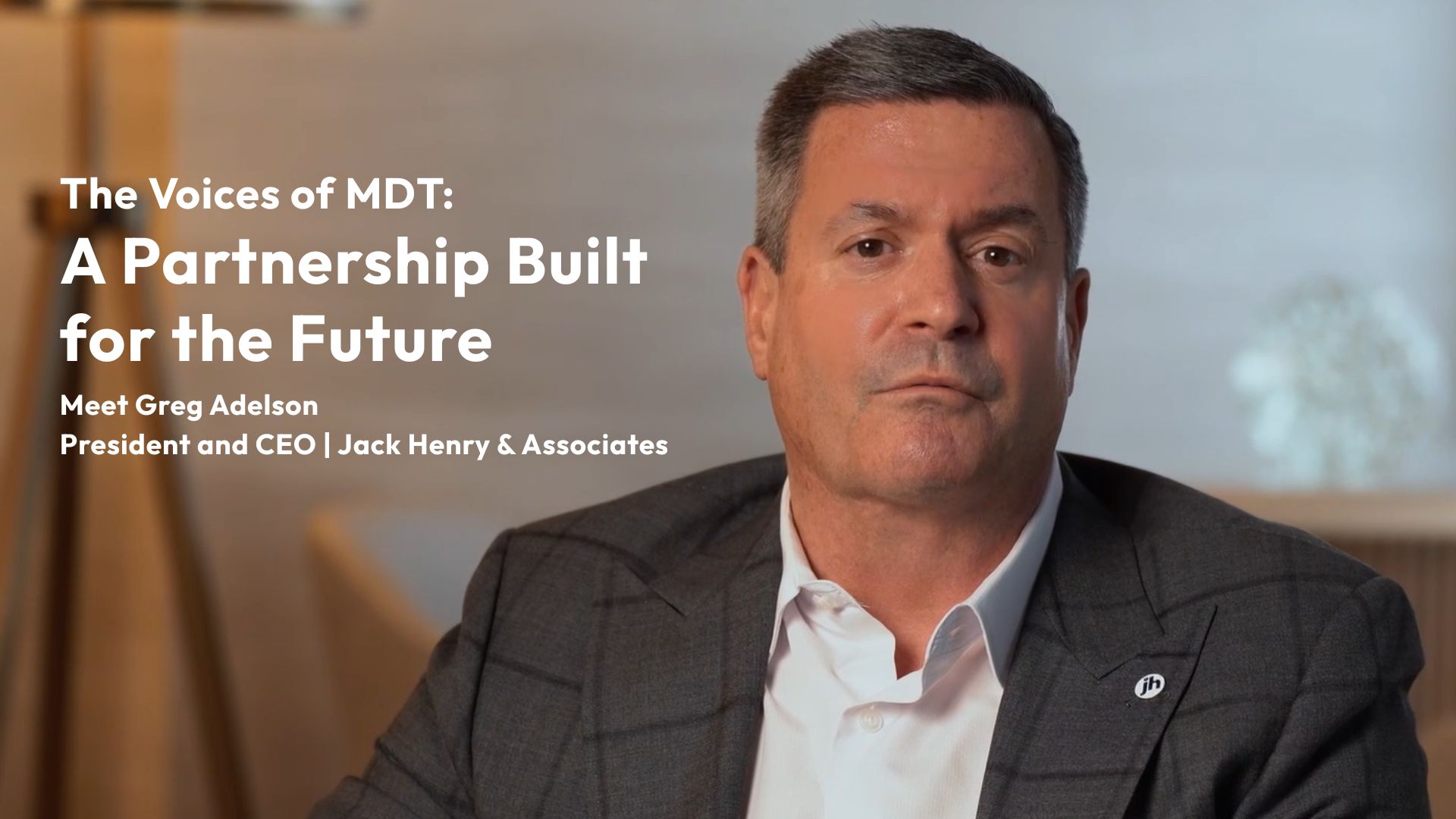
In his January 2026 conversation with credit-union technology partner MDT, Adelson discussed the shift toward a digital front door, the role of cloud-native technology and the importance of an open approach to integration. The partnership gives his ideas a concrete setting: MDT can help implement applications while Jack Henry supplies technology, making adoption less burdensome for the credit union.
The underlying proposition is that a smaller institution should be able to add capabilities without having to invent everything itself. APIs, the interfaces that let software systems communicate, are part of that proposition. So is the willingness to work with other providers. The customer wants a useful service; the vendor has to manage the joins.
This also helps explain Adelson’s interest in small businesses. In his FinTech Cowboys conversation with Dave Mayo and Tanner Mayo, he discussed Jack Henry’s small- and medium-sized business strategy, including its initial focus on sole proprietors. These customers bring business needs into institutions that may already know them as individuals. Serving them well requires the technology and the relationship to travel together.
institution
technology
holder
A conceptual view of the strategy: keep the local relationship while connecting the tools behind it.
The numbers include a difficult quarter
Adelson’s progress can also be examined through results. For fiscal 2026, Jack Henry reported 58 competitive core wins, including 14 institutions with more than $1 billion in assets. Those are company sales outcomes under his leadership, and a useful indication that institutions were choosing its underlying banking systems.
The financial picture contained both growth and friction. Full-year GAAP revenue rose 7.1%, while GAAP operating income increased 11.7%. In the fourth quarter, revenue increased 4.7%, but operating income fell 12.2% compared with the same quarter a year earlier. Diluted earnings per share for the quarter fell from $1.75 to $1.57.
Annual growth and quarterly pressure appeared in the same report. These measures describe different periods.
That combination deserves to stay in the picture. A technology strategy is tested in implementation, customer decisions and financial performance over time. An annual gain does not erase a weaker quarter. Nor does a weaker quarter tell the entire story of a year in which the company won new core business.
Security adds another obligation. In June 2026, Jack Henry and Google Cloud announced an expanded collaboration to develop an AI-driven security platform for financial institutions. The stated aim included analyzing large quantities of security data to identify threats earlier and coordinate responses more quickly. For Adelson, modernization comes with the responsibility to protect the systems customers are being asked to trust.
A fiftieth birthday with other people onstage
Jack Henry’s anniversary year supplied a different measure of the job. Adelson rang Nasdaq’s closing bell in May 2026. In October, at the Jack Henry Connect conference in Kansas City, he presented a $107,450 donation to Junior Achievement USA. Employees had chosen the recipient through a companywide vote; the gift combined company funding with associate contributions.
Junior Achievement’s work in financial literacy, entrepreneurship and preparation for employment gives that gesture a clear connection to the world Jack Henry serves. Banks need customers who can use financial tools, and communities need people able to build businesses. The donation puts money into that earlier part of the story.
Adelson’s own story has reached a stage where the work is less about acquiring another title than making a large organization act on its promises. His route to the job offers a useful clue to his approach. Bill payments taught him one piece of the system. Each promotion added more pieces, more colleagues and more customers with a reason to expect them to work together.
The task now is to keep that whole arrangement useful: modern software, dependable service and room for a community institution to remain recognizably itself. For the person opening an account or paying a bill, success may look entirely uneventful. After a career in payments and operations, Adelson has good reason to appreciate the value of an ordinary day.