On June 23, 2024, Bank First completed a change most customers would rather never think about. The Wisconsin bank, then holding $4.2 billion in assets, moved its data and technology onto UFS’s Empowered Core platform. The build had taken seven months. UFS reported that the conversion finished on schedule, with no customer impact. In banking infrastructure, an uneventful day can be an achievement.
- UFS supplies the technology behind community banking, from core processing to cybersecurity.
- Its founding idea: share specialist expertise across banks.
- After acquisitions and a BankOnIT combination, UFS became part of Navanta in March 2026.
That quiet conversion is a useful introduction to UFS Tech. Its work sits behind the account balance, the payment, the branch workstation and the recovery plan. Bank First wanted more room to grow, integrate financial technology and handle acquisitions. The project’s appeal was flexibility with familiar support. A core platform is a consequential place to ask for both.
The three-bank idea
UFS began in 1991, when three Wisconsin community banks pooled technology and expertise. Originally called United Financial Services, it gave smaller institutions a way to obtain capabilities associated with much larger banks. The interesting choice was organizational: the banks could share technical resources while continuing to operate their own businesses.
Consider the arithmetic, without pretending there is a universal savings figure. A bank needs reliable systems, security knowledge and people who understand its operations. Those needs do not disappear because its market is smaller. Sharing access to specialists can make a capability practical that would be difficult to assemble alone. UFS built its business around that gap.
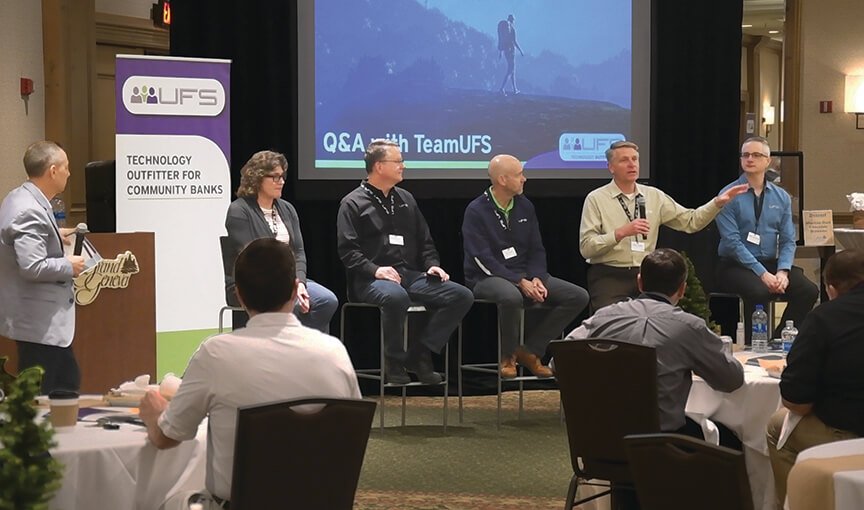
Someone has to own the handoffs
The product list makes more sense when read as a working bank. Core processing supports daily operations. Digital banking gives customers remote access. Payments, treasury tools and document services connect that machinery to actual transactions. Managed IT covers networks, devices, cloud infrastructure and recovery. These are interdependent jobs, however many contracts appear in the purchasing folder.
UFS also offers advisory help. CIO360 supports technology planning, governance and audit follow-up. ISOversight combines compliance applications with specialist assistance. A bank can obtain expertise alongside its own staff, rather than expect a software installation to answer every operational question. Preparation for examinations belongs in the relationship, too.
Customer engagement adds another layer. IQ Essentials, the CRM offering associated with Quest Analytics, connects customer information with appointments, tasks and referrals. Optional modules address prospecting, service and profitability. For a bank, that means infrastructure can support the relationship work that justified having a local institution in the first place.
The distinction from a general IT contractor is the banking focus. The distinction from simply buying a core system is the surrounding service. UFS occupies the space where processing, infrastructure and banking operations meet. Its named customers include Capitol Bank and The Peoples Community Bank, as well as Bank First. The buyer is an institution, not someone downloading a personal finance app.
A September 2026 Navanta account of Mauch Chunk Trust Company’s CRM work makes the problem tangible. The bank’s earlier system was difficult to use and lacked a clear owner. Adoption suffered. Its reset began with understanding staff workflows and assigning responsibility. Navanta reported that retail staff generated 505 wealth-management referrals in one year, with 236 becoming qualified opportunities. Those are customer-reported activity figures, not proof of revenue. They do illustrate something readers can copy: appoint an owner, start with a shared workflow and make the system easy enough for people to use.
referrals in one year
opportunities
Activity measures, not revenue or a guaranteed result.
A customer can outlast an owner
Bank First’s history with UFS contains an instructive wrinkle. It owned 49.8% of the company before selling that interest on October 1, 2023. The sale produced a $38.9 million pretax gain for the bank. That number describes the seller’s accounting gain; it should not be mistaken for UFS’s revenue or the price of the whole company.
The commercial relationship continued. Bank First’s filing reported approximately $5.5 million in UFS data-processing service fees for 2023. That is a historical bill for one bank, with its own scope and circumstances. It is useful evidence that this is substantial operating infrastructure, rather than a guide to what another bank would pay.
UFS earns its place through services and technology supplied to financial institutions. Its public managed-IT testimonials include a reference to fixed pricing. The buying decision therefore involves scope: which systems, which responsibilities, which people and which response commitments. A monthly number becomes meaningful only after those questions have answers.
Four names become one
Expansion added capabilities around that service relationship. UFS acquired infrastructure specialist vIntegrators in April 2024 and Safe Systems, an IT, security and compliance provider, that August. Quest Analytics followed in June 2025. Each move widened the work UFS could take on for a financial institution.
In October 2025, UFS and BankOnIT announced their combination. BankOnIT brought its Bankers Private Cloud and managed IT expertise; UFS brought core banking, advisory and customer engagement capabilities. On March 30, 2026, the organizations adopted Navanta, unifying UFS, BankOnIT, Safe Systems and Quest Analytics. The combined business reported serving more than 700 community financial institutions.
“Integration is never simple”
Eric Jones · President and CEO · March 2026
Eric Jones’s explanation of the new name offered a welcome piece of friction. Bringing the companies together had required work across systems, teams and processes. A single identity would reduce confusion around legacy names. That admission matters: acquiring expertise and making it function as one service are separate tasks.
Borrow the method
For a bank evaluating this model, start with the handoffs. Identify who owns the network, security response, recovery testing, core integration and examination preparation. Then ask the provider to show how those responsibilities connect. This is a practical lesson suggested by UFS’s breadth: evaluate the operating relationship along with the tools.
The model fits institutions that want banking specialists and shared technical capacity. It offers less obvious value to an organization determined to build and control every layer internally. Concentrating services also concentrates dependence. Clear responsibilities, recovery exercises and an exit plan deserve attention before the contract does.
The original three banks found a way to share technical muscle. Navanta now has to deliver that idea across a much larger organization. The test remains pleasingly concrete: when a bank changes something important, can its customers get on with their day?