Grant Belaire arrived at MacPaw with an unusually tidy phrase for a messy assignment. He was looking for “a build.” Not another seat, not a victory lap through familiar territory, but a place where product, growth, and brand still had to be fitted together while the machinery was running. MacPaw offered exactly that. The company had recognizable Mac products, loyal users, a software marketplace, security expertise, and an AI assistant called Eney. What it did not yet have was the simple story that makes a collection feel like a system.
Belaire's job as chief marketing officer is to help write that story and make it operational. He oversees brand, growth, product marketing, customer engagement, and go-to-market strategy. Those functions often sit near each other on an organization chart while speaking entirely different dialects. Brand thinks in memory. Growth thinks in motion. Product marketing thinks in choices. Analytics, when allowed, interrupts everybody with the bill.
His career makes sense of the combination. Over more than 20 years, Belaire has worked through several versions of the consumer internet: AOL trying on a new identity, Yahoo turning vast reach into useful products, local newspapers asking readers to pay online, and McAfee widening the idea of consumer protection. The logos are familiar. The more revealing thread is a recurring question: how does a product earn a direct place in somebody's routine?
The internet learns to introduce itself
In 2010, Belaire was AOL's director of global brand marketing. AOL had recently replaced its old running-man-era identity with the deliberately peculiar “Aol.” wordmark, designed to sit over changing images. This was corporate identity as a picture frame: the brand stayed still while culture moved behind it. Belaire's work from that period included an SXSW activation and a collaboration with Seed.com, AOL's experiment in assigning stories to independent contributors.
That spring he listened to University of Missouri students pitch campaigns for Seed. The students had been given the same brief, yet returned with three different arguments: growth, expertise, and being heard. Belaire praised the polish of all three and chose the concept whose iconography and message could travel readily across formats. It is a small episode, but a useful one. He was not only judging the cleverness of an ad. He was looking for an idea that could become a repeatable system.
Yahoo followed. Belaire spent seven years there in leadership work spanning product marketing, mobile growth, analytics, partnerships, and strategy. His public portfolio still points to a 2011 Yahoo Mail campaign, as if the purple years never quite left the building. In 2023 he wrote that he still “bleed[s] purple.” Nostalgia is normally a poor operating system, but it can be good evidence of affection. Brand people can be slightly sentimental about products and ruthlessly unsentimental about whether the products work.
One career, five versions of a direct customer relationship
Sell the part somebody loves
At McClatchy, the internet problem became less abstract. Local newspapers possessed deep reporting and recognizable names, but the old package no longer matched every reader's appetite. Belaire, then leading digital audience development, helped test a wonderfully literal answer: if somebody only wanted the sports, sell the sports.
SportsPass began rolling through McClatchy markets in 2018. The target was not the reader already delighted to buy the entire paper. It was the person in the middle: engaged enough to care, specific enough to resist the full subscription. Some were no longer local at all. Belaire offered the memorable example of a reader in Hungary who still paid attention to his hometown paper because he wanted to know what was happening with the team. Geography had loosened its grip; affinity had not.
“The sports-only cohort is pretty large and they engage at a pretty high rate. But they weren't ready to commit to the full subscription.”Grant Belaire on the SportsPass audience
The offer spread across markets including Kansas City, Raleigh-Durham, Charlotte, Tacoma, Boise, and Columbia. Each launch was an experiment that made the next one easier. By 2019, SportsPass was live in 10 markets and had attracted subscribers in the thousands. Modest by mass-media standards, perhaps, but revealing. A narrow offer can make room for a broad relationship. Give people the piece they value and they may eventually trust you with more.
Belaire's remit expanded into digital subscription sales, retention marketing, corporate brand, planning, and eventually consumer revenue. By 2021 he was talking about publisher apps as a way to reclaim the connection from search engines, social networks, and news aggregators. “You want to have a firsthand relationship with your customers,” he said. The app could be faster and easier to navigate, but its strategic value was even simpler: it put the publication and the reader in the same room, without a platform standing in the doorway.
He was also clear about the friction. Fewer than 20 percent of unique web visitors came through McClatchy's apps at the time. Readers wanted better search. Awareness was a problem. The lesson was not that an owned channel magically solves distribution. It was that a direct relationship has to be earned through utility. People will not surrender a square of their home screen out of civic duty.
Protection becomes a subscription
Belaire spent four and a half years at McAfee, serving most recently as global head of direct-to-consumer marketing. The category had changed since antivirus software arrived in boxes and announced itself with alarms. Online protection now had to cover an untidy digital life: identity, scams, private information, and risks moving through email, text, and synthetic media. The customer relationship was ongoing because the threat was ongoing.
His team worked on subscriber acquisition and growth, including campaigns for McAfee's Scam Detector. One social-first effort used AI-generated characters to make familiar scams funny enough to remember. The work joined a serious utility to a lighter creative idea, a combination Belaire appears to enjoy. A 2024 recruiting post advertised an opening on his team with an additional perk: the successful applicant would get to work with him. Daily. Colleagues confirmed the perk, with just enough enthusiasm to keep the joke alive.
When he left in April 2026, Belaire emphasized relationships rather than a victory ledger. He named leaders who had challenged him and colleagues whose support had reached beyond the work. Former teammates answered with a consistent portrait: optimistic, direct, data-minded, generous with autonomy, and capable of making people feel heard. One invoked Liverpool's “You'll Never Walk Alone” and joked about whether the greater absence would be Belaire or Mohamed Salah. Marketing careers rarely produce football comparisons. This one apparently did.
A practical AI brief
MacPaw formally announced Belaire's appointment in June 2026. He had already explained the attraction in plainer terms: strong products, loyal users, a growing platform opportunity, and a large shift around AI. The work he loves, he wrote, is connecting those dots into a global growth engine. For all the mechanical language, the decisive part of his statement was human. He respected and trusted founder Oleksandr Kosovan and saw affection for the Mac platform embedded in the company.
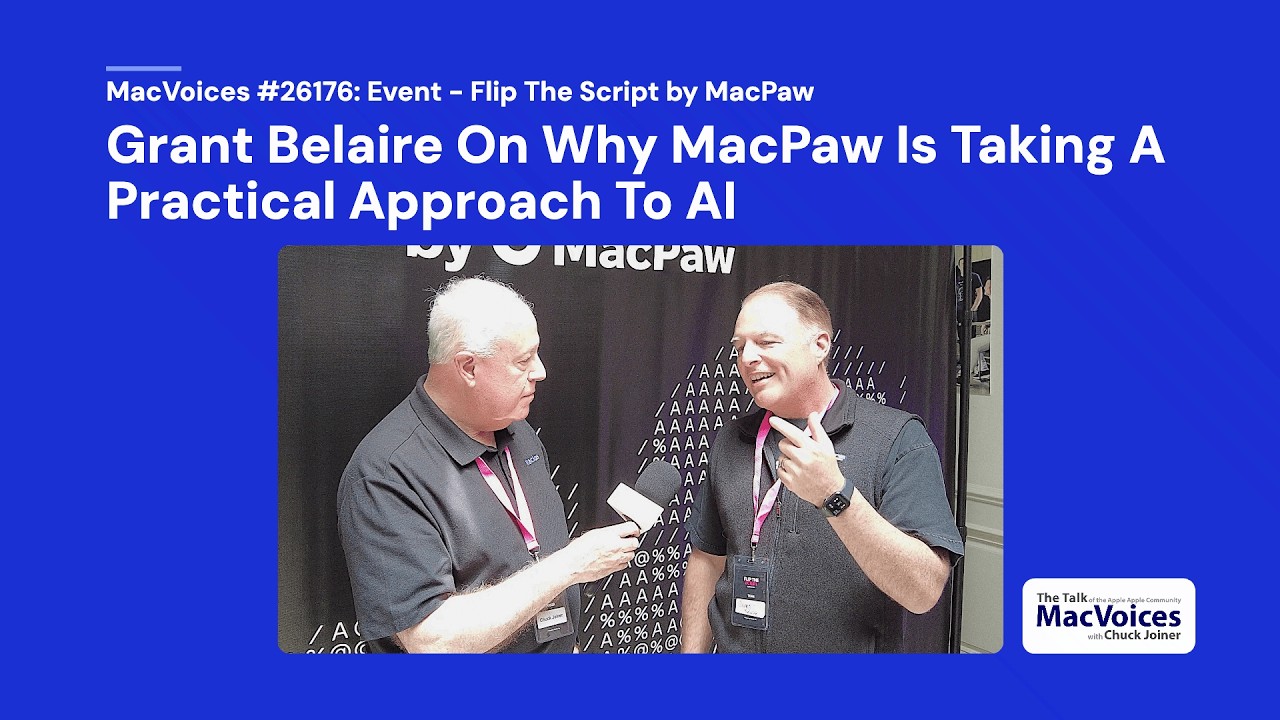
At MacPaw's Flip the Script gathering during WWDC week, Belaire described AI without treating it as a mandatory garnish. Products such as CleanMyMac, Setapp, Moonlock, and Clear already have jobs. AI should make those jobs easier, not turn every screen into a technology demonstration. He emphasized trust and user choice, the balance between customers and outside developers, and the patience required to keep a marketplace alive. An “AI or bust” strategy makes for an emphatic slide. It is less convincing as a daily experience.
MacPaw, meanwhile, has not been timid. The company paused normal work for a two-week internal sprint in which technical and nontechnical teams built reusable AI agents. Belaire praised the move for turning AI from an abstract roadmap into everyday operations. In August, he shared a partnership with Liquid AI designed to bring efficient models onto the Mac itself. His summary was concise: intelligence on the Mac should be private, fast, and local, with cloud capability available when useful.
“I wasn't looking for just another role - I was looking for a build.”Grant Belaire on joining MacPaw
That hybrid model is also a decent description of Belaire's marketing instincts. Keep the relationship close. Bring in the larger network when it helps. Measure behavior. Preserve choice. Make the sophisticated machinery feel ordinary at the point of use.
In August, he joined founders and business leaders at Stanford for an AI, Innovation & Growth program run with Endeavor and Endeavor Ukraine. His questions were larger than tool adoption: what should a company rethink, what should it stop doing, and what does it take to organize around AI without merely decorating the old organization? They are questions for an operator inside a build, where the answers have consequences on Monday morning.
The useful habit
The internet has spent two decades adding intermediaries, bundles, feeds, subscriptions, assistants, and ecosystems between people and the thing they wanted to do. Belaire has worked inside nearly every stage of that accumulation. His recurring move is reduction: identify the appetite, offer a clear door, and let the relationship deepen through use.
At McClatchy, the door was a hometown team. At McAfee, it was protection that kept pace with a changing digital life. At MacPaw, it may be an assistant that quietly coordinates trusted tools on a computer whose owner values privacy and control. Different products, same demanding standard. A habit cannot be declared by a campaign. It forms when the product is useful enough to invite itself back tomorrow.
That makes Belaire's new brief both large and agreeably concrete. The company can talk about platforms and ecosystems. The customer will still ask whether the Mac became easier to use. Somewhere between those two sentences sits the build.