Joyce Kim's first professional software spoke the language of invoices. She programmed billing systems in COBOL and a little C++, an origin less glamorous than a product launch and considerably more revealing. Code demands that the logic work. Billing demands that the numbers do, too. Long before Kim became a chief marketing officer, she was learning that elegant ideas eventually meet an unforgiving user.
She also noticed a gap. The people marketing technical products did not always understand the technology itself. Kim found that astonishing. Her response was not to complain from the engineering side of the wall. She crossed it, moving through product management into product marketing and communications. The move supplied the governing sentence of her career: she wanted to turn what engineers built into value and benefits that businesses and consumers could actually experience.
That sentence has traveled well. Kim has worked on billing systems, Chromebooks, Google Hangouts, Skype, collaboration software, semiconductor designs, customer-experience platforms and cloud security. These products occupy different corners of the technology map. Her job has remained oddly consistent. First, understand the machinery. Then find the human consequence. Finally, explain the bridge between them without making either side sound foolish.
COBOL + C++Connection
Google + SkypeCompute
ArmTrust
Zscaler + Proofpoint
The degrees that should not match
At California Polytechnic State University, San Luis Obispo, Kim earned Bachelor of Science degrees in finance and architecture as a double major. On paper, the pairing looks like the work of an indecisive course catalog. In practice, it anticipates her career nicely. Finance asks whether the proposition makes economic sense. Architecture asks whether the structure will hold. Marketing, when practiced seriously, has to answer both.
Her early technology roles included Symmetricom and Internap. From 2008 to 2015, her work reached products with far larger audiences: product communications and partnerships around Chromebooks and Google Hangouts, then product marketing leadership for Skype and Skype for Business at Microsoft. She became CMO of work-management company Wrike in 2015. The résumé was gathering scale, but also a pattern. Kim repeatedly landed where complex systems needed a story broad enough to leave the engineering department.
“I developed a passion for turning the products that engineers built into the value and benefits that businesses and consumers experienced.”Joyce Kim, on her move into marketing
Making the invisible visible
Arm offered the purest version of that assignment. Its processor designs sit beneath an extraordinary share of everyday computing, yet the company historically spoke most naturally to semiconductor engineers. Kim, first as chief marketing officer and later as chief digital and marketing officer, wanted to widen the room.
When she asked an audience how many people carried a smartphone, every hand went up. Most of those hands were holding technology touched by Arm. The company had ubiquity without everyday recognition, a luxurious problem only until a competitor begins telling the clearer story. Kim's challenge was cultural as well as creative: persuade an engineering-led organization that being understood beyond engineers was strategically useful.
She led global marketing and an enterprise-wide digital transformation, including a new marketing technology stack intended to improve data-driven demand generation and conversion. She also helped launch microprocessor intellectual-property products in Japan and China alongside Arm's partner ecosystem. In July 2018, she represented Arm before the U.S. Senate Commerce Committee at a hearing on the Spectre and Meltdown vulnerabilities. Her prepared remarks treated vulnerability management as a continuing process, including clearer routes for researchers to contact the company and internal disclosure policies.
The keynote belonged to the children
Kim's favorite Arm project did not place a chip executive at center stage. The Empowering Gen Z initiative found young inventors, ages 10 to 14, who were already running startups around things they had made. Arm filmed their work, then proposed that the children take a keynote slot at Mobile World Congress in 2019.
It was, in Kim's account, a high-risk bet. It worked. Other keynote speakers kept referring to the young founders, who became a subject of conversation across the event. Kim did not remember the campaign merely as a clever piece of programming. She remembered it as proof of human connection, which may be the least technical phrase in her vocabulary and the one that best explains her work.
There is also a sly editorial lesson in the choice. A company can explain future computing with a diagram of processor architecture. Or it can hand the microphone to a 10-year-old building the future. The diagram may be accurate. The child is difficult to forget.
A sequence of harder translations
Kim became Genesys CMO in 2020, responsible for global marketing and communications as the contact-center company pressed further into cloud software and personalized customer experience. Twilio followed in April 2022. There, she described an opportunity to carry the developer spirit of a communications platform into the enterprise and to power personalized experiences across a customer's journey.
The language had shifted from processor designs to conversations, but the bridge looked familiar. Developers understood the components. Enterprises needed to understand the outcome. Kim argued that first-party, real-time data would become marketing's backbone because it could reveal what customers needed, when they needed it and where they wished to engage. She was equally blunt about the other side of the ledger: marketers should stop buying advertisements whose return they could not justify.
In November 2023 she moved to Zscaler, joining cloud security just as generative AI was multiplying both corporate possibility and corporate anxiety. On a 2024 episode of CMO Confidential, she discussed zero trust, breach response, the contest between defenders and inventive bad actors, and why marketers should work closely with chief information security officers. Security marketing lives in a delicate neighborhood. It must make risk legible without renting a fog machine and frightening everyone toward the checkout.
“Data is every marketer's future, and activating real-time data needs to be the cornerstone of every marketer's playbook.”Joyce Kim, 2023
Trust becomes the brief
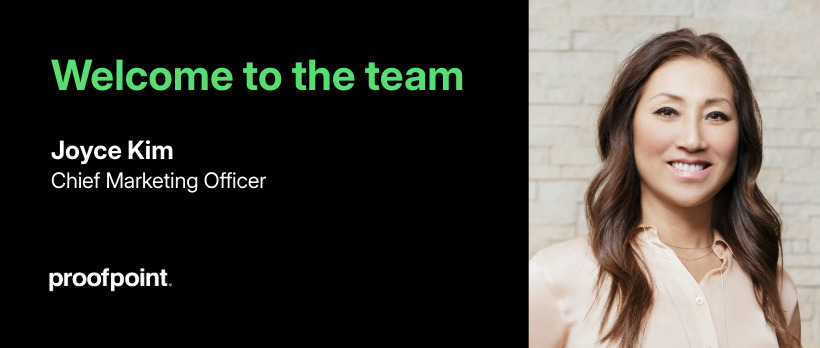
Proofpoint appointed Kim chief marketing officer in December 2025. Reporting to CEO Sumit Dhawan, she took responsibility for global marketing and communications, including brand strategy, demand generation and market engagement across the company's security and compliance portfolio. Her stated brief is to explain how organizations can protect people and data while adopting AI and AI agents.
Trust is a peculiar thing to market. It cannot be wrapped, demonstrated in a showroom or secured by a clever adjective. Customers infer it from preparation, conduct and what happens on a bad day. Kim's technical beginnings give her a useful resistance to treating the product as stage scenery. Her career has moved from building systems, to connecting people through systems, to protecting what moves through them.
The outside responsibilities reinforce that range. Since December 2021, she has served on the board and Audit Committee of QuickLogic, a semiconductor company working in embedded FPGA and endpoint AI. She also sits on the board of Bring Me A Book, a nonprofit associated with the Stanford Center on Early Childhood, and has served as an adviser to SparkLabs Frontier-ASU. One seat concerns programmable silicon and corporate oversight. Another concerns children and books. The combination is less contradictory than it first appears. Both ask what infrastructure makes possibility available.
The scrunchie principle
Executive life becomes more believable around the edges. Kim's first job of any kind was cashiering at a surf shop, where the arrival of a real paycheck also delivered the discovery that taxes were real. She cycles the roads of the Bay Area on weekends. She once chose the hair scrunchie as the fashion trend worth reviving, not for nostalgia but because it does not pull long hair or leave a ponytail crease. Even her frivolity arrives with a product requirement.
Her productivity rule is similarly practical. If she cannot finish something within an hour, she makes herself leave it for at least 15 minutes. Coffee, soda, the mail or a quick dog walk will do. Then she returns, rereads the work and often sees a different route through it. This is refreshingly unlike the heroic folklore of executive endurance. Attention, in her formulation, is a system that benefits from a reset.
The warmer principle is about company. At Twilio, Kim said that enjoying the people on a journey matters as much as the journey itself. She valued the company's call to be a positive force because helping and caring for people can be obvious in theory and difficult in practice. Former colleagues have publicly described her leadership as authentic, positive and humble. Those judgments belong to them. Her own stories make the preference plain enough: the young inventor over the corporate monologue, the colleague beside you over the solitary march, the customer consequence over the feature list.
The engineer never quite left
Kim's appointment at Proofpoint completes no tidy circle; careers are mercifully less obedient than magazine metaphors. But it does reveal a progression. She learned to program business systems. She marketed tools for communication and collaboration. She helped explain the invisible computing architecture beneath daily life. Now she works where communication, data and identity become targets, and where AI agents add unfamiliar actors to the network.
Her job is still translation, only the stakes have changed. The modern security company must speak to engineers, executives, employees and boards. It must describe threats precisely, explain protections plainly and avoid making fear its entire personality. Kim has spent decades practicing the movement between those rooms.
The code was never merely a charming origin story. It established a standard. Understand the thing before naming its value. Check the logic. Remember the person at the other end. Then tell the story well enough that a hand goes up.