Before Tara Ryan marketed clouds, endpoints, identity platforms and self-protecting code, she understood a system with less fashionable vocabulary: a farm. She grew up in Fresno, California, in a landscape where a crop had a beginning, a chain of work and a customer at the other end. Seed to shelf was not a conference slogan. It was simply how the world worked.
That background is an unusually good apprenticeship for enterprise software. Both agriculture and technology are crowded with dependencies. Both punish people who admire one shiny component and ignore the chain around it. Ryan's public career, stretching from advertising in the early 1990s to a C-suite run through some of Silicon Valley's denser categories, reads like an extended argument for seeing the whole system.
Her titles say marketer. Her work has often been closer to translation: taking a complicated product, locating the business process it changes, then giving customers language they can repeat without a glossary. That task led her through Oracle, McAfee, NetSuite, Zebra Technologies, Proofpoint, Coupa, Skuid, Incorta, Contrast Security, Saviynt and Tanium. It also put her near four IPO business successes and several attempts to name or remake a category.
Learn the machinery before naming it
Ryan began in an advertising firm, working on accounts that included Hewlett-Packard and Air Liquide. On her own company site, she recalls learning the basics through SKUs and industry codes. It is a revealing pair of details. One describes the thing being sold; the other describes the market likely to buy it. Ryan has spent much of her career moving between those two coordinates.
At Oracle in the mid-1990s, she supported applications and data warehousing groups. Campaigns took her around the world and asked her to combine transaction-processing benchmarks with business return on investment. Before “data-driven marketing” became a line in every job description, Ryan was learning that the proof and the promise had to travel together.
Network Associates and McAfee widened the frame. She worked across five business units, helped launch myCIO.com and participated in the McAfee.com public offering. She was also in the room for Y2K, when cybersecurity advertising discovered that the apocalypse made excellent creative. Television and radio campaigns warned of digital doomsday. It worked as attention. Ryan later looked back on it with rather less romance.
Most of our marketing was fear-based.Tara Ryan, reflecting on the Y2K era
Fear, like discount pricing, can make the quarter lively and the relationship expensive. By the time Ryan led global marketing at Proofpoint, sophisticated threats were real, but the industry's language was beginning to mature. Years later at Contrast Security, she said security storytelling had become more human and more open. Her practical rule was simple: do not walk into a customer conversation claiming you know better than the customer.
The category comes before the campaign
After McAfee came a procession of companies that helped define the enterprise software era. At NetSuite, Ryan worked during the company's early growth. At Zebra Technologies, the story moved toward the internet of things. At Proofpoint, she integrated global marketing and helped reshape brand propositions after 15 acquisitions. At Coupa, she oversaw marketing and communications around its IPO, as the company expanded its language from procurement toward savings, value and business spend management.
The names matter because category design is not a coat of paint. A category tells a buyer which budget, problem and comparison set should contain a product. Get it wrong and even a useful product stands in the wrong aisle. Ryan's career offers a repeated tactic: begin with the process being improved, then work outward to the product. When she joined application design company Skuid in 2017, she argued that the software industry had become distracted by delivery speed and had lost sight of the business process underneath.
At Incorta, where she was CMO from 2020 to 2021, the process was almost aggressively measurable. Ryan talked about pipeline value by stage, conversion rates, velocity, opportunity volume and win rates. But she did not treat numbers as scenery. The point of a unified data view was action: giving sales and marketing teams enough visibility to change course while the hour still mattered.
Marketing today is data driven, even PR and creative functions.Tara Ryan, 2021
That line could sound like a spreadsheet asking for a corner office. Ryan's actual approach is more balanced. Her favorite productivity exercise is “scenario build.” She writes or draws a scene three to six months in the future, then later checks what happened against it. The drawing supplies imagination; the measurement supplies correction. It is forecasting with enough humility to keep the eraser nearby.
The storyteller studies change
In 2021, Ryan became Contrast Security's first chief marketing officer. The company secured applications by instrumenting software from within, an approach that required a story more nuanced than another scanner finding another pile of flaws. Ryan framed the novelty in plain terms: developers could make applications safer from the beginning. She called the idea “story-worthy,” a small phrase that captures her taste for technical substance with narrative consequence.
Her studies ran alongside the operating work. Ryan earned a master's degree in Transformative Leadership from the California Institute of Integral Studies. The discipline gave formal shape to interests already visible in her management: group dynamics, organizational psychology and the strange human business of helping teams change together. Pipeline has stages. People do too, although people tend to object when placed in a funnel.
That combination of rigor and curiosity helps explain an otherwise eclectic public persona. She can discuss revenue engines and category creation, then recommend the 1982 comedy Night Shift because Michael Keaton plays an “idea man” whose gloriously silly tuna-and-mayonnaise scheme reminds her to think ahead. Her consulting site promises quick solutions, careful spending and work people will remember years later. It also adds, with welcome economy, that she likes to have fun.
Fun is not frivolous in a career spent selling products that sound like committee assignments. Cybersecurity marketing is full of abstract nouns: posture, resilience, compliance, orchestration. Ryan's skill has been to locate a verb. Developers build. Sales teams act. Customers see. A category becomes useful when the sentence starts moving.
A career with the next scene left blank
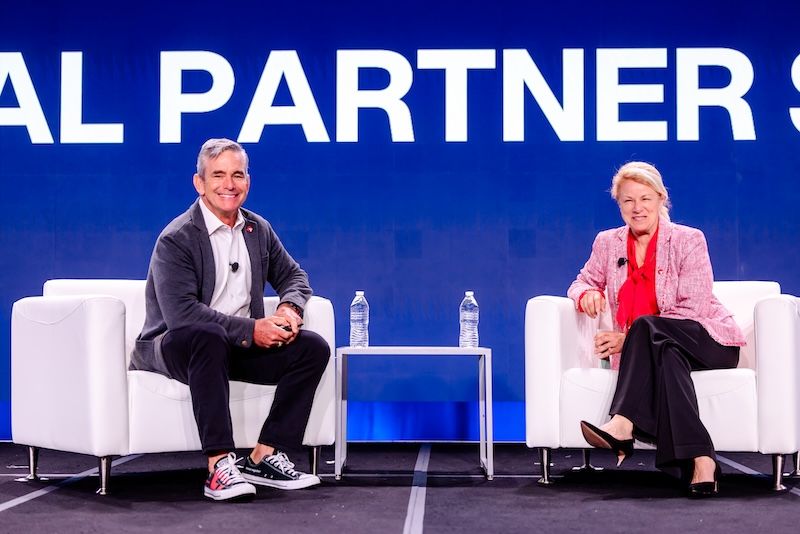
Ryan moved from Contrast to Saviynt in 2023, leading marketing for its identity security platform. In 2024, Women We Admire included her among its Top 50 Women Chief Marketing Officers. Tanium appointed her CMO in June 2025 to oversee brand, corporate marketing, global communications and demand generation. That autumn, she appeared onstage with then-CEO Dan Streetman to discuss the company's partner ecosystem and plans for a broader global presence.
The Tanium chapter was brief. Public reporting placed her departure in May 2026, amid a wider set of executive changes, and the company removed her from its leadership page. No subsequent operating role has been publicly announced. For a person who plans by sketching the future and checking it later, an open rectangle feels less like an absence than an honest diagram.
What remains visible is the method. Ryan has moved quickly without pretending that speed is strategy. She has used data without confusing dashboards for judgment. She has made categories without treating language as decoration. And she has argued, from inside an industry that once happily sold the end of the world, that customers respond to knowledge, candor and partnership.
There is also the farm. The metaphor has been used around Ryan before because it is almost indecently convenient, but convenience does not make it false. Cultivation asks for timing, systems and patience. A field cannot be frightened into growing. Neither can a market. Someone still has to understand the soil, name what is being planted and connect the beginning to the shelf.
Ryan's next public scene has yet to be filled in. Her stated ambition is already clear enough: spend the least required to achieve the most, help leaders navigate change, and create companies, programs and brands people remember years later. It is an operator's goal with a storyteller's aftertaste. The clever part is not making complicated software sound simple. It is making the real value clear without lying about the complication.