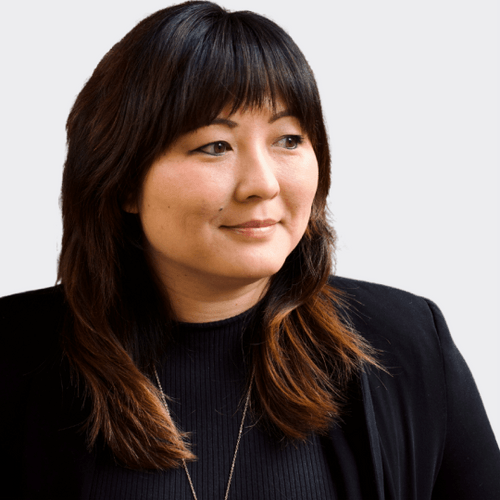
Who She Is
Twenty seconds. That is all Grace Chang's AI needs. Not a questionnaire. Not a clinical intake form. Not the forty-five minutes of a $450-an-hour therapy session she once had to pay out-of-pocket because she could not find care for six months. Just twenty seconds of your voice - talking about anything, in any language - and Kintsugi's model would tell you, with 80% clinical accuracy, whether you were carrying depression or anxiety.
Chang arrived in the United States from Taiwan as a child, one of the immigrants who came with modest means and rebuilt from scratch. She studied computer science at USC on scholarship in 2000, joining a cohort of 230 students where she was one of two women. She described it plainly: the ratio did not improve much as she climbed through Silicon Valley over the next three decades. Some executives told her to "stay in your lane and act more subservient." She built companies instead.
By 2018, she was Head of Product at UnifyID, an authentication startup that launched at TechCrunch Disrupt and became a runner-up in Startup Battlefield, won at South by Southwest, and raised a $20 million Series A with just five people on the team. Chang had a knack for signal processing - the math of extracting meaning from noise. She did not know yet that she was about to apply it to a different kind of signal entirely.
The pivot came from burnout and a trip to Japan. After struggling for six months to access mental health care and ultimately paying $450 an hour for therapy, she recognized the gap between need and access was not a rounding error - it was structural. In Japan, she encountered the ancient art of kintsugi: broken ceramics repaired with gold, the cracks made visible rather than hidden, the object more beautiful for having been broken. She came home with the name of a company she had not yet started.
At an open AI hackathon in San Francisco in 2019, she met Rima Seiilova-Olson - a machine learning scientist who had grown up in a yurt in Kazakhstan without running water or electricity. They were a startling pair: one raised in Taiwan, the other in Central Asia; one an engineer-entrepreneur, the other a researcher. Together, they built Kintsugi. The company received an NSF Phase I grant in October 2019 and never looked back.
From the very early days, I was interested in understanding how things were put together from the ground up.
What Kintsugi built was genuinely strange and important: an AI that listened to how you spoke, not what you said. The model analyzed vocal biomarkers - pitch, cadence, timbre, micro-pauses - patterns that correlate with clinical depression and anxiety. Because it did not process language content, it was language-agnostic. It worked in Mandarin, Spanish, Japanese, English. It worked across gender and socioeconomic background. Chang insisted on building the world's largest annotated voice dataset for mental health machine learning - 110 times larger than competitors - specifically to avoid the algorithmic biases that plague healthcare AI built on unrepresentative training data.
The platform, Kintsugi Voice, found its way into clinical call centers processing 20 million calls annually. Kintsugi was selected as one of 10 companies from 2,600 applicants to work with UnitedHealth Group. In 2024, Kintsugi became Japan's default mental health screener. A peer-reviewed paper appeared in the Annals of Family Medicine in January 2025. Kintsugi hit a 5000% growth in patient screenings over one year. Seven new partnerships. Zero customer churn. A perfect NPS of 10.
Then, in February 2026, Grace Chang announced that Kintsugi would cease commercial operations and release all of its research, models, and technology into the public domain. The reason was not failure - it was physics. FDA regulatory pathways for AI-based diagnostics are expensive and slow. A venture-backed business model could not survive the cost and timeline. Rather than watch the technology sit behind a paywall or quietly dissolve, Chang chose the harder thing: open source everything, let the science live in the commons, give the work a future outside the limits of any single company.
It was a kintsugi move. The company cracked. The gold is visible now.