The first Grön bar had none of the polish now telegraphed by its tidy umlaut and jewel-toned boxes. Christine Apple, then a Portland architect looking for a creative outlet, used Rick Simpson Oil in chocolate because chocolate was shelf-stable and its fat could carry cannabinoids. The result, by her later account, was not exactly gourmet. It was, however, a clue. Oregon’s medical shelves had plenty of perishable cannabutter experiments and too few reliable confections. Apple had found a product problem more interesting than the packaging-design work she originally imagined doing for cannabis companies.
In 2015, after Oregon voters approved adult use, she cashed out stock options from her architecture job and put $50,000 into a tempering machine, a license and rented space. A 2,000-square-foot kitchen followed. One driver carried hard-wrapped bars into dispensaries in a shoebox. Apple worked with testing labs until dosage became consistent, kept improving the chocolate and, within roughly a year, left architecture. The basement diversion had become Grön, pronounced “grewn,” the Swedish word for green.
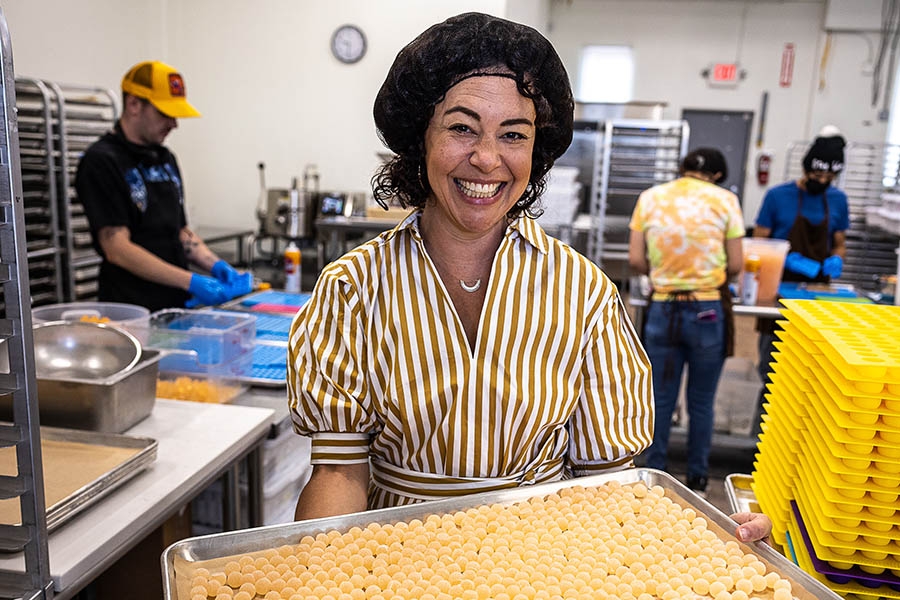
The product is a feeling, translated into candy
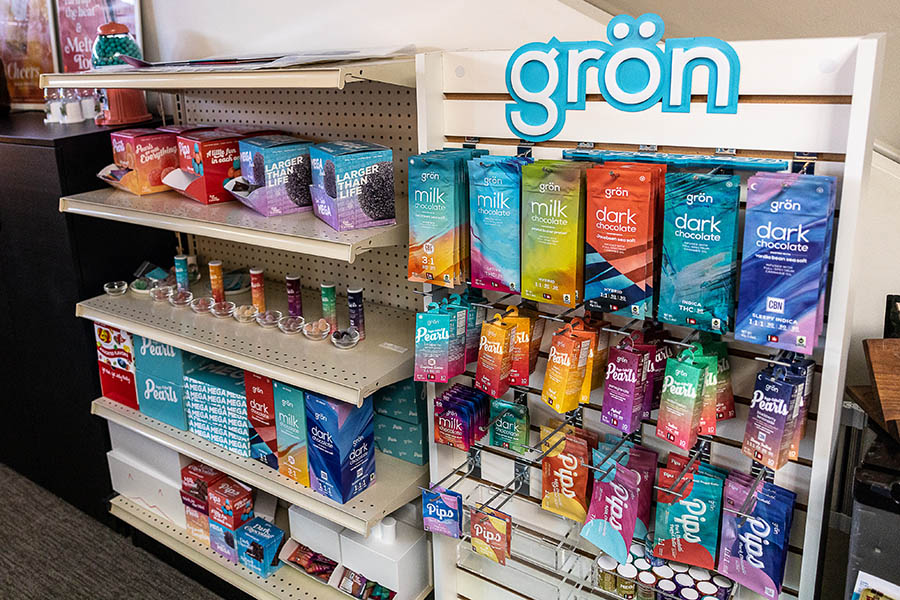
Grön makes cannabis edibles for adults who prefer not to smoke and want more control than a homemade brownie can offer. Its shelf now spans Sugar-Coated Pearls, single-piece MEGAs, candy-coated chocolate Pips, scored chocolate bars and a newer line infused with solventless hash rosin. Potency changes with local rules. The conceptual system travels: bright fruit, clear portions and ratios of THC with cannabinoids such as CBD, CBG, CBN, CBC and THCV.
That ratio architecture is the useful distinction. A customer does not arrive at a dispensary dreaming of a 1:1:1 chemistry lesson. The customer wants to stay social, settle down or sleep. Grön sorts products into daytime, anytime and nighttime occasions, then gives the technical formulation a flavor and a visual identity. Tangelo Pearls, for example, were built around THC, CBC and CBG for an energetic positioning. Blackberry Lemonade and Tart Cherry lean into CBN and nighttime use. These are brand descriptions, not medical prescriptions, and individual responses to edibles vary. Grön’s own guidance is admirably unromantic: start low, wait as long as two hours and do not stack doses impatiently.
A product ladder, not medical guidance
Exact milligrams and permitted serving sizes vary by market. The point is segmentation: control for newcomers, value for high-tolerance and medical buyers.
The range also admits that cannabis consumers are not one consumer. A first-timer may want a divisible Pearl and a quiet evening. A medical or high-tolerance buyer in a market that permits it may care about milligrams per dollar. Grön’s 1,000mg BIG BAR, introduced in Missouri and Arizona in 2025, was explicitly pitched as more potency and value. The same brand can sell restraint and abundance because the formats announce whom they are for.
“You have to bring something to the market that is a value proposition that’s not currently available.”Christine Apple, on entering cannabis now
Chocolate built the company. Gummies changed it.
Founders are often advised to stay loyal to their origin. Grön was more loyal to the shelf. It added Pearls in 2019 as gummies took a larger share of edibles. By 2025, Apple said CBN products represented 30 percent of the portfolio, while an R&D team tested new flavors, minor cannabinoids and rosin. Chocolate remained the craft credential - Grön says it became the first cannabis edibles brand to use Fair Trade Certified cacao in 2019 - but gummies supplied portability, portioning and consumer momentum.
The turn was not painless. Oregon regulators restricted certain artificially derived cannabinoids in general retail channels in 2022. Grön discontinued its CBN-only line after its leading item was caught in the change, though regulated dispensary sales offered a path for other CBN products. Supply shocks also forced recipe changes when ingredients such as coconut became difficult to source. A McMinnville dispensary operator told Oregon Business that his stores had stopped carrying Grön because newer products moved faster. The home market was saturated, and being early did not grant permanent shelf space.
Those setbacks altered the map. Oregon had supplied about 40 percent of Grön’s revenue in 2022, but that share was falling as the company expanded. Apple initially prized self-funding and internal growth. By 2023, she had changed her mind about outside capital: new state markets offered brief windows to establish share, and cash generated at home was not enough to move at the desired speed. In May 2024, AFC Gamma supplied Grön Holdings with an undisclosed first-lien senior secured credit facility for expansion. Bootstrapping had been a tactic, not a personality test.
Inside the company, Apple described a seven-person leadership group that operated more like a board than a command chain. Decisions were shared; once made, the group moved together. The arrangement carries an architect’s fingerprint: specialists argue over a plan, then coordinate around one set of drawings. It also fits a business where food science, compliance, sourcing, sales and package design can each veto a launch. Grön’s women-led identity was visible, but the practical cultural claim was collaboration across those disciplines. A confection cannot be merely clever. It has to taste right, test right, survive a shelf, satisfy a regulator and make immediate sense to the person staring at a crowded dispensary case.
How to scale a product that cannot travel
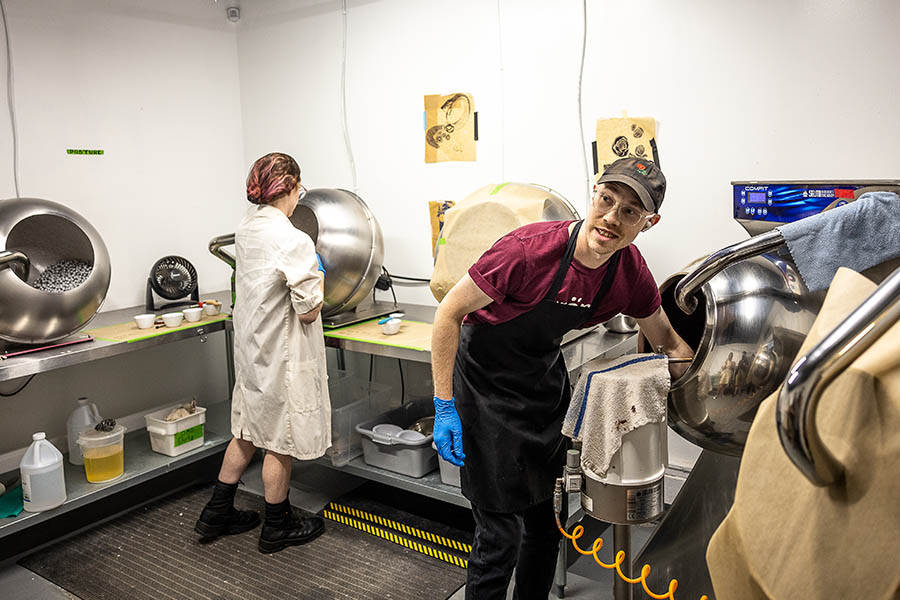
Federal prohibition creates the central absurdity of American cannabis manufacturing. A perfectly legal Oregon chocolate bar generally cannot cross into another state and land on a licensed shelf. Grön’s workaround was to make the operating recipe portable. Portland could ship packaging, candy ingredients and specifications. Cannabis would be sourced and the final product made inside each jurisdiction, either by Grön staff in a partner’s licensed space or through a licensing arrangement resembling a franchise.
The model preserves what customers notice - flavor, visual language and expected experience - even when the underlying cannabis input cannot be identical. It also reveals the business Grön is really in. The factory makes candy. The company makes a repeatable system for making regulated candy in disconnected markets.
Distribution adds another human constraint. Cannabis brands often cannot speak freely to consumers through ordinary advertising or direct commerce. At the decisive moment, a budtender explains the shelf. Apple has noted that Grön trains budtenders, who then advise shoppers, sometimes with a high-dose user’s bias toward stronger products. For Grön, education is not ornamental content. It is channel infrastructure. The brand’s dosage guides and occasion-based labels help a retailer translate the range without reciting a pharmacology textbook.
The $4.8 billion handshake
By January 2026, Grön reported 75 products in nine U.S. states and Canada, nearly 4,500 retail doors and about 300 employees. Forbes, citing BDSA, described it as the fourth best-selling U.S. edibles company. That month, fellow Oregon company Wyld announced it was acquiring Grön for an undisclosed price. Wyld brought a footprint of roughly 7,500 locations, 16 states and Canada. Together with Wyld’s Good Tide brand, the group could cover fruit gummies, candy flavors, chocolates and rosin products.
The acquisition announcement was unusually specific about what would not happen: no formula changes, no new co-branded packaging and no “a Wyld company” badge. Grön’s existing team would keep guiding brand strategy and product innovation. The promise makes strategic sense. Wyld did not need another version of itself; it wanted Grön’s chocolate credibility, format range and colorful interpretation of effect-focused eating. Grön, in turn, gained supply reliability and distribution infrastructure that years of licensing had proved expensive to assemble one state at a time.
That does not make the playbook universal. Effect-oriented branding works only if testing and dosage are dependable. Licensing works only with trustworthy local operators, vigilant quality control and enough margin to support duplicated production. Premium ingredients help when consumers can perceive and afford the difference. And the entire model sits beneath rules that can change by state, product and cannabinoid. A founder copying the bright package while skipping compliance, working capital and retailer education would be copying the wrapper, not the machine.
Five things worth stealing
- Translate technical features into a human occasion, then keep the evidence visible.
- Solve reliability before luxury. The rough bar taught Grön what had to work first.
- Build a dose and price ladder instead of pretending every customer wants moderation in the same form.
- When the finished product cannot travel, package the process so it can.
- Treat the person explaining your product at checkout as part of the product itself.
Grön’s neatest achievement is not that it made cannabis look like candy; plenty of companies do. It made a fragmented, technical purchase feel legible without hiding the adult responsibility underneath. The result began with an architect’s dissatisfaction, survived an ungourmet prototype and became valuable enough for the category’s largest operator to preserve rather than repaint. That is a good ending for a brand built around precise portions: the buyer wanted the whole thing, exactly as it was.