Sixty-two wireless devices is a lot of company for one house. In 2017, Gopi Reddy Sirineni explained his domestic collection with the cheerful economy of an engineer: “I test all this stuff.” Most people acquire a router and hope to forget it. Sirineni had given his network enough companions to make forgetting it rather difficult.
At the time, he was a Qualcomm executive working on the connected home. The number is a small, revealing detail. A wireless network looks orderly on a presentation slide. Inside a house, devices compete for attention, walls intervene and people wander away from the access point. The engineer has to account for the inconvenient habits of both buildings and their occupants.
Today, Sirineni leads Axiado Corporation, where the surroundings are larger and the electricity bills less forgiving. His work concerns the security and management of AI infrastructure. The connection between these chapters is an interest in systems that can notice what is happening nearby and respond. First came the household network. Now comes the machinery underneath AI.
Diamond, heat and a teacher’s son
His early curiosity had an actual object to work on: the family television. Growing up in India, Sirineni took it apart to investigate the electronics. His father was a teacher. He remembers a lesson about knowledge increasing when it is shared, a useful principle for someone whose later work would require many people to understand the same complicated thing.
He studied electronics and communications engineering at Osmania University in Hyderabad, then pursued a master’s degree in electrical engineering at the University of Arkansas. There, William Brown and Hameed Naseem became mentors. A university education put names and methods around the curiosity that had once led him inside the television.
A 1995 research paper supplies an unexpected early chapter. Sirineni co-authored a study of polishing chemically deposited diamond substrates using reactive ion etching. The work concerned multichip modules, packages that bring several semiconductor dies together. Diamond offered a way to conduct heat away, but its rough surfaces complicated the job. The researchers investigated methods for preparing those surfaces more effectively.
The University of Arkansas later recognized him with a Distinguished Alumni Award for 2020. By then his work had traveled well beyond the laboratory. The recognition ties the executive biography back to the place where his curiosity had become formal research, with collaborators and an experiment that other people could examine.
It is a pleasingly physical starting point for a career now associated with AI. Heat already mattered. So did the gap between a material’s attractive properties and the work required to make it usable. A diamond in this story was something to polish for a circuit, which would make a rather disappointing engagement present.
The network learns to share
Sirineni’s subsequent career included Integrated Device Technology, Marvell, Cavium and AppliedMicro, along with leadership work at Ubicom. He also founded Cloudgrapes, a cloud-transcoding business. These were jobs around the mechanisms that carry, process and convert information. The scenery changed, but the practical question of what a customer could do with the technology kept returning.
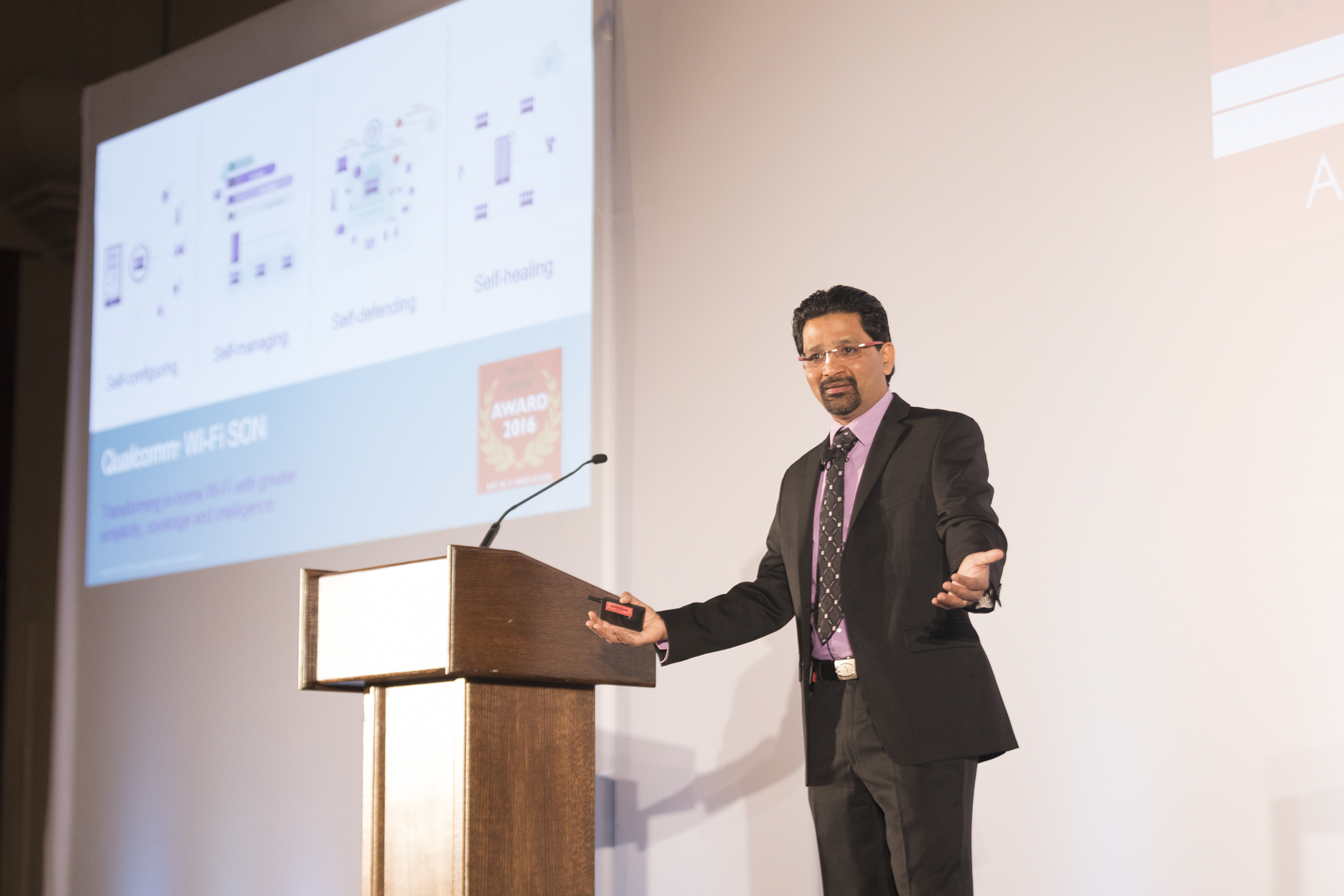
Qualcomm acquired Ubicom in 2012, bringing Sirineni into a company where he spent roughly eight years. He led whole-home Wi-Fi strategy and drove development and launch of Wi-Fi SON, the Self-Organizing Network software associated with distributed Wi-Fi products. Several access points could work together as conditions changed around them.
The idea reached a recognizable consumer product in 2016. Qualcomm collaborated with NETGEAR on Orbi, combining its radio chipsets with Wi-Fi SON. A dedicated wireless connection linked the router and satellite units, while software helped manage the network. The intended benefit was coverage throughout the home with less setup trouble and fewer dead zones.
For the customer, the useful detail was the connection in the room where it had previously been unreliable. For Sirineni, the business involved turning coordinated devices into an understandable proposition. Networking vocabulary is formidable; a household’s demand is refreshingly blunt. The internet should reach the place where someone wants to use it.
Cognitive Systems brought him in as an executive advisor in February 2020. Its work used Wi-Fi signals to sense motion, giving familiar wireless equipment another purpose. The appointment kept him close to a question that had already occupied him at Qualcomm: what else becomes possible when a system understands its surroundings? Ubilite’s later board announcement also emphasized his role in explaining new technology to customers through speaking and media work.
A chip has to earn its place
He joined Axiado as president and CEO in April 2020. The company was developing its product and needed financing. Sirineni had to learn the business closely enough to explain why customers would want what it was building. A technical idea, however persuasive to its designers, still has to survive that conversation.
Axiado completed a $25 million Series B in 2021. The company followed with a $60 million Series C in December 2024 and a Series C+ exceeding $100 million in December 2025. Maverick Silicon led the latter two rounds. Financing gave the work room to continue, while product development, integration and customer adoption supplied their own tests.
The object at the center of Axiado’s work is the Trusted Control/Compute Unit, or TCU. In Sirineni’s account, security needs an observer close to the system hardware, alongside existing software defenses. The chip combines platform management with hardware-rooted trust and AI capabilities. It is intended to watch behavior where control of the machine is exercised.
He explains proximity with a bank-heist analogy. Once someone has entered a building, the location of the defender matters. Axiado wants its technology close to the valuable contents. The analogy makes a technical distinction legible without demanding that the listener first become an expert in server firmware.
His explanation also leaves room for learning. The AI models observe behavior on a particular platform, identify anomalies and compare patterns. When behavior is suspicious, responses can focus on a particular application or component. In his account, collecting information and adapting models are part of the process. A guard who simply declares everything suspicious soon becomes a problem of his own.
The megawatt already in the room
By late 2025, Sirineni was discussing hardware-resident AI agents that addressed efficiency as well as security. The same broader platform-management effort included dynamic thermal management and dynamic voltage and frequency scaling. Those names describe practical adjustments to cooling and to how processors operate as their workloads change.
In September 2026, Axiado presented its infrastructure argument in terms of more tokens per dollar. Tokens are units used in processing AI language workloads. The company reported measurements showing reductions in CPU, GPU and air-cooling power on production-class systems. Its stated outcome was 10 to 30 percent more tokens per dollar. Those are company-reported results on the systems tested; the percentages describe different components and cannot be added together.
“The cheapest megawatt you will ever get is the one you’re already wasting.”Gopi Sirineni / September 2026
That is an unusually tidy sentence for an industry with a fondness for untidy racks. It shifts the conversation toward getting more useful work from equipment already deployed. Buying another processor is one kind of decision. Learning when to change power or cooling is another, and it gives Sirineni’s local-intelligence argument an economic expression.
On October 12, 2026, Axiado announced a collaboration with Arm to integrate its TCU-powered Data Center Secure Control Module cards with the Arm AGI CPU platform. The engineering work uses standards including OpenBMC, OCP DC-SCM and Redfish. It puts his current proposition into the practical language of modules, interfaces and integration.
His writing offers another route into the argument. As a Forbes Business Council contributor, he has published articles about AI and cybersecurity, ransomware and data-center defenses. Those subjects follow the concerns of his executive work. Explaining an architecture to people responsible for budgets and operations requires a different vocabulary from explaining it to the engineer designing a board. Sirineni has made both conversations part of his public work.
The wider professional circle still includes networking. Sirineni sits on Codelucida’s board and has advisory roles at Cognitive Systems and Aprecomm. Ubilite announced his board appointment in March 2026. Moving into AI infrastructure has given him another set of problems without requiring him to abandon the field that occupied much of his career.
The coach beside the circuit board
The leisure list is lively: painting, motorsports, dirtbiking, paragliding, diving and bungee jumping. Painting at least offers the possibility of staying in one place. Sirineni has also coached children in the National Junior Basketball League, describing teams that competed nationally and won two regional championships. He speaks about the satisfaction of helping young people develop.
His account of leadership gives a particular person credit. Marvell co-founder Sehat Sutardja taught him to care for a team and help people feel that they belong. Sirineni pairs that with a focused vision, problem-solving and attention to the measures that matter. The coach’s work and the executive’s work both require other people to understand what they are trying to achieve together.
There is also responsibility in his account of being the oldest son. He describes having to face problems and show younger people how to deal with them. “Take the lead,” he says. It is a compact explanation of leadership, with the emphasis on doing something that others can see and learn from.
When advising younger people, he has urged them to find an inspiration and stay focused on it, while keeping balance in their lives. That seems a fitting close to a career which makes room for research, wireless networks, company building and a paintbrush. The devices demand coordination. So do the people. Sirineni has spent a working life giving both his attention.