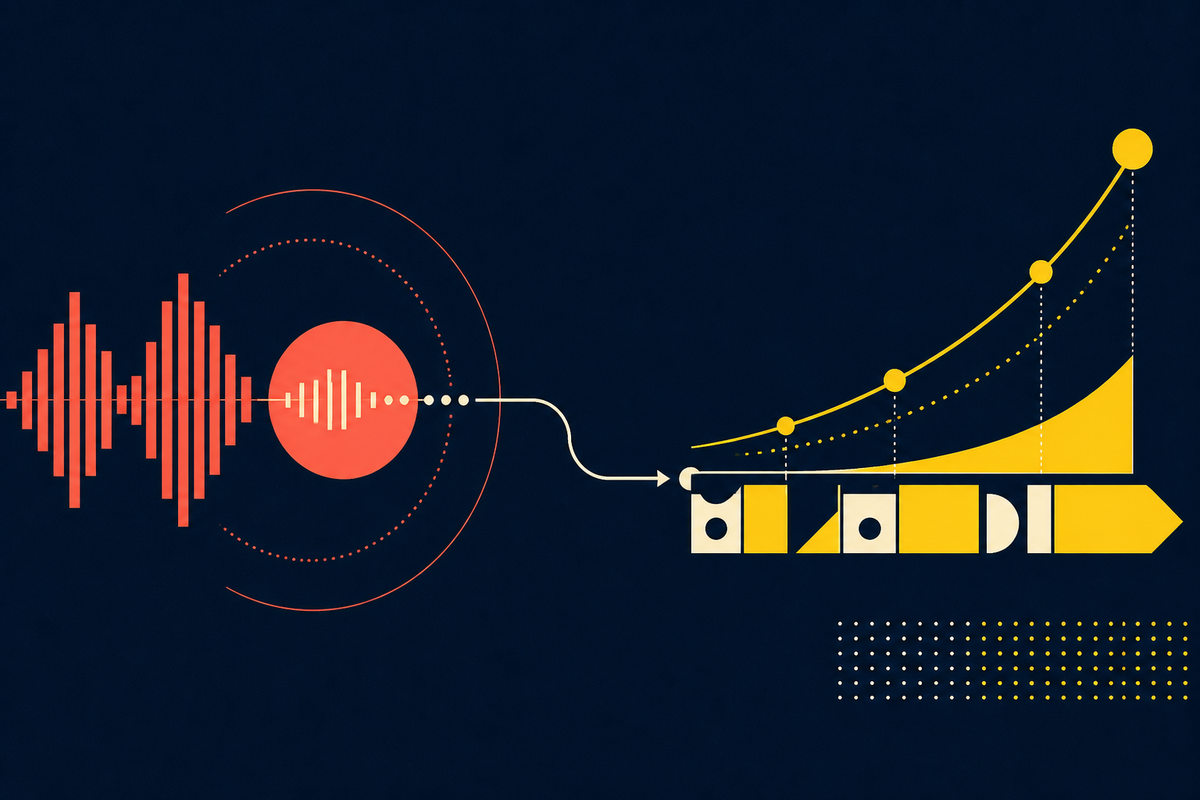
The fastest way to misunderstand Gong and Clari is to open two browser tabs and count features. The resulting spreadsheet will look reassuringly complete and tell you almost nothing. Both vendors can capture signals, inspect deals, surface risk, and help leaders forecast. Both pitch an AI-powered home for the revenue organization. The interesting difference sits further upstream: the raw material each product learned to trust first.
Gong grew up listening. It records customer interactions, transcribes them, makes them searchable, and looks for the moments that change a sale: an objection, a competitor, a promised next step, a missing decision-maker. Its native unit of evidence is the conversation. A frontline manager can hear what happened without asking a rep to reconstruct Tuesday’s demo from memory.
Clari grew up rolling the number. It connects CRM and activity data to the rituals through which a company manages revenue: deal inspection, pipeline review, manager judgment, forecast submission, and executive roll-up. Its native unit of evidence is the opportunity moving through an operating system. A CRO can challenge whether “commit” means the same thing in every region before carrying that number into the board meeting.
Conversation capture, buyer language, coaching moments, next steps, and interaction-derived deal risk.
Forecast roll-ups, pipeline inspection, revenue models, manager calls, and governed operating cadence.
The overlap is real. So is the product gravity.
The neat one-line comparison needs an asterisk. Gong now offers Gong Forecast, which says it combines interaction signals with CRM data and uses more than 300 signals to predict deal outcomes. Clari added Copilot, the product formerly known as Wingman, to record and transcribe calls, surface live battlecards, capture next steps, and send buyer signals into broader revenue workflows. Anyone claiming Gong cannot forecast or Clari cannot understand a call is describing an older market.
The corporate map has changed, too. Clari and Salesloft completed their merger in December 2025. In July 2026, the combined company launched Salesloft Conversation Intelligence, positioning buyer signals as a live layer feeding execution, coaching, AI agents, and forecasts. Buyers evaluating “Clari” now need to examine both the current Clari workflow and the combined roadmap. The merger does not erase Clari’s forecast heritage; it gives that heritage a much larger execution surface.
Yet suites carry the habits of their first successful users. In Gong, the route to insight often begins at the call: listen to the recording, inspect a moment, compare behaviors, coach the rep, then connect that evidence to deal health. In Clari, the route often begins at the operating cadence: inspect the pipeline, compare changes, challenge a submission, drill into risk, then pull in activity and conversation evidence. Similar destination, different front door.
A transcript is evidence. A forecast is a commitment. The buying decision turns on which one your team cannot produce reliably.
This matters because software adoption is mostly ritual. A feature buried three clicks deep does not become a management practice because procurement checked a box. The best platform is the one that fits the meeting your company is prepared to run every week. If managers need to coach discovery, test talk tracks, and stop relying on anecdotal call reports, Gong’s conversation-first shape is legible. If regional leaders need consistent forecast categories, scenario visibility, and a disciplined path from rep judgment to company number, Clari’s forecast-first shape is legible.
From signal to decision
Diagnose the expensive blind spot
Start with the failure that already has a cost. Perhaps a manager spends Friday night sampling recordings because coaching happens from vibes. Perhaps the CRM says a deal is healthy while the buyer has gone quiet. Perhaps every vice president uses a private definition of “best case,” turning the forecast call into political theater. These problems can coexist, but one usually hurts more now.
Gong deserves the first look when the missing truth lives in buyer interactions. The practical jobs are concrete: review a call without sitting through an hour, find every mention of pricing or a rival, build a library of good discovery, verify whether a next step was mutual, and coach from observed behavior. Its own documentation describes recordings, transcripts, and AI insights becoming available after a call, with searchable moments and shareable recordings. That workflow reduces the tax of secondhand retelling.
Clari deserves the first look when the missing truth lives in aggregation and governance. The practical jobs are different: reconcile the CRM with actual activity, inspect which deals changed, roll individual calls into a team forecast, model different revenue types, and make forecast categories consistent. Clari’s Forecast material emphasizes automated roll-ups, scenario modeling, and support for subscription and consumption models. Its Inspect product focuses on deal risk, pipeline accuracy, and guided action.
This scorecard describes product emphasis, not exclusive capability. Packaging changes and enterprise configurations vary; verify the exact modules in each proposal.
The questions demos try to outrun
First, ask for the path from insight to action. A demo may identify a risk with impressive speed. Who receives it? Where? What decision changes? Who closes the loop? If a warning lives in another dashboard, it can become highly accurate shelfware. Have the vendor show a real workflow inside the CRM, manager review, messaging tool, or forecast cadence your team already uses.
Second, test the data boundary. For conversation intelligence, sample the accents, languages, call platforms, and noisy conditions your team encounters. Review consent controls and recording rules by region. Gong’s help center, for example, documents configurable recording behavior, which matters in a multinational rollout. For forecasting, bring ugly opportunities: renewals, usage-based revenue, overlays, partner deals, split credit, and late-stage exceptions. A clean demo account hides the work your admins will inherit.
Third, make permissions visible. Recorded customer conversations contain product plans, pricing, personal information, and commercially sensitive details. Forecast data contains another kind of sensitivity: targets, performance, judgment, and executive expectations. Ask who can search, export, share, train models on, and retain each class of data. Security review should follow the information, not the category label.
Fourth, insist on commercial clarity. Gong publicly says its pricing includes per-user licenses plus a platform fee based on supported users. Clari presents tailored pricing and says integrations and continuous support do not carry extra platform fees. Neither site gives a buyer enough numbers to calculate total cost alone. Compare the quote, required modules, implementation, storage, seats, premium AI functions, support, renewal terms, and the cost of keeping overlapping tools.
Finally, measure adoption without accepting logins as success. For Gong, useful pilot measures might include coaching sessions completed, time saved reviewing calls, CRM fields populated, or a targeted behavior changing across the cohort. For Clari, measure time spent preparing forecasts, changes caught before a call, manager overrides, stale opportunities resolved, and variance between submitted and actual revenue. Accuracy is important, but a short pilot may reveal process improvement sooner than it proves a quarter-level outcome.
Run a pilot small enough to tell the truth
Choose one sales team, one manager, and one recurring meeting. Write down the behavior you want before either vendor configures the demo. “Improve coaching” is too soft. “Every rep gets one evidence-backed discovery review each week” can be observed. “Improve forecasting” is too broad. “Managers resolve every deal with no next meeting before submitting commit” can be observed.
Then use the same ten or twenty real opportunities in both evaluations. Give each platform the same CRM history and, where lawful and consented, the same set of interactions. Ask vendors to configure the workflow rather than tour the catalog. Run the meeting. Watch which questions still require spreadsheets, private messages, or a rep’s memory. The friction is part of the result.
There is also a respectable answer in which a company uses both, especially when conversation coaching and enterprise forecasting are independently mature, high-value programs. But overlap creates its own bill: duplicate integrations, competing scores, unclear system ownership, and another reconciliation meeting. A two-platform architecture needs an explicit data contract. Decide which system owns the forecast, which owns call artifacts, how deal risk travels, and what sellers must update.
The more common answer is to pick a center of gravity and earn the expansion. Gong begins with the voice of the customer and moves toward the number. Clari begins with the number and moves toward the voice of the customer. Your choice should begin with neither company. It should begin with the Monday meeting where your team currently guesses.
Questions buyers keep asking
Can Gong forecast revenue?
Yes. Gong Forecast combines interaction signals and CRM metrics to flag risk, predict deal outcomes, and support forecast workflows.
Can Clari record and analyze calls?
Yes. Clari Copilot records and transcribes conversations, provides live coaching and battlecards, and sends buyer signals into Clari workflows.
Which is better for coaching?
Gong is the more natural starting point when searchable calls and manager coaching are the core need. Clari Copilot also has live coaching, so test both against the same coaching routine.
Which is better for forecasting?
Clari’s product heritage and operating model are centered on forecasting and pipeline governance. Gong Forecast is a direct competitor that adds conversation-derived signals, so the final choice should follow a live pilot.
Should a company buy both?
It can make sense for mature programs with separate owners, but define system ownership and data flow first. Otherwise, overlapping scores and workflows can add cost and confusion.