Every enterprise sales team owns two pipelines. One lives in Salesforce. The other lives in half-remembered calls, private Slack messages, hastily typed notes and the upbeat interpretation a rep gives the manager on Friday morning. Spotlight.ai has built a business in the distance between the two. The Boston company plugs into the systems where selling actually happens, collects the evidence and tries to keep the official record from becoming expensive fiction.
The company calls its product a Deal Autopilot. The phrase is marketing, but it describes a real distinction. Conversation-intelligence software records and summarizes. Forecasting software rolls up CRM data. Spotlight wants to continue down the assembly line: identify the champion and economic buyer, score the opportunity against MEDDICC, expose missing evidence, recommend the next move, update the CRM and generate the follow-up or business-value deck. The desired endpoint is not a smarter dashboard. It is less work waiting behind the dashboard.
The boring middle is the product
Spotlight.ai was founded in 2021 by Roi Carmel, Nadav Efraty and Alec Belfer. Its first identity was narrower: a value-intelligence platform for better discovery, quantified business cases and sharper value positioning. That remains part of the product, especially for business-value consultants. But the company’s public language has widened toward autonomous deal execution - a suite for reps, managers, RevOps teams and value leaders.
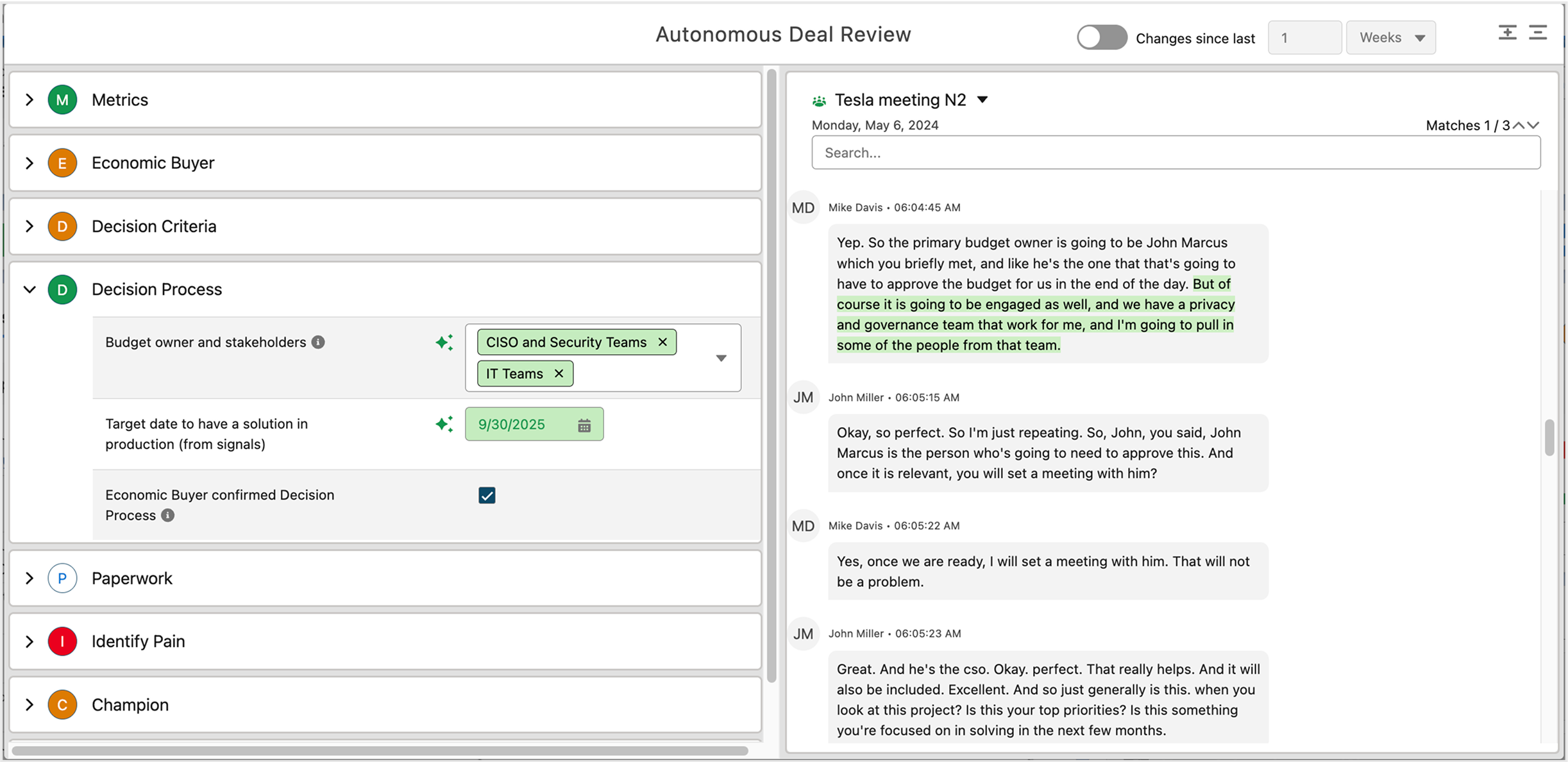
That shift makes sense because business cases do not begin in PowerPoint. They begin when a buyer admits a bottleneck, gives a metric or names the person controlling the budget. If that sentence stays buried in a transcript, the value consultant must chase the rep, the rep reconstructs the conversation and somebody eventually builds a slide from memory. Spotlight tries to make the sentence reusable data. It stores the evidence beside the structured answer, then lets that answer flow into qualification, forecasting and collateral.
A knowledge graph, not a transcript pile
The center of the pitch is Spotlight’s enterprise-sales knowledge graph. The company says it contains more than 40 million signals, informed by over $8 billion in managed opportunities, plus industry context, customer playbooks and each organization’s win-loss patterns. The point is not that 40 million is a magical number. It is that a sales judgment depends on relationships. A friendly evaluator is not automatically a champion. A champion without access to the economic buyer is not automatically good news. A close date without a mapped paper process is mostly a wish with a calendar invite.
“The model is infrastructure. The knowledge is the product.”Spotlight.ai’s argument for domain-specific sales AI
Spotlight breaks big concepts into smaller evidence signals, then rolls them back into decisions. In the interface, a manager can move from a portfolio forecast to one opportunity, from that opportunity to a MEDDPICC element, and from the element to the customer sentence that supports it. This is the company’s cleanest competitive answer. Gong can capture a conversation. Clari can aggregate a forecast. Salesforce can remain the system of record. Spotlight wants to be the connective tissue that turns those records into an inspected decision and then writes the result back.
It can also expose the knowledge graph through Model Context Protocol, allowing a customer to build its own GTM agent on top. That product choice is savvy. A buyer may want Spotlight’s reasoning layer without adopting every Spotlight interface. The company gets to be either the finished car or the engine under somebody else’s dashboard.
Who buys it, and what they buy
The natural customer is an enterprise B2B revenue organization with long cycles, several stakeholders and a qualification framework that managers care about but reps dislike maintaining. Salespeople get summaries, follow-ups, guidance and less data entry. Managers get evidence-backed deal reviews. RevOps gets cleaner structured data and pipeline analysis. Value teams get ROI models, business-value assessments, first-to-second-meeting decks, QBR materials and sales-to-customer-success handoffs without joining every call.
Public references include Wiz, MongoDB, Sysdig, Sprinklr, Tulip, NetSPI, Cribl and Verity. At Wiz, the company’s global head of business value described using the tooling to scale self-service for smaller deals. Spotlight later shared that the Wiz team produced more than 80 customer business cases with little value-team involvement in less than a year. That is the job in miniature: take scarce expert practice, encode the repeatable parts and reserve the expert for the deals that justify one.

Spotlight sells enterprise SaaS with modular entry points. Its public pricing page lists Deal Intelligence at $30 per month on a 12-month term, including automated qualification and deal review, opportunity scoring, adaptive guidance, QBR slides, Salesforce or standalone access and BI exports. Deeper Value Intelligence is custom-priced, and enterprise agreements can include services. The company has disclosed little about revenue or valuation. Supplied company data records a $750,000 convertible note, while public databases name Cardumen Capital as the investor.
What changed was the unit of ambition. Early Spotlight materials concentrated on the business-value specialist and the artifact that person produced. Recent materials start with the whole revenue operation and a squad of specialist agents. The insight behind that expansion is easy to follow: a useful business case depends on clean discovery, clean discovery improves qualification, qualification shapes inspection, and inspection shapes the forecast. Automating only the final deck leaves every upstream handoff untouched. The company now packages discovery, debriefing, qualification, inspection, research, content, value work and analytics as parts of one loop. It is a larger promise, but also a more coherent one.
What failed first
The first failure was not an algorithm. It was the old operating bargain: tell reps to fill in more CRM fields, ask managers to inspect them and hope the forecast improves. Manual MEDDICC tends to decay because the seller is busy, the update is retrospective and human memory likes positive evidence. The next generation of tools captured calls, but often left the judgment and action to a person. Spotlight’s product is a response to both failures.
Its own rough edges are more ordinary. Public reviewers have praised Salesforce integration, easy setup and faster presentation building, while noting slide formatting that still needs cleanup, trouble exporting a BVA and the absence of a desired Zoho integration. Those complaints matter. A deck that is 75 percent finished is useful; it is not autonomous. “Zero touch” should be treated as a direction and tested workflow by workflow, not accepted as a universal property.
Autopilot needs a road
The model weakens when a company has thin call and email capture, an inconsistent CRM, no shared qualification standard or a sales motion too simple to justify this machinery. It also struggles organizationally when legal, security or buyers will not permit the required interaction data to flow into an AI system.
The idea worth stealing
Carmel’s most portable advice is to stop shopping for an AI trend and start with a bottleneck. Pick the repetitive decision that delays work. Define what good evidence looks like. Connect the places where that evidence already appears. Automate one action and measure whether the downstream metric changes. Only then hand over more control.
Choose one painful workflow, such as post-call CRM updates or business-case drafts.
Store the source sentence beside the structured field so people can audit the answer.
A generic model cannot infer what a qualified deal means inside your company.
Count completed actions, saved hours, conversion and slippage - not generated summaries.
The approach will not work everywhere. A five-minute self-serve sale does not need a nine-agent squad interrogating its paper process. A team with no repeatable playbook will automate disagreement. And an organization that cannot connect conversations will leave the system reasoning from a partial record. The best conditions are the opposite: expensive deals, multiple stakeholders, observable interactions, a stable CRM and leaders willing to define evidence before they ask AI for judgment.
Spotlight.ai’s bet is ultimately less dramatic than the word “autonomous” suggests, and more useful for it. The company is not trying to remove the rep from the relationship. It is trying to remove the rep from the clerical loop around the relationship. If it succeeds, the forecast call becomes shorter, the CRM becomes more believable and the value consultant arrives only when expertise - not formatting - is required. That is a practical payoff hiding inside a very large AI metaphor.