The customer seemed to have changed their mind. At Carry1st, which connects games businesses with African consumers and their preferred payment methods, some purchases appeared to end in ordinary cancellations. People abandon checkouts. Dashboards count them. Everyone moves on.
Except some of these customers had encountered a payment window that failed to load. Global App Testing’s local testers helped expose the problem. In the company’s November 2023 case study, Carry1st payments manager Ankur Mishra reported that success on one payment method rose from 78% to 90%. That is a 12-percentage-point improvement. The transaction channel handled at least $300,000 in daily volume, he said; that figure describes money passing through the channel, not recovered revenue.
This is the interesting territory occupied by Global App Testing. A software failure can arrive dressed as weak demand, customer impatience or a disappointing international launch. The London company sells the people, coordination and evidence needed to investigate what actually happened.
A different outcome.
The world will not fit in a device drawer
Founded in 2013 by Ronald Cummings-John and Owais Peer, Global App Testing combines a software platform with managed testing services. Its current crowd pages advertise more than 100,000 vetted professionals and coverage spanning over 190 countries. That network is separate from its employee base. The distinction matters: customers are buying access to distributed testing capacity, supported by people who organize the work.
The basic assignment sounds simple. Take an app or website, select the conditions that matter, and ask suitable people to use it. Those conditions can include an operating system, language, location, payment instrument or particular customer profile. The outputs include bugs, recordings and observations that an internal team can examine.
Global App Testing’s payment offer gets unusually literal about the word “real.” Testers can have the local cards, bank accounts and wallets required to complete a transaction. Its broader targeting covers low-end devices and everyday connectivity conditions. For a payments manager, the useful question is whether the entire journey works where the customer lives.
Its customers extend beyond payment businesses. FPE Capital, its investor, names Google, Microsoft, General Electric and Booking.com among the brands using the service. Product teams can investigate usability; localization teams can inspect an experience in context; engineering teams can check releases. The common problem is an internal team whose reach is narrower than its product’s audience.
That makes local knowledge part of the product. A tester who can complete a payment journey supplies access as well as labour. For a company entering a new country, that can be more useful than buying another handset for headquarters. The task is to recreate a customer’s circumstances closely enough to understand the obstacle, then make the observation useful to the people building the software.
Wednesday becomes Tuesday
Airportr, the baggage collection and check-in business, provides a less dramatic but easily understood result: time. Its QA lead, Roman Nowab, engaged Global App Testing in 2021 as the company recovered from the pandemic. By the published November 2023 account, his small team faced an audience in which 77% of users were on mobile or iPad.
Testing more devices was only part of the burden. A multilingual service also meant checking customer communications, including email and SMS. Airportr used GAT across 17 countries and reported saving a day of testing per sprint. Meanwhile, its internal automation coverage had risen from zero to approximately 15%.
“I used to release on a Wednesday. Now I release on a Tuesday.”
Roman Nowab / Airportr, quoted by Global App Testing
That combination is instructive. An external human testing service can free an internal team to write more automated tests. The Airportr case describes a change in how the team spent its time. It gives a buyer something concrete to examine: which work is consuming the release calendar, and which work becomes possible if somebody else takes it on?
A crowd needs a control room
Recruiting testers is only the start. A useful finding needs a clear description, the circumstances in which it occurred and enough evidence for an engineer to reproduce it. Otherwise the recipient inherits another mystery. Global App Testing’s platform organizes that handover through environment information, test media, severity, sorting controls and retesting.
Customers can configure a test themselves or work through the managed service. The available approaches include executing written test cases, exploratory testing and surveys. These answer different questions. A written case checks an expected path; exploration gives someone room to discover an unexpected problem; a survey collects judgments about an experience.
- SpecifyJourney + market + conditions
- ObservePeople use the actual product
- InvestigateMedia + context + reproducible steps
- RetestCheck the repaired journey
The company advertises connections with Jira, GitHub, TestRail and SmartBear Zephyr, alongside an API and webhooks. The purpose is practical: feed findings into the systems a development team already checks. TestRail’s integration, for example, joins test management to crowd execution and brings the results back into a common view.
There is a community behind the machinery. GAT runs Testathon, its hackathon-style gathering for testers, and directs prospective contributors to Tester Work. Turning the search for defects into a competitive event is an unusually cheerful recruitment proposition. It also makes visible a skill that usually receives attention only after something breaks.
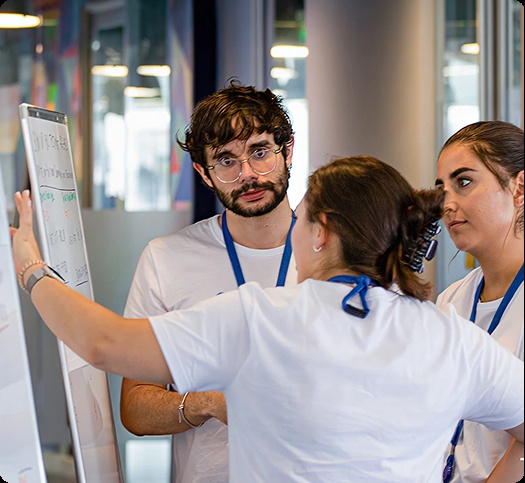
The company’s employment culture is more ordinary than its global testing footprint might suggest. Recruitment material lists flexible working, private healthcare and an employee assistance programme. Public employee reviews praise colleagues and flexibility, while some raise concerns about alignment between teams and compensation. They offer individual perspectives on the organization coordinating the crowd, rather than a single verdict on what working there is like.
The $10,000 conversation
Global App Testing sells to businesses. Its current website says investment starts around $10,000, followed by a conversation about requirements and a bespoke proposal. A services page also describes a flexible credit model. This is a scoped buying decision: which journeys, how much coverage and what kind of support will justify the spend?
The business sits between a testing software vendor and a managed specialist service. The platform provides repeatable coordination; the crowd supplies reach; consultants help frame and interpret the work. A buyer needs to judge all three. A large tester count is less persuasive than reliable access to the particular people and conditions a product requires.
Nor is GAT alone in combining people and software. Applause offers functional testing that joins a global testing community with managed services and AI-assisted automation. Test IO also sells crowdtesting. GAT’s case rests on its targeting, managed relationships and ability to connect local experience to an engineering or commercial decision. Coverage on a map is the beginning of that comparison.
Its own expansion has attracted outside capital. FPE led a growth investment in August 2022, identifying product development, autonomous testing and the US market as priorities. In November 2024, FPE announced Nick Viney as CEO, citing his experience at Microsoft, Google and McAfee. The direction was toward larger enterprise relationships and a broader product offer.
A sensible proposal would therefore connect spending to a defined decision: whether to release, where to investigate a falling conversion rate, or which local experience needs repair. Counting bugs alone can reward volume without showing importance. The useful comparison is the cost of obtaining actionable evidence against the consequence of continuing to make that decision with incomplete information.
The research assistant that got too helpful
That broader offer now includes AI GroundTruth, a service for evaluating AI with human participants. It covers preference ranking, cultural validation, safety review and adversarial exploration. The commercial logic is recognizable: software can satisfy an internal test and still behave awkwardly when a different person starts using it.
Perlego’s research assistant made the issue specific. The education platform wanted an AI tool that helped students discover books without sliding into writing their assignments. According to GAT’s June 2026 case study, ten UK-based evaluators tested it in English on Windows and macOS during April.
The evaluation examined intended use, excessive helpfulness, adversarial robustness and trust. Book discovery performed well. But persistent conversations exposed a weakness: an assistant that initially held its boundaries could provide more of the student’s work as requests became narrower. GAT called this boundary erosion. Its recommendations emphasized stronger refusal logic across multiple conversational turns.
4 assessment areas.
UK-based evaluators · English · Desktop
April 2026
For buyers, this is a helpful distinction within AI testing. A person can examine whether an answer serves the product’s purpose, and whether that remains true after follow-up questions. GAT’s own service description distinguishes crowd-based adversarial exploration from specialist red teams. The scope of the review still determines what confidence it can reasonably provide.
The choice of participant deserves as much attention as the choice of test. GAT distinguishes professional testers from representative users and offers recruitment for a required demographic. The former may be especially good at documenting a defect; the latter may expose an expectation the product team never considered. Those are different contributions, and a well-scoped investigation can have a reason to seek either.
Test the assumption, then the software
The lesson a product team can copy is to start with a suspicious customer journey. Choose a payment method, registration step or AI conversation whose performance needs explaining. Define the relevant conditions. Then collect evidence of someone attempting the task, including the point where the experience diverges from the intended outcome.
That is an editorial reading of the cases, rather than a promise that every investigation will find a profitable fix. The approach depends on choosing suitable participants and giving the internal team time to act. If reports simply accumulate, more coverage produces a longer queue. If the task is a stable, repeatable check already handled effectively by automation, another human test may add little.
Global App Testing is most interesting where a business has mistaken an assumption for an observation. The payment was cancelled. The customer was uninterested. The assistant understood its limits. Each statement sounds plausible until somebody watches the whole journey. Sometimes the useful next step is to find a person who can show you what happened.