The trouble with a successful test is how little it can tell you. A shopping app opens. A button responds. A payment completes. Yet somewhere between those reassuring events, a customer has spent long enough waiting to reconsider the purchase. The software works. The experience needs an explanation.
- HeadSpin gives teams remote access to physical devices and real networks.
- Its pitch combines functional testing with evidence about speed, playback, and experience.
- Subscriptions range from basic public-cloud testing to custom enterprise deployments.
HeadSpin occupies that uncomfortable space between the green check mark and the impatient person. Founded in 2015 by Manish Lachwani and Brien Colwell, it supplies testing infrastructure and analytics for mobile, web, and media applications. Its useful proposition is quite concrete: run a customer journey somewhere closer to the conditions in which customers actually live.
The phone is only half the experiment
A device sitting beside a developer’s laptop has a location, an operating system, and a network connection. Those details can become invisible through familiarity. HeadSpin makes them variables. Its infrastructure includes physical devices with real SIMs and carrier connections. The company describes a footprint spanning more than 50 countries, although access depends on the product and deployment a customer buys.
Teams can interact with devices remotely or run automated tests. Existing Appium and Selenium workflows fit into the platform. The attraction is partly logistical: a distributed engineering team can reach hardware without collecting, charging, updating, and shipping every phone itself. A device lab becomes a service the team accesses. The trade is practical: less hardware administration, but more dependence on the provider’s inventory and availability. Teams still need to choose representative devices and design tests that reflect the people they serve.
The second attraction is diagnostic. HeadSpin advertises more than 130 built-in performance and experience indicators. Its Waterfall UI brings session information, network activity, and labels together for investigation. Regression tools compare results across builds, networks, and locations. Engineers can ask whether a new release made the same journey slower, then examine the evidence behind the difference.
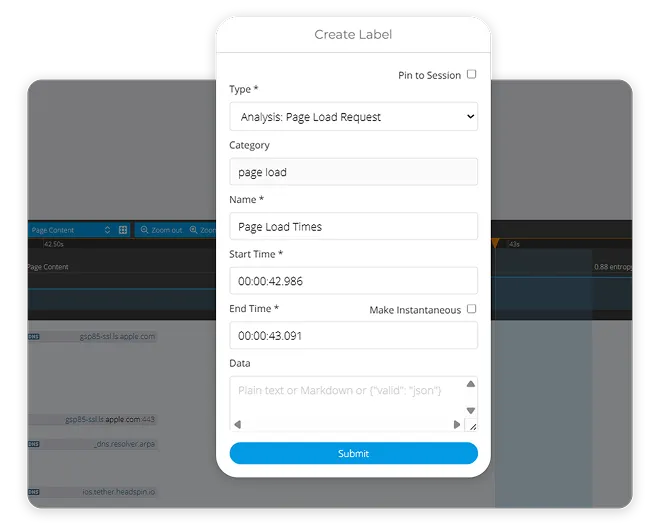
There is a discipline hidden inside that comparison. Change the build and the network at the same time, and an improvement becomes harder to explain. Keep a useful record of the environment, repeat the important steps, and the result becomes easier to challenge. HeadSpin provides tools for that work; the test designer still decides which comparison deserves attention.
A television does not behave like a browser
Consider the work of a streaming company. Login is one hurdle. Playback is another. The app may have to function across phones, browsers, Apple TV, Fire Stick, and Roku. Fox Corporation’s published HeadSpin case study describes centralizing real-device testing and automating important journeys from login to live playback across its media applications.
That explains why HeadSpin reaches beyond ordinary mobile testing. Its audio-video offering examines output from physical media devices, including streaming boxes and smart speakers. A successful command is only one part of the experience; the picture and sound also matter. Media testing gives the company a specific technical problem around which to organize its hardware and analytics.
The same logic appears in retail. A HeadSpin and Red Hat case study describes a retailer running more than 3,000 regression cases and coordinating two devices for barcode or QR-code input. These are awkward details for a tidy software checklist. They are also the details that make an application useful in a store.
“Now it's simply a matter of logging into HeadSpin with a browser and running tests.”Gareth Ouellette, Akamai
In a HeadSpin-published customer story
Partnerships help connect this evidence to established workflows. HeadSpin announced its Tricentis partnership in 2022, combining automation with device access and performance analysis. Atlassian Ventures invested in 2023, with an emphasis on DevOps and synthetic observability. The business logic is straightforward: testing findings are more useful when they can move into the systems where teams organize the repair.
The bill starts small. The requirements decide the rest.
HeadSpin sells subscriptions, capability add-ons, and enterprise deployments. Its current pricing page lists CloudTest Lite from $49 a month, with 40 hours of usage for manual functional testing. CloudTest Go starts at $100 a month; automation, performance, and experience capabilities have add-on conditions. CloudTest Pro is custom-priced for more demanding requirements.
$49/moCloudTest Lite
$100/moCloudTest Go
The distinction matters. Lite and Go list a smaller location selection than Pro. Dedicated devices, on-premise installations, air-gapped environments, and specialized media functions belong to a different buying conversation. A bank protecting sensitive test data and a small team checking a few screens are not purchasing the same arrangement.
BrowserStack, Sauce Labs, Perfecto, and Kobiton compete for overlapping budgets. HeadSpin emphasizes the combination of carrier conditions, performance analysis, media testing, and deployment flexibility. Buyers should make that comparison with their own test matrix. A large catalog helps only if the required device, operating system, carrier, and location are available together.
A sensible trial therefore starts with a troublesome journey rather than an impressive dashboard. Check whether the service reproduces the problem, whether its measurements help isolate a cause, and whether the team can act on them. If the evidence does not change a release decision, extra measurements have limited value.
The company needed its own reality check
There is an unavoidable complication in a business selling evidence. HeadSpin’s former CEO supplied investors with false financial information. Federal court records describe an employee raising concerns about purported customers in 2020, prompting an investigation. Lachwani left the CEO role that May. In April 2024, he received an 18-month prison sentence after pleading guilty to wire and securities fraud.
The operating business continued. PartnerOne acquired HeadSpin in July 2024; TechCrunch reported a $28.2 million purchase price. The episode gives the company’s story a second lesson about measurement: financial claims need independent checks too. A working product cannot validate a fundraising spreadsheet.
Now the test can begin with a sentence
In April 2026, HeadSpin launched ACE, its AI Cognitive Engine. The product takes a scenario written in ordinary language and generates an executable test journey. HeadSpin says it uses live interface structure to generate and validate scripts and adapt when elements change. Engineers can inspect the steps. That visibility is essential: generated automation still needs a meaningful definition of success.
The useful practice to copy is modest. Pick a journey customers care about. Establish a baseline. Compare the next build under comparable conditions. Investigate the difference. For a team needing only simple functional checks, advanced experience analysis may add expense without answering a pressing question. For a team losing customers somewhere between tap and playback, knowing exactly where to look can change the next release.