Imagine a shopkeeper checking the lights, the till and the stockroom, then declaring the shop open. Outside, the front door sticks. This is the problem Keynote understood: a business could inspect its own machinery and still miss what happened when a customer tried to use it. On the internet, the distance between those two perspectives could be an ocean, a mobile network or one stubborn browser.
Founded in 1995 by James Barrick and Andy Popell, Keynote made that distance measurable. Its software and distributed testing infrastructure checked websites, applications and online services from the outside. The useful question was deceptively plain: could someone actually get through? For an online business, a successful internal health check was only the beginning of an answer.
- Test the service from the customer’s side of the connection.
- Repeat the checks across locations, networks and real devices.
- Follow the business from the dot-com crash to Dynatrace.
Send a customer who never sleeps
Keynote Perspective turned checking into a service. Instead of asking an employee to keep opening a website, a company could have measurement computers repeat the job. Later products extended those checks into transactions, applications and streaming. The subscription bought repeated observation, delivered through the cloud, with results available for people who needed to investigate delays and failures.
Think of a retailer rehearsing the route from product page to checkout. A synthetic test follows a prescribed journey at intervals. Repeating it from different locations helps distinguish a widespread problem from trouble along a particular route. That example describes the method, rather than a reported customer incident. Its appeal is practical: the business can look for trouble before a shopper takes the trouble to complain.
By 2013, Keynote reported more than 7,000 measurement computers and mobile devices across over 275 locations, collecting over 700 million measurements daily. These were company-reported infrastructure figures, not a count of people browsing. The distinction matters. Keynote was selling a repeatable view of experience, with enough geographic variety to make a single reassuring test look rather lonely.
measurement computers
and mobile devices
The phone was part of the problem
A website did not stop being complicated when it shrank to fit a handset. Devices, operating systems and carrier networks introduced more combinations to check. Keynote expanded into mobile through acquisitions, including SIGOS in 2006 and DeviceAnywhere in 2011. The latter added a particularly tangible proposition: use a real phone remotely, rather than keep buying every phone yourself.
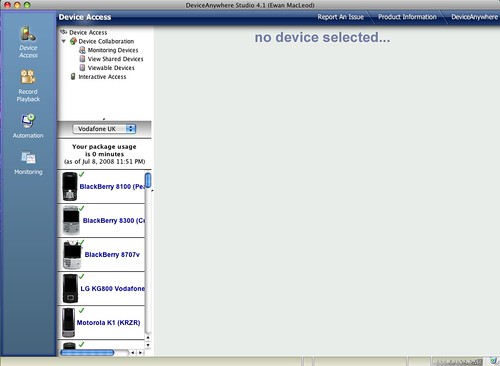
An archived 2008 walkthrough of DeviceAnywhere shows the wonderfully literal nature of this cloud. A desktop application presents a library of handsets on operator networks. Pick an available device and work with it remotely. The screenshot belongs to DeviceAnywhere before Keynote bought it; the underlying idea helps explain the attraction of the acquisition. Somewhere, there really was a phone.
At FinovateSpring 2012, the business demonstrated Test Center Enterprise Automation with HTML5 Web Testing. Engineering and quality assurance teams could automate tests across real devices. An IBM-certified integration later allowed teams to execute DeviceAnywhere automation scripts from Rational Quality Manager. The product fitted into the work of shipping software, alongside the work of keeping a live service healthy.
Then the customers disappeared
Keynote had its own availability problem: would its customers remain in business? After the dot-com crash, customer losses undermined the simple web-measurement model. In a World Economic Forum case study, Umang Gupta, who became CEO in 1997, described a roughly $40 million business losing about $20 million annually. Layoffs followed. Rebuilding meant broader products and a more experienced direct sales operation.
What changed management’s calculation was the opportunity to replace disappearing demand with more complex enterprise work. Cash raised during the boom gave Keynote room to attempt it. The lesson is less romantic than a startup comeback usually sounds: financing bought time; acquisitions and a different sales approach gave that time a purpose. Gupta’s internal refrain was “from profitability comes stability.”
“from profitability
UMANG GUPTA / 2010 WEF CASE STUDY
comes stability”
A subscription backed by expensive machinery
The commercial model mixed cloud subscriptions with licensed mobile testing systems, hardware, maintenance and consulting. Customers could buy continuing measurement without operating the whole network themselves. The engineering expertise sat in repeated measurement, device access, automation and interpreting results. For a small team with one simple site, that breadth could be excessive; for a business spanning networks and markets, it addressed a real coordination problem.
American Express, Disney, eBay, Google and Vodafone appeared among Keynote’s named customers. These businesses differed enormously, but each had reasons to care about an online service working beyond headquarters. Alternatives included Compuware’s Gomez, Neustar’s Webmetrics, SmartBear’s AlertSite and Perfecto Mobile. Keynote’s position combined external web measurement, mobile network testing and access to real devices, rather than depending on one check from one place.
The infrastructure strategy carried a price. DeviceAnywhere cost $60 million in cash, with up to $30 million more contingent on performance targets. Thoma Bravo’s 2013 purchase of Keynote valued the transaction at approximately $395 million. Those are acquisition figures, not customer fees. At the other end of the scale, DeviceAnywhere Free offered repeatable ten-minute website spot-checking sessions in January 2013.
- 01Choose a journeyMake it matter to the business.
- 02Repeat it elsewhereUse relevant locations and devices.
- 03Investigate the failureGive the result an owner.
Keep the outside view. Add the inside view.
In June 2015, Keynote became part of Dynatrace. The merger announcement paired Keynote’s synthetic testing and consulting with capabilities including real-user monitoring and PurePath transaction tracing. The combination made conceptual sense: a failed journey tells you something is wrong; deeper application information helps investigate why. In 2016, Keynote Mobile Testing’s employees and products moved into SIGOS, giving the mobile branch a separate continuation.
There is a useful habit here to copy. Choose a customer journey that matters, repeat it from relevant places and devices, and connect failures to someone who can act. But a script observes the path you gave it. It can miss an unexpected action, an unrepresented handset or a particular user’s conditions. Pair rehearsals with evidence from actual usage. Keynote’s enduring contribution was to make the customer’s side of the connection a place businesses could measure.
Open another window
Explore the successor platform, the archived product blog and a real-device testing demonstration.