Rodrigo Lewit’s 2010 engineering thesis concerned a problem with very little glamour: getting people into lunch. His proposed business, MatchFace, would use facial biometrics to control access to restricted areas and services. Workplace dining rooms were the commercial focus. Before the international software operation, before the recruitment pitches and the large customer counts, there was a question about who should pass through a door.
It is an unexpectedly useful place to begin with a founder. A lunch queue offers few opportunities for grand speeches. People need to eat; someone needs to account for the meals. Technology earns its place by making that arrangement work. Lewit’s later public advice would return to a similarly inconvenient judge of an idea’s merit: the customer willing to pay for it.
The lunch queue before the world map
At the Universidad de Chile, Lewit studied industrial civil engineering, graduating in 2010. His thesis built a business plan around an integrator of facial recognition technology. It considered the market, marketing, staffing, operations and finances. The proposed equipment varied by customer segment. The engineering was accompanied by the less photogenic work of deciding whom to sell to and what the business would cost.
Read as an early piece of commercial thinking, the proposal has a familiar preoccupation: a crowd of people creates an administrative problem, and identification might help solve it. This was a business plan, with estimates and proposed products. Its significance here lies in the question Lewit chose to study, rather than treating its projections as accomplishments.
His working life was already taking shape alongside that education. His career record places the start of his CEO and co-founder tenure at Victoria S.A. in March 2009. The overlap matters. There was no neat ceremonial handover from student to businessman. The academic questions and the commercial ones were occupying some of the same years.
A professor, two students, one attendance problem
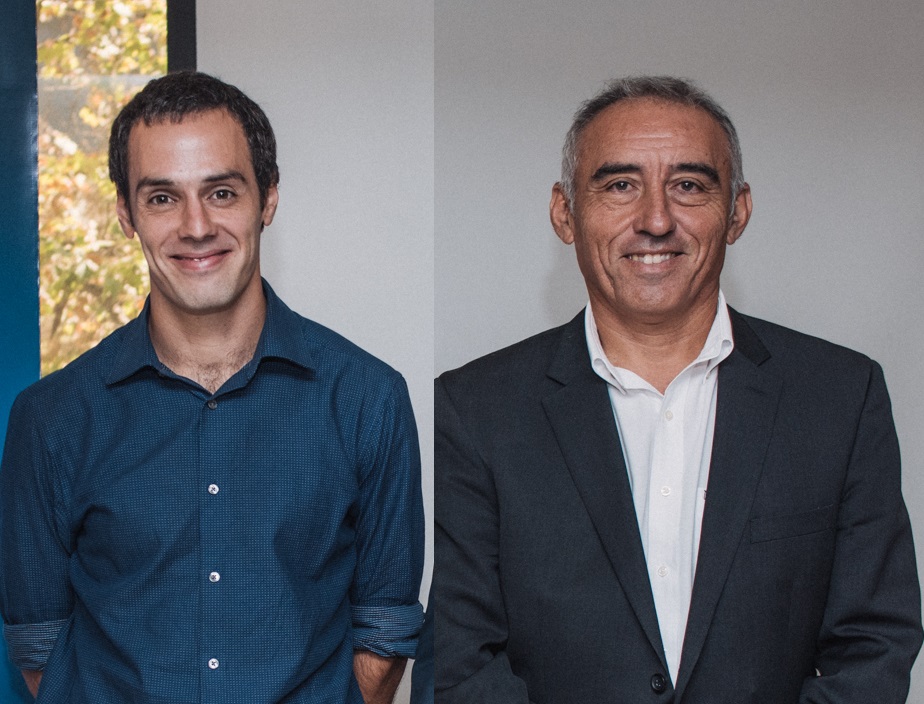
GeoVictoria’s origins reach back to a university project involving professor Sergio Astudillo and students Lewit and Jorge Bossa. In 2007, they developed voice identification for attendance registration. A telephone call could establish that a worker had arrived. The first interface was something people already knew how to use.
That choice has a certain everyday intelligence. A workforce may be dispersed across customer sites, stores or buildings. A manager cannot stand at every entrance. An attendance record becomes useful when it travels faster than the person asking where everybody is. The commercial opportunity sits in that gap between an event and the person who needs to know about it.
The first product’s modest interface is worth remembering alongside the later geography. A phone call asks the worker to use a familiar tool. For the employer, its value depends on producing a record somebody can use. The distance between those two experiences is where much of the work in business software happens.
As transaction volumes grew, the service moved to the cloud. By September 2022, the business was reporting use in 40 countries and offices newly opened in California and Italy. Astudillo used Starbucks to explain the operational stakes: a coffee business needs to know whether its barista has arrived. Even the most ambitious expansion plan eventually meets somebody waiting for a coffee.
The customer gets a vote
When Lewit offered advice to prospective entrepreneurs in June 2021, he recommended keeping a salary while testing a business idea. Find customers, then consider the transition. His metaphor involved riding two horses. It was more financially cautious than the usual invitation to leap into the unknown, if somewhat more demanding of the rider.
He also described the experience of taking apparently good ideas out to sell and discovering that buyers were less impressed. His test was explicit: “Lo que define bueno o malo es la disposición a pagar del cliente.” In English: what defines good or bad is the customer’s willingness to pay.
There is a bracing quality to that standard. Approval in a meeting is cheap. A purchase competes with other claims on a budget. For someone considering a new venture, his advice makes the first sale a piece of evidence worth obtaining before making the largest personal commitment.
“La disposición a pagar del cliente.”
Rodrigo Lewit, June 2021
Lewit’s professional profile lists Spanish and French at native or bilingual level, and English at full professional proficiency. Alongside his university education, he lists Alianza Francesa. The language entries give this international working life a more personal dimension. Expansion appears on a map as a line between countries. In practice, it also involves finding words that make sense to another person.
The unromantic work of making it usable
One glimpse of Lewit’s working concerns comes from a December 2015 inquiry he submitted on behalf of Victoria S.A. He asked whether several employers could share an electronic attendance system. The response, issued in March 2016, addressed technical requirements and the separation of each employer’s records.
That is a revealingly specific question for a software founder to pursue. Shared infrastructure may be efficient, but customers still need their information handled separately. A product’s usefulness depends on details that never appear in a demonstration of its cleverest feature. The query places Lewit in the practical work between making software run and making it fit an employer’s operations.
There is no need to turn an administrative exchange into a heroic episode. Its interest is precisely its ordinariness. Attendance software lives among records, responsibilities and permissions. Understanding those boundaries is part of building the product. The founder’s job includes asking questions whose answers will never fit comfortably on a launch poster.
Independence had a price in lemons
The early business had three people, a small office and a large whiteboard. Sales arrived slowly. To provide working capital, Astudillo sold a lemon field, contributing US$80,000; CORFO supplied another US$100,000. In September 2023, Lewit described the business as otherwise bootstrapped and said the partners valued keeping their autonomy.
It is a financing story with actual agricultural roots. More seriously, it puts a tangible asset behind a software company’s freedom to continue. The founders’ ideas needed time, and time had to be paid for.
The company’s own chronology records more than 100 customers at its 2011 independence and more than 1,000 when it adopted the GeoVictoria name in 2017. A growing customer base changes the founder’s obligations. Every new account adds another set of people expecting the system to work tomorrow.
A network, and a deliberately informal face
Lewit became an Endeavor Entrepreneur in 2019. His public portrait for the organization is rather less solemn than that designation might suggest: a hoodie, a novelty black hat and a whiteboard behind him. The photograph makes room for an expression that corporate portraits often seem contractually obliged to remove.
The same profile records his enthusiasm for sport and orange juice. These are modest personal details, but they give the public founder a little texture beyond software metrics. The juice also supplies a pleasing citrus footnote to a business once helped along by a lemon field.
He has credited the Microsoft and Endeavor ecosystems with helping the company develop. In October 2020, he encouraged entrepreneurs to draw on people willing to help one another, in Chile and abroad. His account of independence therefore leaves room for connections, advice and commercial relationships. Retaining ownership does not remove the need to know people.
That is an appealing complication in a founder’s story. The company can protect its freedom to choose while learning from a wider circle. For a business selling into other countries, the distinction has practical weight. A local relationship may help a team understand the buyer standing in front of it. An international network may introduce the next one. Neither replaces the work of delivering something useful once the introduction is over.
In a software business, these public values also give prospective colleagues something to examine. A candidate can ask how they appear in an ordinary working day. A founder can ask whether the people being recruited understand the kind of organization they are joining. The vocabulary only becomes useful through the decisions that follow it.
GeoVictoria’s published values are Happy, Honest, Humble and Hungry. The vocabulary pairs appetite with restraint. Read together with Lewit’s argument for testing ideas through sales, humility has a practical application: leave enough room in your thinking for a customer to change your mind.
Still recruiting for a bigger map
In an April 2025 recruitment post, Lewit sought leaders for marketing and revenue. He reported more than US$20 million in annual sales, 8,000 customer companies and 1.4 million users. The invitation paired commercial experience with alignment to the four Hs. He also set out an ambition to operate across five continents and exceed US$100 million by 2030.
Those were targets, with years of execution still ahead. The recruitment pitch is interesting because it shows what he was asking other people to help build. An ambition becomes more concrete when it requires naming the roles needed to pursue it.
His public career profile now lists co-founder and CCO at GeoVictoria from November 2025, following his long CEO tenure. That career record sits alongside his persistent interest in buyers, revenue and recruiting people who can sell a service across borders.
By September 2026, GeoVictoria was reporting more than two million employees served across more than 10,000 businesses. Its Mexican plans included increasing daily active users from 100,000 to 200,000 and adding about 70 people. These were company figures and expansion plans, rather than a completed scorecard for the year.
That next stage returns the story to a recognizable scale beneath the large numbers: another implementation, another customer, another team that needs to know who has arrived. Lewit began his engineering work with the practicalities of identifying people at a door. His company has taken that question across borders. The question he puts to a new entrepreneur remains equally concrete: will somebody pay for your answer?
Follow the conversation
GeoVictoria - company website Rodrigo Lewit - LinkedIn Watch: advice for new entrepreneurs - YouTube The 2010 facial-biometric business plan The early business and its financing - 2023 interview The university project and international expansion Rodrigo Lewit - Endeavor profile Entrepreneurship networks and GeoVictoria A practical attendance-system inquiry, 2016 GeoVictoria’s Mexican expansion plans, September 2026