Giuseppe Commisso has acquired two jobs in which people are unusually willing to tell you when they are unhappy. One involves the internet connection in their living room. The other involves the football club in their heart. In 2026, he became chairman and chief executive officer of Mediacom Communications and president of Fiorentina. Between the American broadband customer and the Florentine supporter, there is little prospect of a quiet suggestion box.
Both institutions came into his life through his father, Rocco, who founded Mediacom and later bought the Florence club. Both now require Giuseppe to become more visible. The family name arrives before he does, carrying a history of decisions, loyalties and expectations. His task is to put his own decisions beside it. A surname can be printed on a business card; confidence has to be renewed by other people.
Before the larger office
The route to those appointments included a considerably less public education. At Millbrook School, Giuseppe liked mathematics, valued close relationships with teachers and found the Dutchess County campus reassuringly reminiscent of home across the Hudson. He joined the school in tenth grade and graduated in 2000. He also received the Founders’ Prize, a student award recognizing community commitment, initiative and team play. Long before the football presidency, there was a school acknowledgment for contributing to a team.
Columbia University followed. His degree was a Bachelor of Science in Civil Engineering. Later, he attended Harvard Business School’s Cable Executive Management Program, sponsored by the CTAM Educational Foundation. The combination puts technical study beside industry education. It offers useful context for a career that would involve the infrastructure of a communications company and the finances behind it, without requiring an engineering degree to explain every subsequent choice.
At Mediacom, he spent almost two decades in roles of increasing responsibility. By the time the leadership transition arrived, he had been group vice president of corporate finance and a board member. An executive working in finance can remain comparatively unfamiliar to the customers of a large company. Becoming its chief executive changes that relationship, even when the executive already knows the organization well.
The company gives that change a substantial setting. Mediacom focuses on smaller American markets, particularly in the Midwest and Southeast, offering broadband, television, phone and mobile services across twenty-two states. Its business includes commercial connections through Mediacom Business and advertising through OnMedia. Those activities bring a chief executive into contact with several different ideas of good service. A household, a school and a business may rely on the same operator for different purposes. For Commisso, the move out of corporate finance means taking responsibility for the whole range of those expectations, alongside the financial decisions he already knew.
The first visit, seen properly
Mediacom announced his vice chairman and interim CEO appointment on January 23, 2026. Fiorentina named him president on January 27. Mediacom confirmed him as chairman and CEO on February 6. In a few weeks, a career developed largely inside the family business acquired two conspicuous public titles. The announcements were formal. One of his first accounts of the change was much more physical: arriving somewhere he had already spent years watching from a distance.
Speaking at the end of January, he described going straight to Viola Park after reaching Florence on a Sunday evening. He had followed its construction, seen pictures and watched matches broadcast from it. Walking into the training center gave those remote impressions a different weight. He described his pride in what his parents had created. For someone trained to think about built structures, the scene has an appealing directness: eventually, you have to stand inside the building.
His address ranged across the club, from the men’s first team to the women’s side and the young players using the facilities. He also acknowledged the responsibilities that would take him back to America. The two jobs were already present in the same speech. Florence could claim his commitment; Mediacom still required his attention. Even a presidential itinerary has to submit to geography.
A city does not fit on a balance sheet
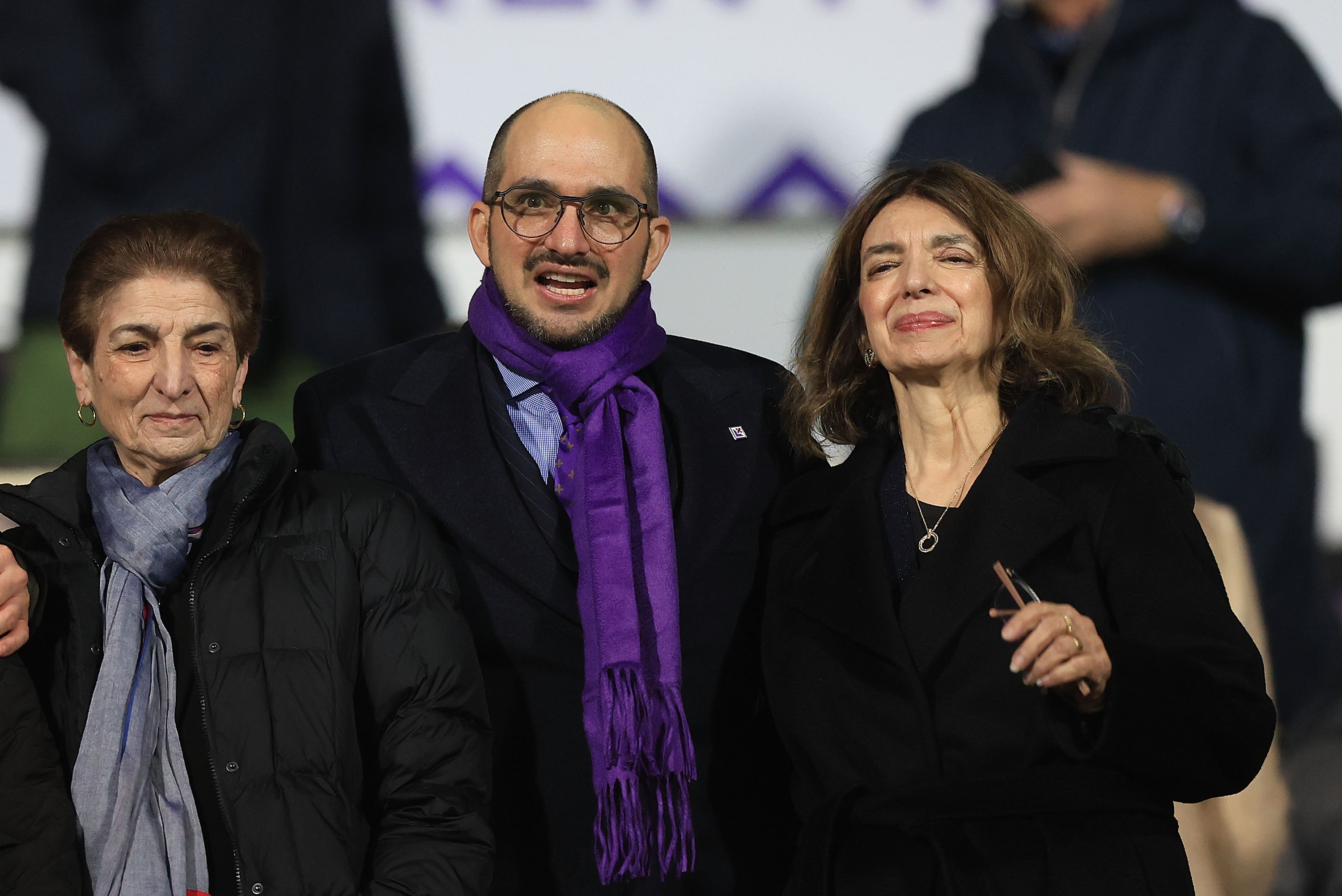
The Fiorentina appointment initially emphasized continuity. Mark Stephan was confirmed as chief executive officer and Alessandro Ferrari as general manager. Catherine Commisso, Giuseppe’s mother, joined the board. Giuseppe publicly backed the management and thanked his mother. The arrangement made family involvement explicit while also naming the people responsible for running the club. A presidency can be personal and still depend on a distribution of duties.
By September, his presence around Fiorentina had acquired a more informal vocabulary: high-fives for players, embraces for supporters, selfies and emphatic reactions to goals. There was also an embrace with Giancarlo Antognoni, the club great, following disagreement around Antognoni’s absence from the centenary celebration. These are small scenes, but football institutions accumulate meaning through small scenes. A gesture can become part of the conversation before the next formal announcement is drafted.
Such visibility has its own demands. A president who greets people closely becomes a person supporters expect to encounter again. Enthusiasm is welcome, but it also creates a continuing relationship. Commisso’s public arrival in Florence puts him among people whose attachment to the club predates his appointment and will be measured on a different calendar from his tenure.
A century in someone else’s hands
On September 14, he accepted Tuscany’s Pegaso d’Oro on Fiorentina’s behalf. The regional honor recognized the club’s hundredth year. His mother and Ferrari were there with him. It was a useful image of the distinction between holding an office and possessing its history: a new president receiving an award for a century of collective life.
The Pegaso d’Oro recognized the club’s centenary. Commisso received it on the club’s behalf.
The celebrations also reached back to Millbrook. Members of his school community attended an August celebration, and the school later marked his acceptance of the award. The former pupil and the football president briefly occupy the same frame. It is a reminder that a public career does not replace earlier affiliations. Sometimes the people who knew the teenager come to watch the ceremony.
An anniversary can make the future sound conveniently distant. For Commisso, it also gives the job a concrete scale. A club that has reached one hundred years contains generations of investment by people who never sat on its board. Receiving an honor on their behalf is the pleasant part. Deciding what to preserve and what to change begins again afterward.
The people who make the promise work
At Mediacom, that question has become a management problem with names attached. In June, Commisso hired Toni Murphy as executive vice president of operations. Several long-serving executives were entering retirement, creating openings for outside recruits and internal promotions. For a company built over decades by a familiar leadership group, a change at the top was becoming a wider change in the people running it.
His competitive argument was plain: Mediacom’s footprint had remained largely stable while the industry around it consolidated. Larger rivals had greater scale. He wanted Mediacom to make use of its ability to act creatively and quickly. The implication is demanding. Remaining a family company does not relieve an operator of the need to compete for customers who can compare service and price.
“We must use that to our advantage.”
Giuseppe Commisso, on Mediacom’s ability to move quickly, October 2026
Murphy described a related priority: earning customer confidence through reliability, fair pricing and an experience that matches what people bought. Put beside the management appointments, it makes the succession less abstract. The work runs through operations, service and the decisions customers notice. A boardroom promise has a long journey before it becomes a satisfactory afternoon in somebody’s house.
A different kind of home fixture
In June, the two sides of Commisso’s public life met at a familiar American address. He joined Italian football figures and FIFA president Gianni Infantino in New York ahead of the World Cup. The occasion included a FIFA Legends Match at Columbia University’s Rocco B. Commisso Soccer Stadium. His university, his father’s name and his role at Fiorentina were present in one setting.
That gathering gives the transatlantic story a human scale. New York and Florence can look like labels on an executive biography. Here they became people arriving at a football ground. Commisso’s connections cross the Atlantic through a company, a club, a university and a family. The relationships overlap, and the overlap makes each appearance carry more than one meaning.
What the next hundred years ask
His June message to Fiorentina supporters laid out ambitions beyond the next ceremony. He discussed higher standards, youth development and the importance of Viola Park. He also described an intention to work with Florence’s municipality on modernizing the Stadio Artemio Franchi. The stadium argument connected a better home for supporters with the club’s ability to generate revenue and reinvest.
Those plans remain commitments to be judged through what follows. A training center serves the players who use it. A stadium project needs agreement and execution. A management appointment succeeds through the work of the person appointed. Commisso’s first year has supplied a series of beginnings rather than a completed verdict. That is a fair place to leave a new executive, however familiar his surname.
His two audiences will keep the assessment practical. In America, the connection needs to work. In Florence, the club needs to give people reasons to return with hope. He has taken responsibility for institutions that already belong in other people’s daily lives. The office grants him authority over decisions. The people at the other end will decide what those decisions are worth.