The most revealing sentence on PhenoTap's website is not a grand promise about a wearable. It is an operating decision: “We make the enzyme; our partners build the devices.” For Giovanni Battistini, that choice is the product of a career spent watching good ideas collide with the institutions meant to use them. He has built in startups, searched for science inside global companies, and organized networks between researchers, investors, operators, and customers. Now he is concentrating those lessons on a component small enough to disappear inside somebody else's hardware.
Battistini is the CEO and co-founder of PhenoTap, a New York biosensing company. Its core technology, KetoTap Core, is a patent-pending oxidase engineered to measure beta-hydroxybutyrate, or BHB. The company's proposition is deliberately industrial. Instead of asking a device manufacturer to adopt an entirely new production system, PhenoTap says its enzyme can work with electrochemistry and immobilization approaches already used for glucose sensors and blood test strips.
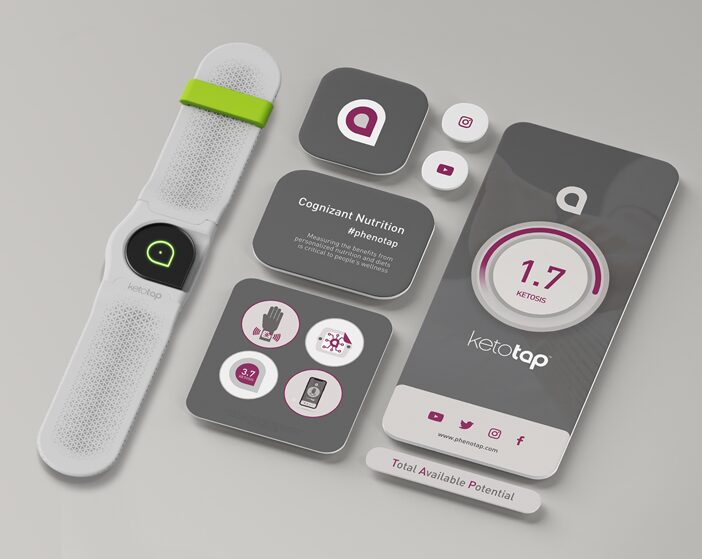
This is not how the venture first presented itself. An early product image showed a wrist-worn monitor, a round app dashboard, and the phrase “Cognizant Nutrition.” The concept was consumer-facing and expansive: live measurements translated into understandable guidance. The current company is much narrower. PhenoTap now describes itself as a B2B original-equipment supplier. It plans to sell the biochemical engine and let established manufacturers carry it into meters, strips, and continuous monitors.
A career built across borders
The route to that narrower bet was anything but narrow. Battistini earned a master's degree in electronic engineering at the Università di Pavia and completed an executive program at MIT Sloan. He began his career at ABB, the industrial technology group. A public biography now sums up his experience as 30 years at the intersection of business and technology, which is accurate but almost too tidy. The interesting detail is how often he crossed from one kind of institution to another.
He moved to the United States when he was young and worked in several industrial fields before leaving the scale and structure of a large company for startup life. At Zonebee, a New York spinout from the University of Arizona, he served as co-founder and CEO. The company developed software and hardware for informal learning and knowledge management in places such as museums, stores, and trade shows. One former colleague remembered him as a technologist who could move between industrial marketing and web applications, then dissect the business model underneath the software.
Zonebee is an early version of the pattern that would follow. Battistini was not simply making a technical object. He was leading a multidisciplinary team and asking how people would discover, understand, and adopt something unfamiliar. The technology changed as his career moved into food and nutrition. The operating question stayed.
Industrial technology and the first layer of a career connecting engineering with markets.
A University of Arizona spinout building software and hardware for informal learning.
Scientific discovery, commercialization, and a global system for finding ideas outside company walls.
A return to venture creation, with an increasingly focused bet on enabling biosensor technology.
Learning to look outside
At Firmenich, Battistini became Global Vice President of Flavor Innovation Discovery. He led the search for and commercialization of science in taste modulation, nutrition, natural and sustainable systems, and cost innovation. In this world, innovation was not a brainstorming exercise. The job was to find technical work outside the company, understand its commercial relevance, and build a path that could carry it into a global operation.
Ferrero hired him to apply that logic at a different scale. As Senior Vice President of Open Innovation Science, he created a global organization to discover, evaluate, and plan the integration of external science, technology, and entrepreneurial projects. Ferrero already had a strong research operation and a network of collaborators. Battistini's assignment was to make the outward gaze systematic: scan beyond the company boundary, decide what mattered, and give promising projects a route inward.
“One of the first strategic steps was to define the return on the future.”
The phrase sounds whimsical until you hear what he meant by it. “Return on the future” was a quantitative basis for comparing projects with different potential impact and risk. An organization with active antennae can notice everything from biotechnology to packaging. It still has to choose. Resources must be concentrated and sequenced. A portfolio of fascinating possibilities is not the same thing as a strategy.
His language from this period is unusually grounded for someone paid to think far ahead. He argued that innovation is incomplete without impact, and that impact requires more than a distinctive idea. The idea must be integrated. Its adoption must be designed. Inside a large company, that means earning credibility with people who have different tolerances for risk and building enough support for an embryonic project to cross into ordinary operations.
Battistini sorted collaborators into those four roles because partnerships are not interchangeable. A connector may surface a useful technology without being able to scale it. An academic inventor may produce the technical leap without owning a manufacturing channel. A visionary can widen the horizon while an enabler handles the stubborn work that makes the project real. The useful network is not merely large or prestigious. Its pieces are complementary.
Back to the small-company clock
By 2021, Battistini had returned to venture creation. He founded Better Gambit, a one-person New York advisory and venture-building firm, and founded PhenoTap. He later became a venture partner at Barnstorm Foundry, the company-building platform propelled by Cornucopian Capital. He has also been listed as a board director representing the fund at Biocanic.
The shift put him back under startup constraints. A young company does not get to explore every plausible market or fund every technical branch. Battistini has said that the central challenge is finding a business model compatible with both the technology and the limited resources available. The warning is pointed: wearable companies can chase an attractive innovation with the wrong model and unreasonable expectations. A technically impressive product does not exempt anyone from unit economics, capital discipline, or timing.
PhenoTap's evolution reads like a practical response. The team identified an enzyme as the bottleneck in continuous ketone measurement. Work incubated through Barnstorm Foundry took shape with the Siegel Lab at UC Davis. PhenoTap now names UC Davis, UC San Diego, Codexis, and EvoEnzyme among its development partners. Janet Tamada leads biosensing and customer-product reference work. Joe Wang, director of UC San Diego's Center for Wearable Sensors, leads early on-sensor validation. Ray Garcia runs technology and AI infrastructure. Battistini leads commercial strategy and customer development.
In March 2025, the Helmsley Charitable Trust awarded PhenoTap a $3 million grant for an 18-month project to develop a BHB oxidase. The award gave the technical program a defined clock and a concrete mandate. PhenoTap's current site says KetoTap Core is commercially ready and that production scaling and customer sampling were scheduled to begin in the second quarter of 2026.
The company also says it holds patent-pending composition-of-matter intellectual property around the enzyme. Its pitch to manufacturers is built on familiarity. A direct oxidase can avoid the external co-factor and mediator required by the incumbent dehydrogenase approach. More important for adoption, the company frames the architecture as compatible with the manufacturing logic that device makers already know.
The founder as translator
Battistini does not present as the lone inventor at the center of the laboratory. His role is closer to translator and architect. He finds the commercial shape around scientific work, decides which partner should own which problem, and keeps the route to adoption visible while the technology develops. His public network reflects that preference: investors, protein engineers, biosensing scientists, device veterans, and food-industry operators occupy distinct seats around the same table.
This is what someone can steal from his career. First, define the bottleneck precisely. Second, resist the urge to own every layer around it. Third, design the partnership network by function. Fourth, treat adoption as a technical requirement, not a marketing task postponed until launch. Finally, measure speculative work with enough rigor that “the future” does not become an excuse for avoiding choices in the present.
A breakthrough is only halfway there when it works. The other half is finding the system willing and able to use it.
There is a neat symmetry in Battistini's path. Zonebee tried to help people navigate information and make their thinking visible. Firmenich and Ferrero asked him to help organizations navigate external science. Better Gambit exists to assemble ventures around opportunities. PhenoTap's current product turns a biochemical event into a signal a device can read. The recurring act is translation: between disciplines, between time horizons, and between invention and use.
The next test is commercial rather than rhetorical. Customer sampling has to become customer adoption. A patent-pending enzyme has to perform consistently inside manufacturing and product constraints. Partners have to move from aligned names on a website to a repeatable supply chain. Battistini has spent three decades studying precisely this passage. This time, the object crossing it is almost invisible.