The email that changed Raoul Scherwitzl's company arrived while he was shopping for groceries. Years of clinical work, documentation, questions, and waiting had resolved into a message confirming that Natural Cycles had received clearance from the United States Food and Drug Administration. Scherwitzl was standing in a supermarket. The company's future had suddenly become more legible. The shopping list had not. He still needed milk.
It is a compact scene, and unusually faithful to the way consequential companies are built. Public milestones appear all at once. The work that earns them accumulates without ceremony. Scherwitzl has spent more than a decade in that gap, turning a project begun by two physicists into a consumer technology business that operates across software, research, hardware, and regulation.
His route into the job was not a straight line through business school or a venture-backed accelerator. Born and raised in Vienna, he grew up with two sisters in a household where both parents taught. His mother was French; his father came from Carinthia. After secondary school he went to ETH Zurich to study physics. A year abroad at the University of California, Santa Barbara introduced him to Swedish physics student Elina Berglund, his future wife and co-founder.
Elina remembers something less scripted: they were probably sitting around a table doing physics homework. The disagreement is affectionate and revealing. Scherwitzl knows the value of a memorable story; Berglund Scherwitzl restores the ordinary work underneath it. Natural Cycles would need both instincts.
The subject changed. The method traveled.
At ETH, Scherwitzl worked on superconducting resonators. In Geneva, he earned a doctorate in condensed matter and materials physics, studying the behavior of ultrathin oxide films. His publications dealt with metal-insulator transitions, interfaces, and materials whose properties change under carefully controlled conditions. The vocabulary is far from consumer software. The habits are close: isolate the signal, define the claim, measure what happens, and expose the result to other people who may try to prove you wrong.
In the summer of 2012, after the couple had married, an experiment at home became the beginning of a company. Berglund Scherwitzl started reading research and writing an algorithm for their own use. Six months after recognizing a broader need, the pair left their jobs to work on it. Natural Cycles was founded in 2013 and launched in Sweden the following year.
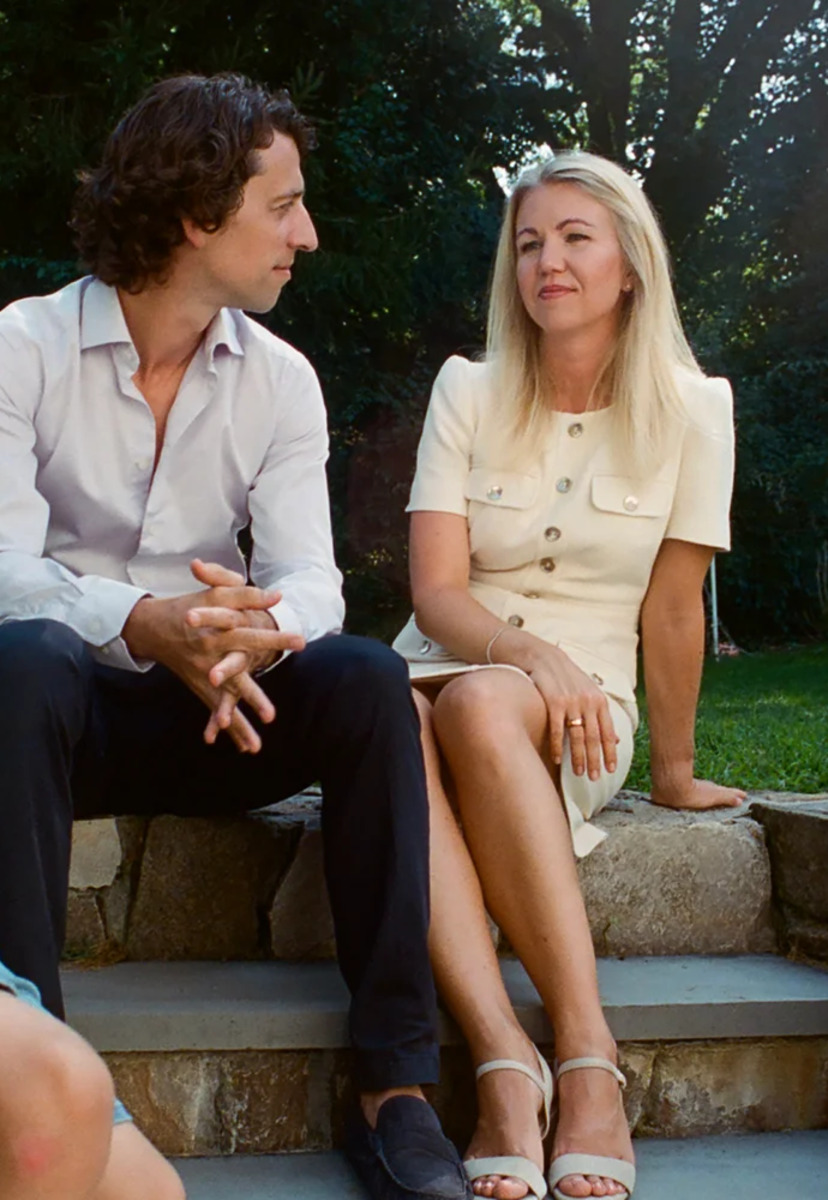
Scherwitzl has a precise diagnosis of the early gap. “As scientists, we were both trained to analyze data and write code,” he has said. “The difficulty came in understanding regulation and marketing the product. That's where we had to find help.” It is a useful sentence because it refuses the founder fantasy of universal competence. Their advantage was not that they knew everything. It was that they knew which parts required proof and which parts required another expert.
The Scherwitzl proof loop
Frame a precise question
Build and measure
Invite outside review
Turn trust into reach
Responsibility arrives before scale
The first hires changed the emotional geometry of the project. Scherwitzl recalls the scary realization that the founders were no longer risking only their own time and savings. Other people had chosen this uncertain enterprise as their livelihood. A prototype can remain an argument between its creators. A company has to make promises that survive the creators' moods.
That responsibility produced an operating style built for long feedback loops. European certification arrived in 2017. United States clearance followed in 2018. Each milestone represented a visible result of mostly invisible labor: quality systems, research, documentation, and repeated review. A month after the FDA email reached the supermarket, the founders moved to New York, bringing them closer to what would become the company's largest market.
The counterintuitive feature of this pace is that caution can create options. Once the company had built a way to evaluate data quality and manage regulatory change, it could extend beyond its original measuring device. Partnerships with Oura, Apple, Samsung, Garmin, and WHOOP pushed the interface toward wearable hardware. The surface became easier for a consumer. The machinery underneath became more demanding.
That is where Scherwitzl's scientific background looks less like a biography detail and more like company architecture. A wearable partnership is not only a logo exchange. It creates a new measurement pathway that must be tested. A software update is not only a feature release. It can carry a burden of evidence. In ordinary consumer technology, friction is something to remove. In regulated technology, some friction is the process by which the company earns the right to move.
The compounding asset nobody screenshots
Startups like clean metrics because clean metrics travel. Downloads fit in a chart. A funding round fits in a headline. Scientific and regulatory capacity is less photogenic. It lives in the ability to design a study, answer a difficult question, pass an audit, and repeat the process when the product changes.
Scherwitzl talks publicly about publication counts and citations with the enthusiasm other founders reserve for revenue dashboards. During his doctorate, he noted, a single paper could require more than a year of hard work. At Natural Cycles, he treats a growing research record as proof that the company's work is useful beyond its own marketing. The important idea is not the number on any given day. It is that evidence, like software, can become an accumulating asset.
The business record accumulated alongside it. Natural Cycles reached profitability in 2022. A strategic round led by Samsung Ventures followed in 2023. In 2024, the company announced a $55 million Series C led by Lauxera Capital Partners. The capital supported a company moving from a single software experience toward a wider mix of subscriptions, connected devices, and owned hardware.
A founder who zooms out
Scherwitzl's public voice toggles between technical specificity and domestic comedy. He can describe a regulatory change-control plan, then mention that a watch's vibrating alarm keeps him from waking his wife. He calls himself a lifelong hiker. In St. Lucia, after his phone fell from his shorts while climbing, a Garmin feature helped him locate it. There was no summit photograph, he wrote, but the watch was there.
The anecdote is small, yet it explains the appeal of the devices gathering around the company. Technology disappears when it fits into a person's routines. Making that ease dependable requires a great deal of work the person never sees. Scherwitzl seems drawn to that inversion: complexity behind the curtain, simplicity in the hand.
His latest expansion posts carry the same mix. A launch with WHOOP is described through validation language, then through the pleasure of a ten-minute final meeting with no scrambling. A move into Brazil includes investors, recruiters, a local team, advisers, and institutions, then ends with dinner, beer, and football. The operating detail and the lived detail share the frame.
The lesson in his career is not that every scientist should become a founder. It is that a method of knowing can become a method of building. Scherwitzl moved from materials physics into a field where the unit of progress is not merely a feature shipped. It is a feature shipped with enough support that customers, partners, researchers, and regulators can all place weight on it.
That standard creates tension. It slows some decisions and raises the cost of changing others. It also gives the company a memory. Each reviewed process makes the next process less alien. Each study strengthens the ability to design another. Each integration turns a one-off technical problem into an organizational capability.
What the milk run understood
Founder biographies tend to hunt for transformation scenes: the meeting, the leap, the approval, the check. Scherwitzl's story has all of them. The more useful pattern sits between them. He and Berglund Scherwitzl did homework together, then research, then product work. They hired people who knew what they did not. They learned to turn scrutiny from an obstacle into a routine.
The supermarket matters because it returns the story to scale. An institution-changing email can arrive while someone is comparing cartons. A decade of work can condense into a notification, but the life around it stays stubbornly human. You receive the news. You tell your co-founder. You imagine the next market. Then you finish the errand.
For Scherwitzl, the aspiration remains expansive: more countries, more devices, and a broader platform, all without giving up the evidentiary discipline that made expansion possible. The speed of proof can look slow from one week to the next. Zoom out far enough and it begins to look like momentum.