An hour can be a considerable economic distance. Ghufron Mustaqim’s village outside Yogyakarta was roughly an hour from the city centre, a place he remembered through its rice fields and the people around them. His neighbours had skills, energy and the willingness to work. Their chances to turn those qualities into a better income were harder to come by. For a future entrepreneur, it was an education in the things a market leaves waiting.
Years later, he would help build Evermos around a connection: local brands needed buyers, and people outside the major cities needed ways to earn. A reseller could stand between the two, using a phone and personal relationships to help a product find a customer. The neighbour, so often treated as someone to be reached by the digital economy, could become part of its distribution.
By October 2026, Ghufron was working on another connection, this time between Indonesian entrepreneurs and businesses in China. The map had grown. The original question remained recognisable: what helps a capable person get a fair chance to trade?
An hour away, a different economy
Ghufron’s account of home is striking for the problem he chooses to emphasise. The people were ready; the opportunities were limited. Young residents often worked in informal occupations. He saw an unused capacity to do more, and wanted to create another route into business. That distinction matters because it places the work of building a company partly in the connections around a person.
A small producer faces a related difficulty. Making something worth buying does not automatically produce a distribution network. Reaching customers can require stock, shops, distributors and money committed well before a sale. An otherwise promising local brand can remain local for thoroughly practical reasons. It is difficult to expand your horizons when the inventory bill keeps arriving first.
Evermos brought those two problems into the same commercial arrangement. A network of resellers could help brands reach buyers; the brands could give resellers something to sell. Training and support would help people make use of that connection. Ghufron described the larger idea through gotong royong, the Indonesian tradition of mutual cooperation. In his business vocabulary, shared prosperity had a series of actual transactions to arrange.
A political education, then a commercial one
His route into this work began in international relations at Universitas Gadjah Mada, where he graduated in 2013. The choice fits a biography already occupied with public life. He founded Forum for Indonesia in 2011 and joined Indonesia’s delegation to the 2012 G20 Youth Summit in Washington. The delegation’s Minister of Development title was a youth-summit role, an early rehearsal in thinking beyond one institution.
After university came a year at McKinsey & Company, followed by a vice presidency at fashion ecommerce business Sale Stock. Along the way, he founded the Anak Panah Institute in 2014. His interests included history, philosophy and economic development. The reading list and the operating career make an interesting pair: questions about how societies work accompanied the more immediate question of how a company works.
Sale Stock supplied a practical lesson he later identified as part of Evermos’s design: acquiring customers could be expensive. A business could spend heavily to bring people through its digital door. That experience gave a commercial reason to examine a model built around resellers and relationships. His hometown supplied the people he wanted to help; ecommerce supplied a difficult bill to understand.
“We have stayed true to our commitment to supporting local brands since day one.”Ghufron Mustaqim, May 2023
The neighbour becomes a sales channel
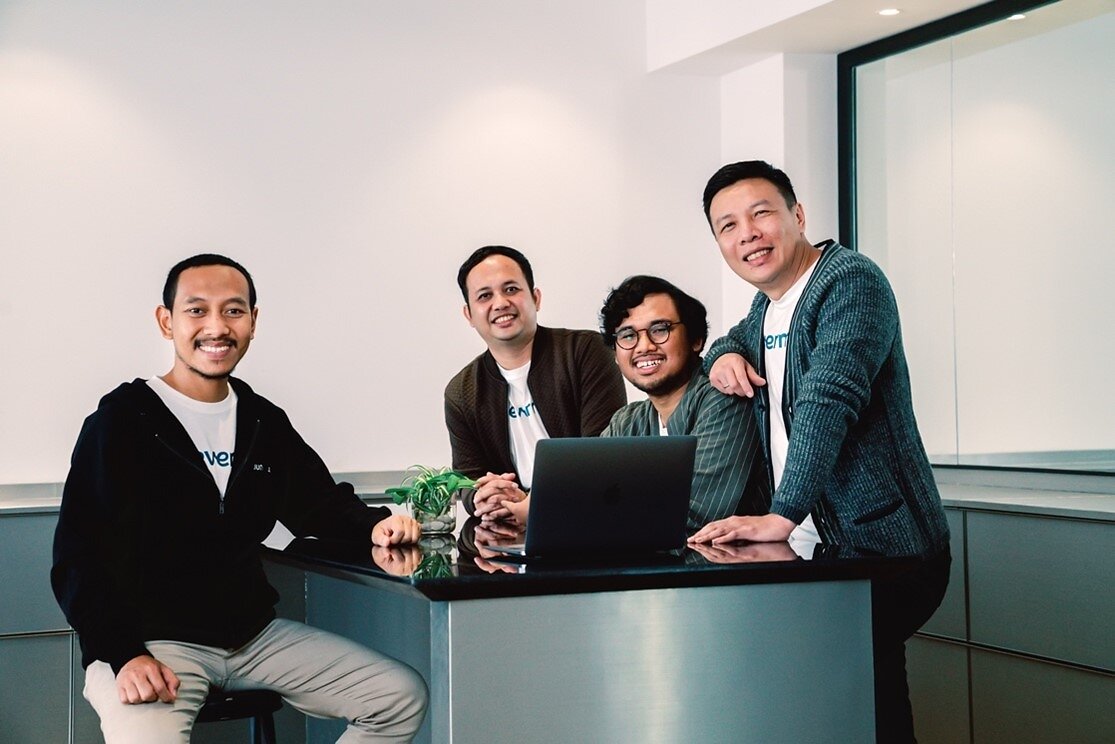
In November 2018, Ghufron co-founded Evermos with Arip Tirta, Iqbal Muslimin and Ilham Taufiq. He became CEO in 2020, succeeding Muslimin. The company connected local brands with resellers who, in turn, reached end customers. Its origins in products for Muslim consumers were reflected in the name: Everyday Need for Every Moslem.
There is an ordinary human judgement at the centre of the model. A reseller chooses what to offer and speaks with a buyer. The company organises access to products and the commercial process around that exchange. The arrangement gives a person’s existing relationships a role in finding customers, while giving a manufacturer a way to reach people beyond its own immediate circle.
Training followed naturally. Someone unfamiliar with online transactions or reselling needs more than a download button. Evermos offered learning online and in person. That commitment made the business more demanding than a catalogue alone: people had to become comfortable using the service, understand what they were selling, and build the skills to keep selling it.
The arithmetic behind the ambition
In January 2023, Evermos counted 160,000 monthly transacting resellers. That May, it announced a $39 million Series C. IFC and its Emerging Asia Fund invested $5 million and $16 million respectively. Other participants included existing and new investors, giving the company capital to develop its network and tools.
Those figures belong to the company and that period. They describe the size of a financing and a particular measure of activity, rather than Ghufron’s personal wealth or a promise about what every seller earned. The distinction keeps the scale of the business intelligible. A funding announcement can supply a very large number without supplying the answer to a household’s much smaller, more pressing calculation.
January 2023
May 2023
Ghufron had articulated the ambition in December 2022 as reaching one million active resellers in 2025, with meaningful productivity and income alongside participation. It was a target. The useful part of the ambition is the second half: joining a platform and earning reliably from it are different measurements. His stated goal put the reseller’s earnings alongside the brand’s sales.
His operating language could be equally specific. In a post about Evermos town halls in Yogyakarta, Bandung and Jakarta, he described the company’s north star in terms of contributing a significant share of income or business to resellers and brand partners. The question becomes how much the platform matters in someone’s working life. That is a more demanding test than appearing on their phone.
A community needs something to do
His subsequent work has taken that interest in networks into Serikat Usaha Muhammadiyah, or SUMU. As its Secretary General, and now also its Director, he works with an organisation of entrepreneurs whose activities include business meetings, mentoring and connections between members. In April 2025, he attended the opening of a member’s ice-cube factory in Sidoarjo. Economic development has its ceremonial scissors, too.
The same year, SUMU’s Venture Capital Academy named him its lead mentor. The programme proposed eight months of online mentoring, with 24 webinars covering 60 subtopics and opportunities for selected participants to meet investors. The schedule says something useful about the job: preparing a business to raise money was being treated as sustained work, with repeated questions and preparation.
His own website offers another way to begin that preparation. GM AI Co-Pilot asks founders about their customers, market, traction and advantage, then offers an investment analysis. The prompts are pointed. Who are the first customers? Why is this team equipped for this problem? For a founder with a beautiful idea, a form can be a rather efficient interrupter.
The map gets bigger
Public affairs and commerce continue to meet in his newer work. Tsinghua University identified Ghufron as an Indonesian member of its 2025 BRI programme cohort. He also builds Ummah International, a community for Muslim entrepreneurs and professionals. Its biography describes him as Evermos’s former CEO and co-founder, marking a subsequent chapter in a career still closely associated with the company.
His ambitions for that community include economic cooperation and a religiously grounded concern for Palestine and Al-Aqsa. In sharing a video interview, he asked readers to ignore its clickbait title and focus on the message. It is a revealing small intervention from someone whose work has required visibility: he wanted the audience to look beyond the colourful packaging to the purpose he was trying to communicate.
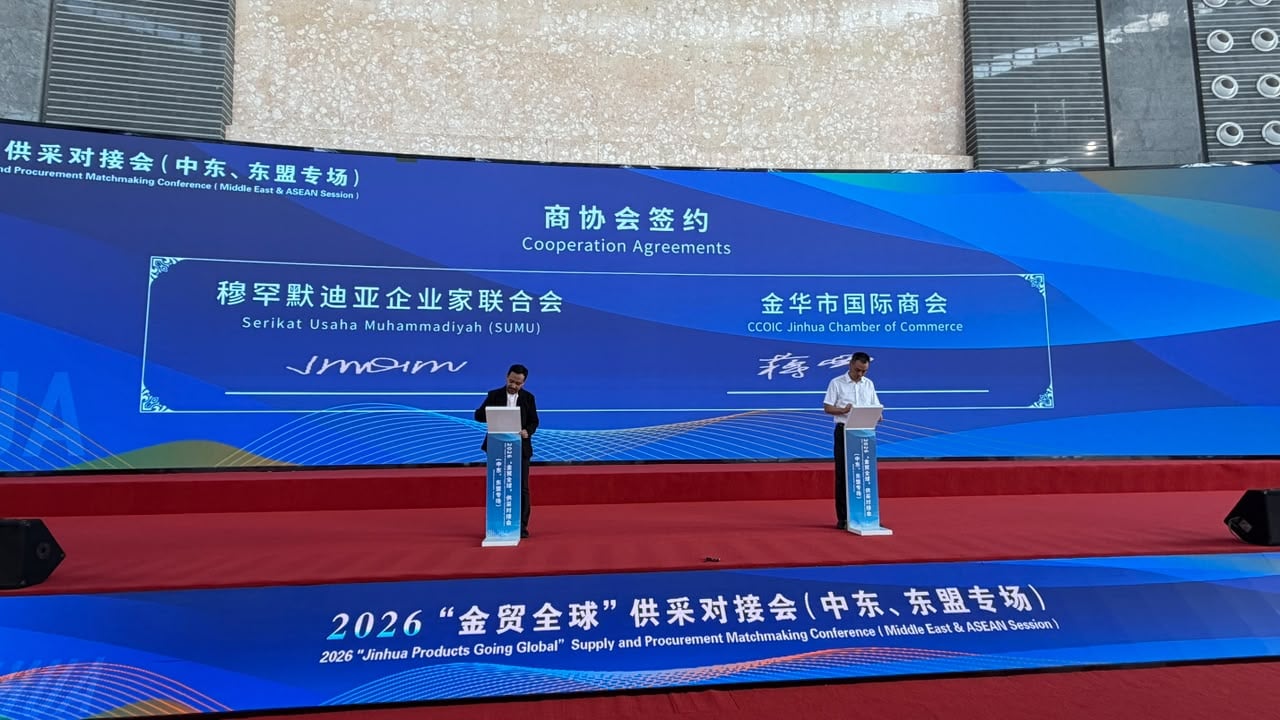
On October 22, 2026, he signed SUMU’s cooperation agreement with Jiang Zhenlei, chairman of Jinhua’s international chamber of commerce, in Yiwu. Muhammadiyah leader Anwar Abbas witnessed it. The agreement sets out opportunities for trade, investment, information exchange and business connections between Indonesia and China.
Its practical scope includes delegations, study visits, exhibitions, workshops and meetings between potential partners. Those are the arrangements through which an international ambition might become useful to an individual business. A signature starts the relationship; the introductions and subsequent work determine what people can do with it.
There is a long journey between the rice fields outside Yogyakarta and a cooperation agreement in Zhejiang. Ghufron’s account of opportunity gives the journey a consistent question. Somewhere, a person has the ability to make or sell something. Somewhere else, someone might buy it. He keeps looking for ways to bring them within reach.
Read, watch, connect
- Personal website & GM AI Co-Pilot
- X / Twitter
- Medium essays
- YouTube: his interview on entrepreneurship and Muslim business networks
- His essay on gotong royong
- The Evermos operating interview
- Endeavor profile
- SUMU’s October 2026 China agreement
- Ummah International
- Evermos company profile