At Eratani’s year-end gathering in December 2025, Andrew Soeherman gave each employee a personal handwritten letter. The company had assembled at Ballroom Aroem Mahakam for an evening called Eradoscope, with team challenges, a look back at the year and a theme of “Mission Possible.” There were videos and gifts. Then there was the decidedly unautomated business of putting pen to paper.
For a founder running an agricultural technology company, it was a revealing choice of medium. A letter takes time, has an intended recipient and cannot be improved by adding another dashboard. The gesture offered a small, concrete view of how Soeherman chose to acknowledge the people doing the work. Agriculture, after all, gives a technology business plenty of reasons to remember that people are involved.
His public story is usually told in larger units: farmers, hectares, investment rounds. The letters supply a useful starting point before the numbers arrive. They put the chief executive back among colleagues, at the end of a working year, recognising individual contributions to an enterprise whose ambition is spread across thousands of rice fields.
A sales career takes a turn toward the fields
Soeherman began selling tiles for a local construction materials company in Medan while at college. His subsequent career included consumer goods and electronics businesses, followed by Gojek, where he joined in 2018 and led expansion in East Java. He later worked at OYO. Sales and regional operations came before the decision to start an agricultural company.
The family connection was already there: one uncle owned an agricultural-input plant in Medan; another worked in palm oil. But familiarity with an industry through relatives is a different preparation from building a business inside it. During a career break, difficulty obtaining quality agricultural products prompted him to investigate further. He spent three months learning from farmers in smaller West Java cities.
Rice became the focus. An introduction to an angel investor brought $300,000 in initial capital, and Eratani was established in 2021. The sequence matters: a supply problem, time spent asking questions, then a commodity choice and a company. It gives his change of career a practical scale. Before there were expansion plans, there was something his family had struggled to obtain.
The business continues after planting
Listen to Soeherman explain Eratani’s approach on CNBC Indonesia’s Tech a Look segment and the emphasis falls on continuity. The work begins with verifying farmers and understanding their needs. It includes access to working capital, seeds and other inputs, continuing guidance and a route to market. The company concentrates on rice while trying to cover the successive decisions required to grow and sell it.
Each service answers a different question. Can a farmer obtain financing? Are suitable inputs available at an affordable price? Who provides advice while the crop is growing? Where does the harvest go? A business organised around the whole season has to keep those questions connected. Improving one stage still leaves the farmer with the others to manage.
Soeherman also speaks about the company’s own economics. Social impact needs a financially sustainable business behind it; margins matter because the organisation must remain able to deliver its services. That makes the model an exercise in coordination as much as technology. Financing institutions, suppliers, field support and buyers all have a part in whether a season ends well.
- 01 Working capital
- 02 Quality inputs
- 03 Cultivation guidance
- 04 Harvest market
Three services, one crop cycle
The current product names make the structure visible. EraFarm provides access to funding through farmer verification for financial institutions, alongside knowledge and technology support. EraKios links agricultural inputs to local kiosks and suppliers. EraMarket connects harvests with market partners, including rice mills and warehouses. The names divide the work into manageable parts without removing the connections between them.
As of October 2026, Eratani’s website reports more than 46,000 farmers in its ecosystem, more than 600 partner kiosks and over 120 rice-milling partners. It also lists more than 21,000 hectares under its “Acquired Land” measure. These are company-reported indicators of reach, each describing a different part of the network.
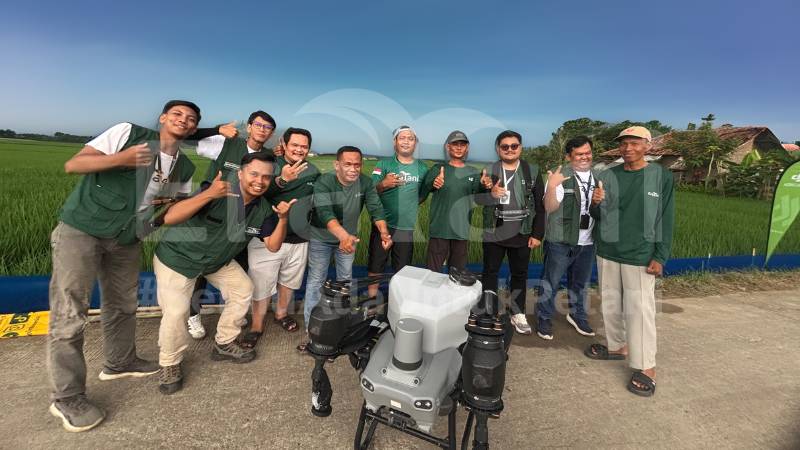
They also explain why a photograph of people beside a field belongs in the story. Procurement and crop sales require relationships at particular places. The kiosk and the mill are familiar commercial institutions; Eratani’s proposition puts them into a connected service. For Soeherman, the growth question extends beyond how many farmers join to how the other participants keep pace.
When a farmer can name the difference
A partnership with KoinWorks offers a closer view of what the financing work involves. The two companies began collaborating in early 2022. Their work included supply-chain financing, invoice financing and direct loans to farmers, supporting different points at which an agricultural business needs money before it receives payment.
One farmer featured in KoinWorks’ impact reporting was Engkus in Indramayu, West Java. His reported production rose from 3.5 tonnes to 4.2 tonnes on half a hectare, an increase of 20%. He described support with agricultural resources, agronomic assistance and taking up the harvest. It is one reported example, with a named farmer and a defined plot size.
That specificity is useful. A gain has meaning when the starting point is visible. The example also places several services in the same season: resources to begin, help managing the crop and a way to sell the result. For an executive explaining an integrated business, an individual farming account can make the mechanics easier to understand than a diagram alone.
A funding round with a longer timetable
In April 2025, Eratani raised $6.2 million in Series A funding. Clay Capital led the round, joined by TNB Aura, SBI Ven Capital, AgFunder, Genting Ventures and Impact Investment Exchange. SBI’s follow-on investment came after its fund’s initial investment in July 2023. The round gave the company additional backing for its work with smallholder rice farmers.
At the time of that announcement, Eratani reported supporting more than 34,000 farmers across Java and Sulawesi. Its reported 2024 results included average yield increases of 29% and income increases of 25%. Those figures describe the company’s stated outcomes for that period; they are best read with their date attached, rather than treated as a promise about every farmer’s next harvest.
Soeherman’s accompanying ambition was measured expansion built on a firm operating base. The planned uses of funding included precision agriculture, mechanised land preparation and sustainable cultivation. The practical implication is a demanding one: capital has to become equipment, useful advice and services that farmers can use. A funding announcement opens that work; the growing season supplies the next test.
A visitor with a notebook mentality
In June 2024, Soeherman travelled through New Zealand with nine other Southeast Asian agribusiness entrepreneurs. The itinerary took them to Auckland, Tauranga and Hamilton. They met agribusiness leaders, spoke on conference panels and visited Fieldays. For a founder working on Indonesian rice farming, it was a chance to examine another agricultural system at closer range.
His assessment was candid: “I think New Zealand Agribusiness is five steps ahead comparing to my country, Indonesia.” He described wanting to bring the knowledge home and prepare the earlier steps needed to develop stronger expertise. The comment is striking for its willingness to count the distance, rather than pretend the visit had erased it.
Agricultural learning often has this awkward feature: seeing a useful practice elsewhere does not mean it can simply be unpacked at home. Soeherman’s language of first, second and third steps makes the visit sound like preparation. For someone whose earlier work involved regional expansion, it is an apt way to frame a trip: observe what works, then consider the sequence required to put it to use.
“I think New Zealand Agribusiness is five steps ahead comparing to my country, Indonesia.”Andrew Soeherman / June 2024 visit
Making room for the next entrants
Another route into the sector opened in September 2024, when Soeherman signed a cooperation agreement with IPB University’s Faculty of Economics and Management. Dr Irfan Syauqi Beik signed for the faculty. The agreement focused on research and certified internships, bringing students closer to agricultural work and giving the company a link to university learning.
Soeherman’s stated hope was to change young people’s perceptions of agriculture by offering worthwhile research and internship opportunities. He wanted them to see a field with prospects and professional standing. It is a recruitment argument as well as an educational one. A company that promises continuing assistance to farmers will need people prepared to learn the work.
There is a patient timescale to that effort. An internship cannot immediately supply an experienced field team, and a research agreement has to turn into work that students and practitioners can use. It nevertheless gives the ambition an institutional home: a faculty, a company and a programme through which new entrants can meet the people already working in agriculture.
His own career has also become material for others considering a change. In May 2024, he appeared among the speakers at “Turning Point: Choosing Your Next Career,” an event co-hosted by Antler and Trihill Capital for more than 100 professionals, executives and founders. The discussion placed his move into entrepreneurship beside other people’s decisions about what to do next.
The distance between those early tile sales and a rice-farming company contains several kinds of education: selling, managing regions, listening to farmers and visiting another country’s agricultural businesses. By the time of the handwritten letters, Soeherman had colleagues making their own contributions to the project. The next season would require them again. A seed still needs planting, and a harvest still needs a buyer.