Chocolate is unusually good at concealing its paperwork. The wrapper gives you a brand, a flavour and perhaps a handsome drawing of a cocoa pod. The farmer, the trader and the route between them generally receive less attractive billing. Manfred Borer has made a business out of bringing that missing cast into view. His work begins far upstream of the confectionery aisle, where a farm needs a location, a producer needs a record and a transaction needs a history.
Borer came to this work by a route that included roofs. Trained as a carpenter in Switzerland, he began running Borer Timber Construction in 1994. His business covered house building, carpentry and roofing, with a specialism in modular construction. He later studied at the University of Applied Sciences and Arts Northwestern Switzerland, completing an engineering degree with a focus on business processes and plant management. Construction gave way to another kind of assembly: information systems.
The change did not take him straight into a venture capital pitch. In 2005, he worked on a management information system for a vocational training programme in Albania. In 2006, he developed systems for programmes in Benin, Burkina Faso and Mali. These were practical assignments for Swisscontact, the Swiss development organisation. His emerging technical career concerned institutions that needed to organise information about people, programmes and results.
Indonesia supplied the next question. For his 2006 thesis, Borer examined how cocoa farmers in Flores made decisions. The project used system dynamics, a method for exploring how different parts of a system influence one another over time. Its subject was agricultural decision-making, rather than a new consumer gadget. Even the proposed training tool had an appealingly unexpected name in his career account: a management flight simulator. The cockpit, in this case, was a cocoa economy.
A cocoa database grows legs
After his thesis, Borer continued with Swisscontact in Indonesia. An early assignment involved the Jakarta office’s resource planning and management information system. By May 2007, he was managing a World Bank-funded cocoa value-chain project in Sumatra. The sequence matters: a business-process student was now working with the real relationships behind the diagrams. Farmers, buyers and development partners all belonged to the same chain, but they did not necessarily share the same information.
In recounting Koltiva’s origins, Borer dates his arrival in Indonesia to 2006 and an early digital cocoa-producer database to 2008. A database is a modest object to put at the centre of an entrepreneurial story. It lacks the glamour of a product launch. Yet registering producers changes what an organisation can see. A farmer who previously appeared only as part of an aggregate can become an identifiable participant, connected to a place and a record.
Borer went on to direct the Sustainable Cocoa Production Program. Its final report records his programme leadership from 2010 to 2017 and describes him as an initiator of the programme. He also became Swisscontact’s Indonesia country director. This was a substantial apprenticeship in coordinating development work: technology sat alongside training, commercial relationships and the continuing business of helping cocoa producers participate in markets.
Koltiva was established in Indonesia in 2013. Its founding team includes Borer, Ainu Rofiq and Furqonuddin Ramdhani. The company’s history places CocoaTrace, its early cocoa digitisation platform, at the beginning. In 2017, Koltiva AG was established in Switzerland and Borer became CEO. He left the cocoa programme that year to work on the business. The programme’s account describes that move as a continuation of its transparency initiative. There is a line between the development project and the company, rather than a clean break.
“If you don’t have data, your ideas are just opinions and not facts.”Manfred Borer, December 2020
The app still needs a pair of boots
The familiar promise of software is that it can travel farther than the person selling it. Borer’s public arguments repeatedly return to the person who travels with it. In a 2022 interview, he described a hybrid model and several hundred field agents across Indonesia. Agribusiness clients needed people on the ground to verify supply chains. Digitisation could store and connect a record; verification still involved encountering the thing being recorded.
His explanation extended to finance. A digital application alone did not satisfy the need to understand a farmer and verify a lending relationship. The appeal of the model is its refusal to wish away that practical work. An app can make a process easier to administer. It cannot make a field visit happen by looking particularly elegant. Somewhere, a person must take responsibility for checking the details.
At Koltiva, that field work is organised through KoltiSkills. Its services include producer surveys, farm verification, group training and individual coaching. They also cover support for businesses in the chain and preparation for sustainability certification. The range reflects a recurring problem in Borer’s work: knowing where a product originated is useful, but the people who produced it may also need knowledge, records and support to meet a buyer’s requirements.
KoltiTrace supplies the digital side. Producer profiles, farm boundaries and recorded transactions help connect agricultural goods to their origins. The platform includes land-use information and tools for documenting product journeys. Viewed together, the two operations give Borer’s idea a concrete shape. One gathers and checks information in the field. The other preserves relationships between those observations as goods move through a commercial system.
There is also a question of who gets to use the information. In a contribution on farming and digital technology, Borer described FarmCloud as giving smallholders access to information collected about them and a say in how their personal data is used. That detail deserves attention. A farmer can be highly visible to a buyer while remaining poorly informed themselves. Making records available to the producer changes the direction in which information can travel.
- LocateRegister the producer and map the farm.
- VerifyCheck information through field engagement.
- FollowRecord transactions through the supply chain.
When a record becomes a financial foothold
In December 2020, Borer put his preference for evidence plainly: “If you don’t have data, your ideas are just opinions and not facts.” It is a brisk line, with little patience for ornamental ambition. His work gives the sentence a practical setting. The records concern actual producers and exchanges, so the question becomes what useful opportunities those records can help create.
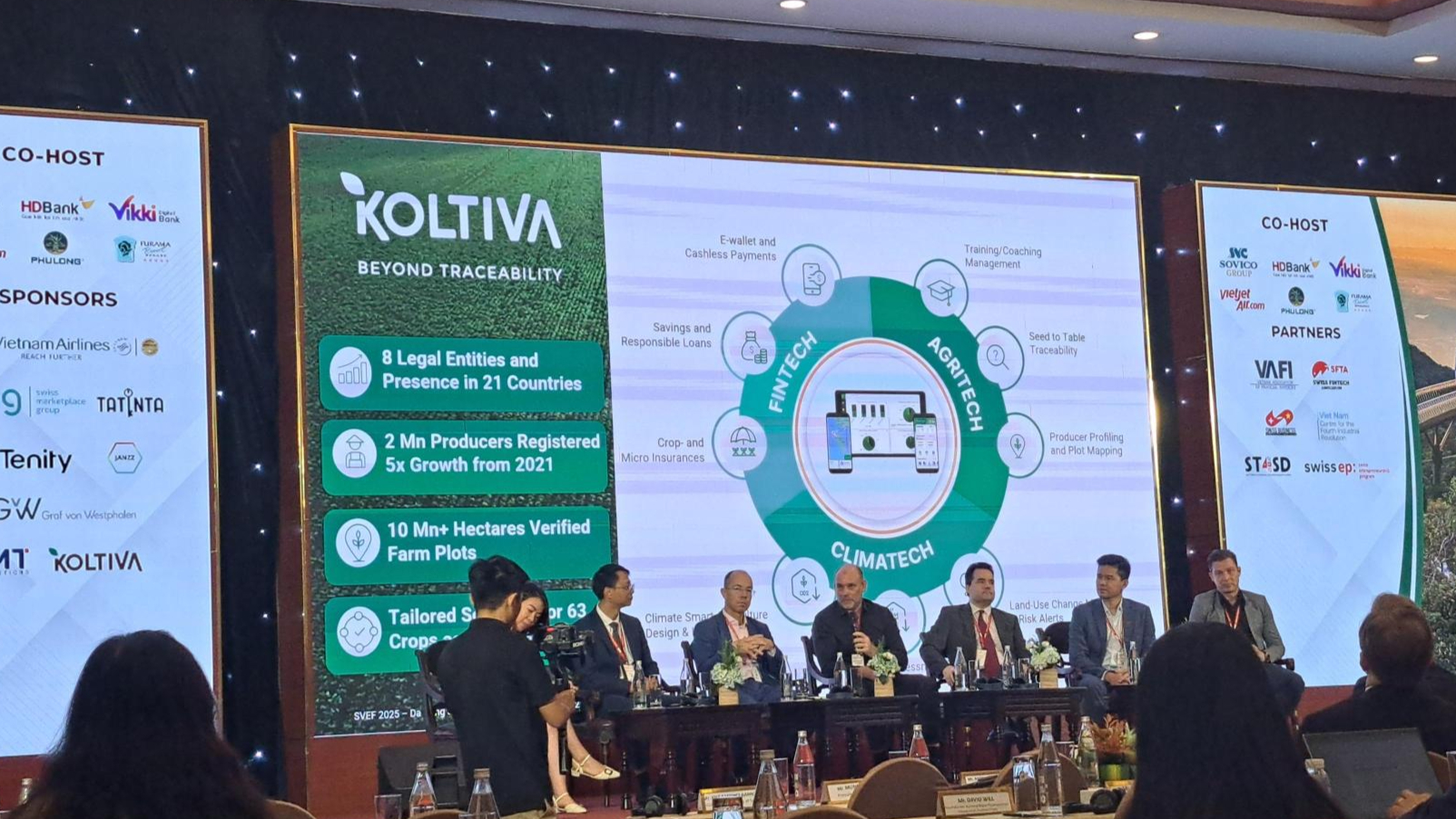
KoltiPay adds a financial layer to that work. The company describes an e-wallet linked to its agricultural applications, allowing payments and access to financial services within the same broader system. The intended connection is straightforward: records of participation and transactions can help make a producer’s activity legible beyond the next sale. Finance enters the story through the accumulated history of doing business.
Vietnam has become one place where Borer has pursued this connection. Koltiva joined the GRAFT Challenge Vietnam cohort in August 2021. The programme helped the company explore partners, adapt to local market needs and establish a local presence. Rural finance was a central concern. Expansion involved the work of introductions, recruitment and testing, the sort of tasks that rarely fit comfortably into a triumphant arrow on a presentation slide.
By November 2025, Borer was presenting KoltiPay’s approach at the Swiss-Viet Economic Forum in Da Nang. His fintech panel connected traceability, credit assessment and capacity building. Koltiva subsequently reported a memorandum of understanding with the forum organisation. The Vietnam work carries forward a question already visible in his Indonesian career: how can information gathered around agricultural trade become useful to the smallholders doing the producing?
The ambition behind the audit trail
Koltiva’s September 2023 financing announcement offered a dated measure of how far this work had travelled. The company reported more than one million producers, 6,800 businesses and work with producers in 52 countries. AC Ventures led the seven-figure Series A round, alongside other investors. Those figures describe the company at that moment. They also show how much broader the operation had become than an early cocoa database.
The funding was intended to expand software, services and climate offerings. Borer’s stated ambition included benefits for global brands and for the people at the beginning of the supply chain. “We envision a world where transparent and sustainable trade is standard,” he said. It is a useful description of his destination: practices that currently require deliberate effort becoming ordinary commercial expectations.
He has also expressed more numerical ambitions. During the GRAFT programme, he described a goal of bringing five million farmers and producers onto Koltiva’s platforms, alongside a target to raise farmers’ incomes through its combined services and products. These were goals. Their value in his story is that they locate the intended beneficiary. His business depends on corporate customers, while its ambitions reach down to the producers those customers buy from.
The work has continued to occupy his public appearances. On 2 September 2026, Borer presented “From Seed to Table: Building Transparent and Traceable Food Supply Chains at Scale” in the Swiss development agency’s Thoughts for Food series. The subject stays close to the one that has followed him through the past two decades: making a dispersed agricultural system understandable enough for people to act on it.
Borer’s biography contains a tempting metaphor. A carpenter learns to fit pieces together; a supply-chain entrepreneur works on connections between people, places and products. The resemblance is an editorial reading of his career, rather than a claim about why he changed professions. What can be seen is a succession of practical jobs: running a building company, constructing information systems, directing a cocoa programme and leading a technology business.
That succession gives the chocolate wrapper a different cast of characters. Behind its polished surface sit producers who need to be registered, farms whose boundaries need checking and businesses whose purchases need recording. Borer’s contribution is to organise ways of following those relationships. The work has software, investment rounds and international speaking engagements. It also has surveys, coaching and field agents. A product’s origin remains a real place, however neatly its journey appears on a screen.