In 2014, Nevada had a health insurance problem that looked like a website problem. Its exchange technology, supplied by Xerox, had stumbled. The state moved enrollment onto HealthCare.gov. For anyone contemplating another state-run system, the obvious question was: why risk it again?
Five years later, Nevada did. This time, the machinery came from GetInsured. The useful part of the story lies between those two decisions: officials changed what they were willing to buy, and what they demanded a vendor prove.
- States buy the software; families use it to find coverage.
- Shared infrastructure supports different state marketplace rules.
- Enrollment technology and consumer assistance come together.
- Savings depend on the contract, the federal alternative, and the work still required.
Nevada’s expensive first lesson
GetInsured began in 2005 with Chini Krishnan and Shankar Srinivasan. The ambition was familiar to anyone buying airline tickets online: make insurance easier to compare and purchase. Then the Affordable Care Act changed the opportunity. States needed marketplaces, and the consumer shopping business developed a government customer.
In a 2020 interview, Krishnan described the shift toward cloud platforms that could accommodate state policy differences without rebuilding everything. His description of the commercial model was unusually short: “We’re SaaS.” The contracts, he explained, tended toward fixed enterprise pricing.
Nevada’s procurement required a vendor already deployed in another state for at least one successful plan year. Rising federal fees threatened its reserves. An operating system elsewhere offered evidence that a fresh proposal could not. GetInsured won the competition; enrollment opened on its platform in November 2019.
falters
takes over
opens enrollment
The shopping cart has a back office
To a resident, an exchange is a place to compare plans. To an operator, it is a chain of decisions: establish eligibility, calculate available assistance, display options, transmit enrollment, maintain records, and handle changes. A broken handoff can become somebody’s unanswered coverage question.
GetInsured supplies the cloud platform behind that chain, along with implementation, migration, integration, and consumer assistance services. Its customers include marketplace agencies in Pennsylvania, New Jersey, Nevada, Virginia, Georgia, and other states. Brokers, navigators, insurers, and agency staff use the system alongside consumers.
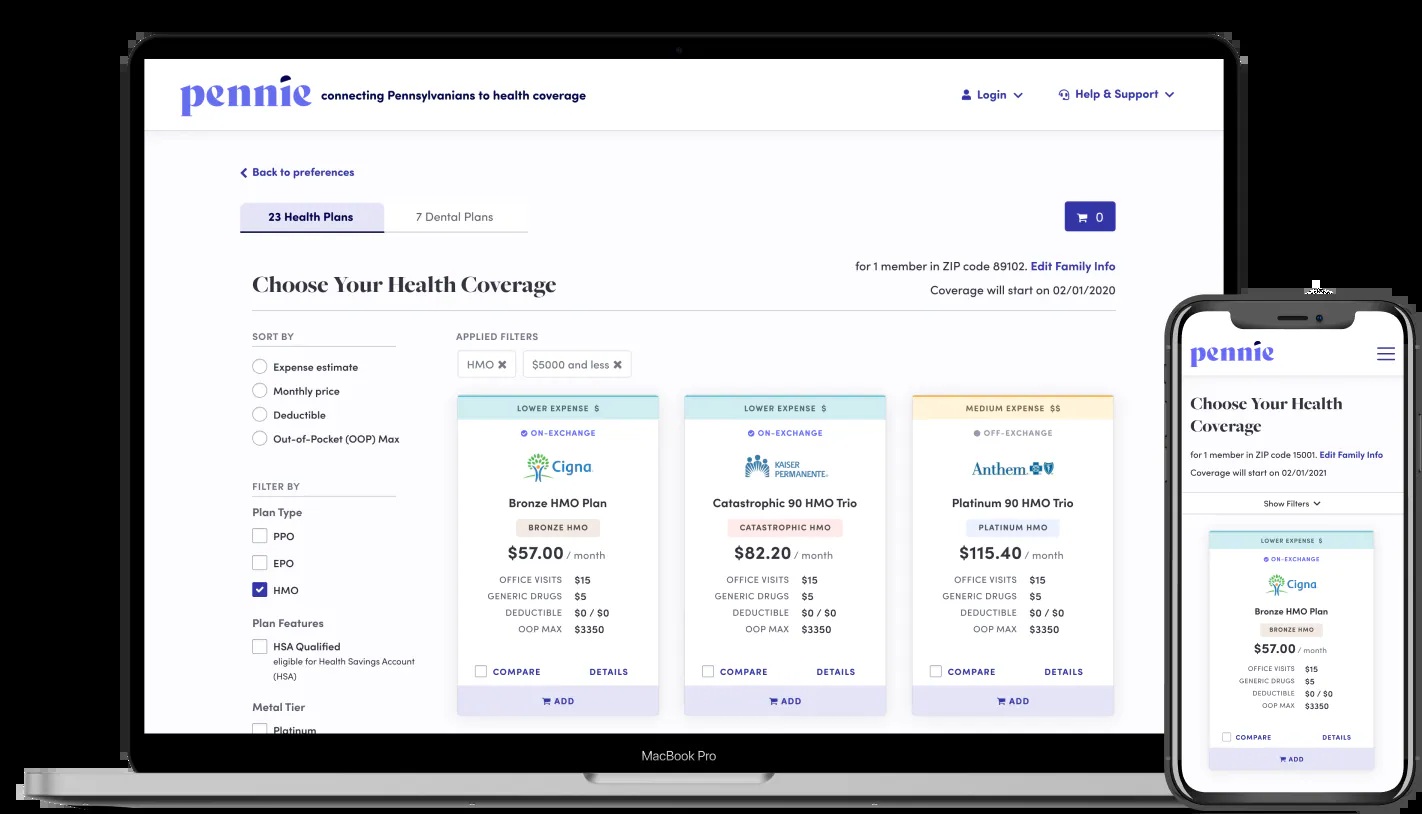
The comparison tools can help users consider estimated expenses, deductibles, prescriptions, and doctors. The state marketplace remains the public front door. GetInsured’s role is to make the transaction behind it work.
There is another route into the same administrative machinery. Enhanced Direct Enrollment lets approved third-party websites handle more of the enrollment experience without bouncing shoppers back and forth to the federal site. GetInsured’s 2018 explanation focused on that awkward double redirect. The product question was simple: how many times should someone have to change websites to complete one application?
The phone line matters just as much. For Oregon’s planned marketplace, the company describes an integrated call center whose representatives can use one internal account dashboard. That is a practical distinction from buying a website and arranging support separately: the person answering should be able to see the problem.
The invoice matters
The competitive choice is often structural. A state can use the federal platform, commission a custom system, or configure a shared one. GetInsured occupies that third position. The state retains its own marketplace identity and policy responsibilities, while the vendor supplies technology used across customers. The trade-off deserves attention: common infrastructure must still accommodate local requirements without turning each installation into a separate development project.
Nevada’s February 2025 contract paper puts numbers on the arrangement. GetInsured’s technology and call center services cost $5,310,222 in 2024, equivalent to about 0.90% of enrollee premiums. The comparable federal platform fee was 1.8%. This comparison covers those services, rather than the exchange’s entire budget.
Same year. Defined service scope. A useful comparison.
But the same paper proposed a 27% rate increase for 2026. It cited enrollment growth, tighter security requirements, and higher hosting and telephony costs. The benchmark moved, too: federal fees fell in 2025. Shared software still needs servers, compliance work, and people. A savings claim needs a date attached.
A working site can still be an expensive project
GetInsured’s history also contains a less comfortable lesson. A 2015 New Mexico legislative audit recorded $27.5 million reimbursed to the company for a completed small-business exchange and partial work on an individual exchange. The board had delayed the individual launch in July 2014. Auditors also criticized contracting practices, including work beginning before a final agreement.
That record complicates any tidy tale about cheap, repeatable software. State decisions, project scope, contracting, and enrollment all affect the result. Software reuse cannot settle an agency’s unresolved decisions. New Mexico later selected GetInsured again for a four-year modernization agreement announced in 2024, for plan year 2026.
Software reuse cannot settle an agency’s unresolved decisions.
A bigger job, an older name
By November 2025, GetInsured reported migrating coverage for more than 430,000 Illinois residents. Oregon’s transition was planned for 2027. Those are consequential assignments, but enrollment totals reflect policy, affordability, outreach, and partners as well as technology. A vendor cannot take credit for the whole insurance market.
In 2021, Vimo acquired Change & Innovation Agency, adding expertise in how public agencies organize work. On September 1, 2026, the businesses announced they would operate under the Vimo name. Their combined remit extends into Medicaid, food assistance, child care, and other public benefits.

The lesson a public buyer can copy is fairly concrete. Ask for a running reference system. Define who owns each handoff. Test migration before enrollment opens. Compare total costs against the actual alternative. Keep policy decisions and customer support in the project from the start.
That approach depends on an agency able to govern the work and a platform that fits its requirements. Where either is missing, another procurement will not supply it. Nevada’s second try offers something more useful than a promise of easy modernization: a reason to ask better questions before signing.