A roofing contractor can replace a roof, photograph every shingle and collect the final payment, then handle the happiest customer’s referral with the administrative rigor of a lemonade stand. A name lands in a text. Somebody promises a check. The lead changes hands twice. Three months later, the customer wonders what happened to the neighbor they recommended.
Get The Referral, a San Diego software company founded by Jamey Vumback, has spent more than a decade turning that loose exchange into a visible system. Its Referral Hub gives contractors a branded homeowner app and web experience, a separate field app for sales reps, shareable links and QR codes, a dashboard, CRM connections and a digital wallet. Customers can submit a friend, watch the opportunity move through stages and collect a reward. The contractor can see who referred whom, whether the job sold and what the channel returned.
This is vertical SaaS with dust on its boots. GTR is aimed at roofing, solar, remodeling, windows and doors, pools and other home-services firms. The company says it serves more than 500 of them across 35 states, Puerto Rico, Canada and Australia. It is unusually blunt about the other side of that filter: the current pricing page says the product is not for solopreneurs, independent contractors or teams shopping for a $99-a-month tool.
The thing that failed first
The origin story begins in 2013, when Vumback was running a solar company. According to GTR, paid leads were getting more expensive, margins were tightening and traditional marketing was producing inconsistent returns. Word of mouth still converted, but it could not be summoned on schedule or measured cleanly. What changed his mind was not a sudden love of loyalty software. It was the arithmetic of buying the next lead.
GTR launched its first branded referral app in 2014. The initial insight remains intact: homeowners have goodwill, but goodwill needs a route. A customer should not have to remember a salesperson’s number, invent the right introduction and trust that a promised reward will eventually materialize. Put the company icon on the phone, give the customer a unique link and show progress. Reduce the number of moments where intent can evaporate.
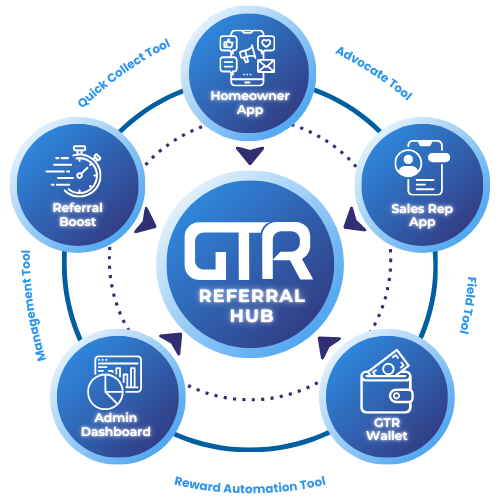
The company has since widened the product without abandoning that loop. Refer-Pro is the customer-facing experience, branded with the contractor’s own name, colors and icon. It can carry project stages, messages, contracts, permits and warranties as well as referral tools. The Sales Rep App lets field teams register advocates and follow leads. Referral Boost sends personalized invitations to an existing contact list. The Admin Dashboard handles attribution, pipeline stages, rewards and ROI. GTR Wallet, powered by XTRM, offers bank transfers, prepaid cards and digital gift cards.
A product that sells a habit
The company’s difference is not referral tracking alone. Plenty of products can produce a link and count conversions. GTR bundles the referral ask with the ongoing homeowner relationship: project updates, documents, messages, reviews and rewards. That gives the app reasons to exist between “please refer us” and “here is your money.” Its integrations can sync customers, referral stages and project statuses through a CRM, an API, webhooks or Zapier. Named ecosystems include Salesforce, HubSpot, Leap, JobNimbus, MarketSharp and Monday.
“We’ve done a million and some change just off sales from the GTR app.”Donald Beal, Kingdom Roofing Systems · company case study
That case study is the company’s cleanest proof point. Kingdom Roofing Systems had been managing referrals by spreadsheet. GTR reports that 124 advocates submitted 175 referrals, producing 106 sold deals, more than $1 million in revenue and a 73-times return. The conversion rate was about 60 percent. These are vendor-published results, not an independent audit, but the operational change is concrete: one place for promotion, tracking and payment replaced an “archaic” sheet.
Company-reported Kingdom Roofing results. Useful as a mechanism, not a universal forecast.
The broader customer picture is messier, which makes it more instructive. G2 reviewers praise simpler payout handling, CRM synchronization and a single place to monitor advocates. They also describe terminology that confused sales teams, occasional freezing, uncertainty around manual wallet cash-outs and weak onboarding. One 2025 reviewer wrote that the technology and onboarding were “extremely lacking.” Another said GTR had eliminated a cumbersome mix of spreadsheets and CRM reports.
Both can be true. Referral software is sold to the buyer but lives or dies with the rep and customer. If a salesperson does not introduce the program at the right moment, no dashboard can detect the referral that never entered. If an advocate expects instant cash but must still redeem a balance, a technically successful workflow can feel broken. The first failure in a rollout is often not tracking. It is participation.
What it costs - and what you are buying
GTR now publishes pricing. Starter is $399 a month with a $500 setup fee. Pro Lite is $799, Pro is $999 and Premium is $1,899, with setup fees rising to $2,500. Annual payment reduces the subscription by 10 percent. The plans include unlimited advocates and referrals; higher tiers add sales seats, API access and deeper integration capacity. There is no free trial, and the company uses annual contracts. Its explanation is that a customized program takes implementation work and that high-ticket home-service jobs can take months to close.
Published monthly installments · August 2026
Setup fees: $500 to $2,500. Annual prepayment: 10% lower. Reward budgets and internal labor are separate economic costs.
That is more than a generic referral widget because the customer is buying branding, implementation, support, integrations and a multi-sided workflow. The economic fit improves when jobs are valuable, lead costs are high and a company already has enough customers and salespeople to activate. One incremental roof, solar installation or remodel can cover months of software. A low-ticket operator with thin margins needs a very different equation.

The playbook worth stealing
GTR’s best idea is not that every business needs a branded app. It is that a valuable behavior becomes more reliable when the full feedback loop is visible. The advocate knows the referral arrived. The rep knows what to do next. The administrator knows when to pay. The buyer can compare referral revenue with software and reward costs.
Copy the loop, not the logo
- Choose the moment of peak satisfaction - a finished roof, a passed inspection, a clean handoff - and ask there.
- Give customers one obvious sharing action, preferably a personal link or QR code.
- Feed status changes from the system employees already use, so double entry does not kill adoption.
- Reward quickly and offer choice. A smaller payment that arrives predictably can feel better than a vague larger promise.
- Measure sold revenue, payout cost and participation by rep. A referral count without conversion data is a vanity metric wearing work boots.
The market position follows from that recipe. GTR sits between broad customer-advocacy platforms such as Influitive and referral specialists such as Referral Rock, Friendbuy, Extole and Buyapowa, while competing most often with a contractor’s improvised stack of CRM fields, forms, email, spreadsheets and checks. Its moat is vertical detail: field reps, project stages, homeowner communication, contractor CRMs and high-value rewards in one product.
Partnerships reinforce the same focus. XTRM powers the wallet. GTR lists relationships with Owens Corning, Leap, Angi, Ingage, SalesRabbit, CompanyCam and ActiveProspect, among others. In 2026, the company also pushed its Advocate experience into a redesigned web app, removing the download requirement while keeping the branded mobile apps. That is a sensible concession to reality: a contractor may adore having an icon in a customer’s pocket; the customer may prefer tapping a link once.
Conditions where it probably will not work
If the underlying service disappoints, there is no goodwill to automate. If teams will not ask, if CRM data is unreliable, if rewards are slow or confusing, or if the average sale is too small to support the subscription and incentive budget, the system becomes expensive shelfware. It is also a poor fit for very small operators who lack a repeatable sales process and enough customer volume to create a useful advocate network.
The final lesson is pleasantly unromantic. Word of mouth is emotional at the moment of recommendation and operational everywhere else. The introduction has to be captured. Consent has to be recorded. Sales has to follow up. Status has to move. Money has to arrive. Get The Referral built a company in those handoffs.
For contractors, the promise is not that referrals become effortless. It is that the effort stops disappearing. For software builders, the pattern is portable: find a valuable behavior currently held together by goodwill and memory, close every gap around it, and charge for the resulting certainty. Just remember that the most elegant workflow still begins with a customer who has something nice to say.