The trouble with a sales call is that the useful part of the training often happens somewhere else. There is a workshop, a slide deck, a manager with excellent advice. Then a customer asks an awkward question about price, and the salesperson is alone with a headset. Salesken has built a company around that interval: the few seconds between a difficult question and an answer that might keep the conversation alive.
- Live prompts help reps respond during customer conversations.
- Call analysis feeds coaching, quality reviews and deal insights.
- Pricing combines user licenses with a platform fee.
The training room had a blind spot
Co-founders Surga Thilakan and Sreeraman Vaidyanathan came from sales training. Their earlier business, iStar, equipped entry-level staff to talk to customers. Training thousands of people raised an inconvenient question: how could anyone tell whether the lessons survived contact with an actual buyer?
An early Salesken prototype analyzed conversations and detected problems. But a diagnosis delivered after the customer departed could do little for that particular lead. Early deployments exposed another difficulty: software that served a manager’s appetite for visibility gave the frontline salesperson less reason to use it.
The team’s response was to turn analysis into immediate assistance. The rep would receive cues while speaking, with useful information arriving when an objection appeared. There is a portable product lesson here: the person doing the work needs a reason to welcome the tool.

A prompt has to beat the pause
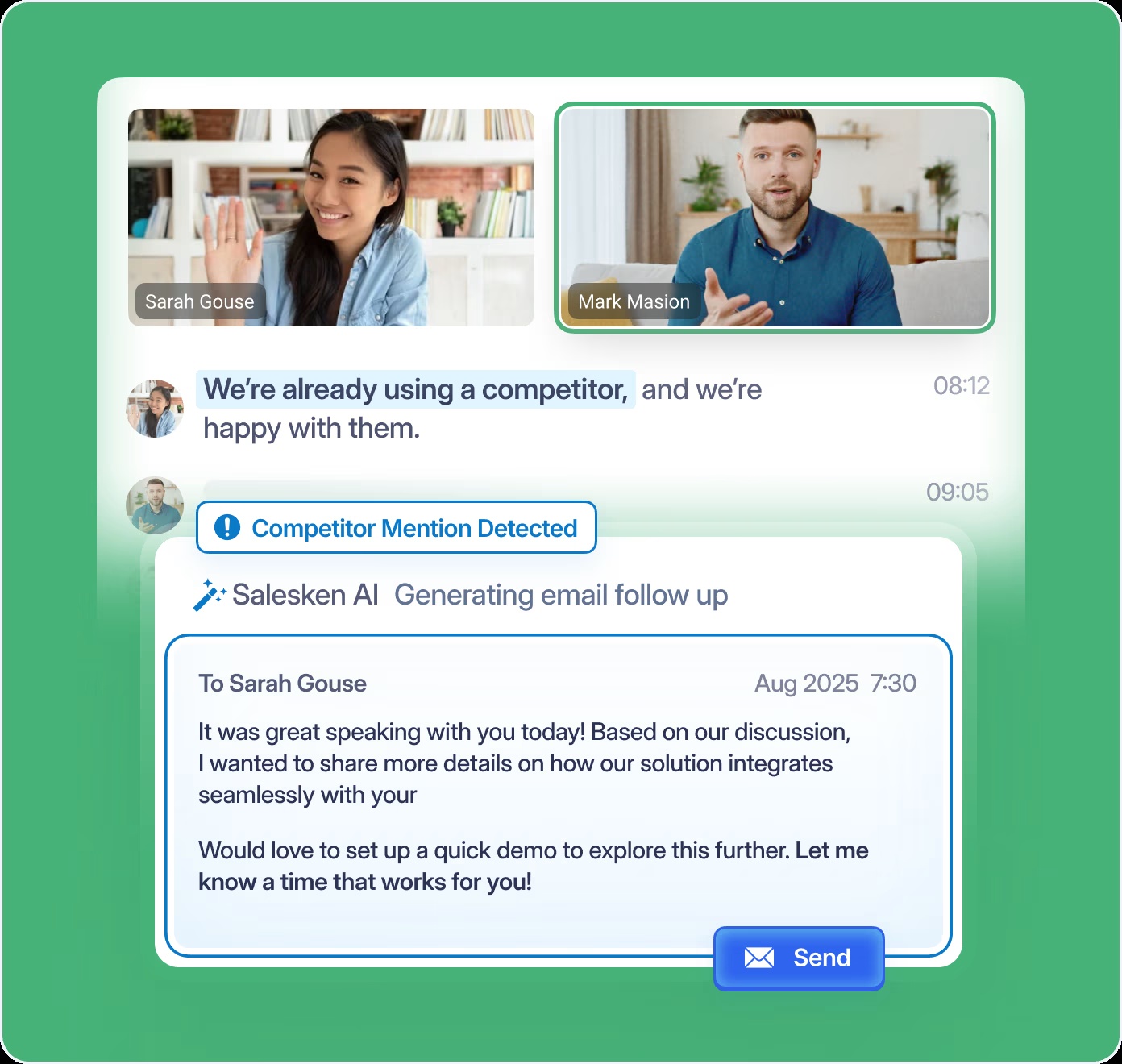
Today, the AI Sales Assistant offers prompts for objections, competitor mentions and talking points. It also produces transcripts, summaries, follow-up drafts and CRM updates. The proposition is practical: give a rep information without asking them to abandon the conversation to search for it.
Think of the difference between knowing a company has a particular product feature and remembering it when someone asks the relevant question. Salesken’s cues attempt to close that gap. The rep still speaks; the software supplies a suggestion. That leaves room for judgment, including deciding that the suggestion does not fit.
- 01Conversation
- 02Signal
- 03Live cue
- 04CRM update
The less glamorous detail is setup. Salesken’s Salesloft marketplace listing says its customer-success team uses call data and sales materials to configure cues, which customers can edit. Good assistance therefore depends partly on a business knowing what a good answer looks like. An elegant prompt attached to an obsolete policy remains an obsolete policy.
The call becomes the record
Salesken’s March 2026 integration article lists Salesforce, HubSpot and Zoho. It describes pushing transcripts, summaries, tasks and deal signals into CRM records. This tackles a familiar administrative weakness: customer conversations contain details that hurried salespeople may never type into the official system.
The company also advises buyers to check field structures, decide which system takes precedence when records conflict, and pilot with a small team. Those details matter. Automatic updates are useful only when they land in the right place and colleagues understand what the fields mean.
Revenue Intelligence extends the same logic to managers. Salesken describes deal-health signals, pricing concerns, competitor mentions and closure predictions drawn from conversations. A pipeline stage can say that a deal is progressing while the buyer’s words suggest hesitation. Listening adds another kind of evidence; a prediction still requires interpretation.
The manager’s second pair of ears
Quality Assurance AI addresses a different bottleneck: reviewing calls. Salesken advertises automated evaluation across all conversations, with scoring, risk flags and configurable team goals. Instead of treating a small selection of recordings as the whole picture, managers can look for recurring problems across a larger body of interactions.
Coverage and correctness are different questions. A score can help locate a coaching moment, but managers still need to understand the conversation behind it. A technically compliant pitch may be bewildering to a customer; a warm exchange may omit essential information. The useful work begins when a flagged moment receives attention.
Meeting notes and Field Sales QA widen the product range beyond a desk-bound call. Salesken sells into customer-facing workflows across industries including insurance, banking, education and real estate. Its website says more than 200 businesses use the platform. That is the company’s count, rather than an independent measure of adoption.
Thirty million dollars to shorten the distance
The funding gives the ambition a scale. Salesken announced an $8 million Series A led by Sequoia India in March 2020. In November 2021, it announced a $22 million Series B led by M12, Microsoft’s venture fund, with Sequoia India participating. The stated priorities included North American expansion and further product development.
“We created Salesken to make selling scientific and seamless.”Surga Thilakan · February 2022 company announcement
The ambition comes with a bill. Salesken’s published pricing model charges per recorded user, plus a platform fee based on supported users. Bundles and tailored enterprise plans are available, and the pricing page says integration with an existing stack is free. Buyers need a quote to establish the actual cost of their configuration.
The advantage is useful timing
Salesken occupies the crowded intersection of conversation intelligence, sales coaching and revenue software. Gong offers conversation analysis and forecasting; Clari’s conversation product also offers live assistance. Real-time coaching alone does not make Salesken unique. Its argument combines in-call cues, automated QA and deal intelligence in a single platform.
For teams with repeated questions, frequent calls and usable sales materials, that combination has an intelligible purpose. For teams unable to provide live audio, keep guidance current or connect conversation data to their workflow, its usefulness narrows. The clever idea is easy to copy: shorten the distance between a problem and the help that answers it. The hard part is ensuring that, when the prompt appears, the person wearing the headset is glad it did.