The consequential object in George White’s story is not a bridge, a drone or even a tablet. It is the construction notebook: useful, familiar and quietly capable of trapping an afternoon’s worth of knowledge between two cardboard covers. A note made beside a roadway still had to travel back to an office. A photograph still needed a label. A report still waited to be assembled. The concrete could cure faster than the paperwork.
White, a mechanical engineer from the University of Washington, made a career of worrying about that distance between work and record. He is the co-founder and CEO of HeadLight, the Seattle software company built around visual field data for infrastructure construction. Its premise sounds modest because good workflow ideas often do: let inspectors capture what they see while they are still standing in front of it, and keep the place, time and project context attached.
The ambition underneath is larger. Roads, bridges and public works are physical promises made with public money. Their documentary twin matters. When the record is late or thin, decisions slow down, claims become harder to resolve and institutional memory develops holes. White’s work has been an extended attempt to give that second structure stronger beams.
01 / The first layer
Asphalt before apps
The story begins before HeadLight had a name. In 2002, White was among the authors of “Online Tools for Hot-Mix Asphalt Monitoring,” a paper recognized with the Transportation Research Board’s K. B. Woods Award. The prize is given for an outstanding paper in the design and construction of transportation facilities. There is something pleasingly direct about his early subject: asphalt, the web and the challenge of knowing what is happening while a road is being made.
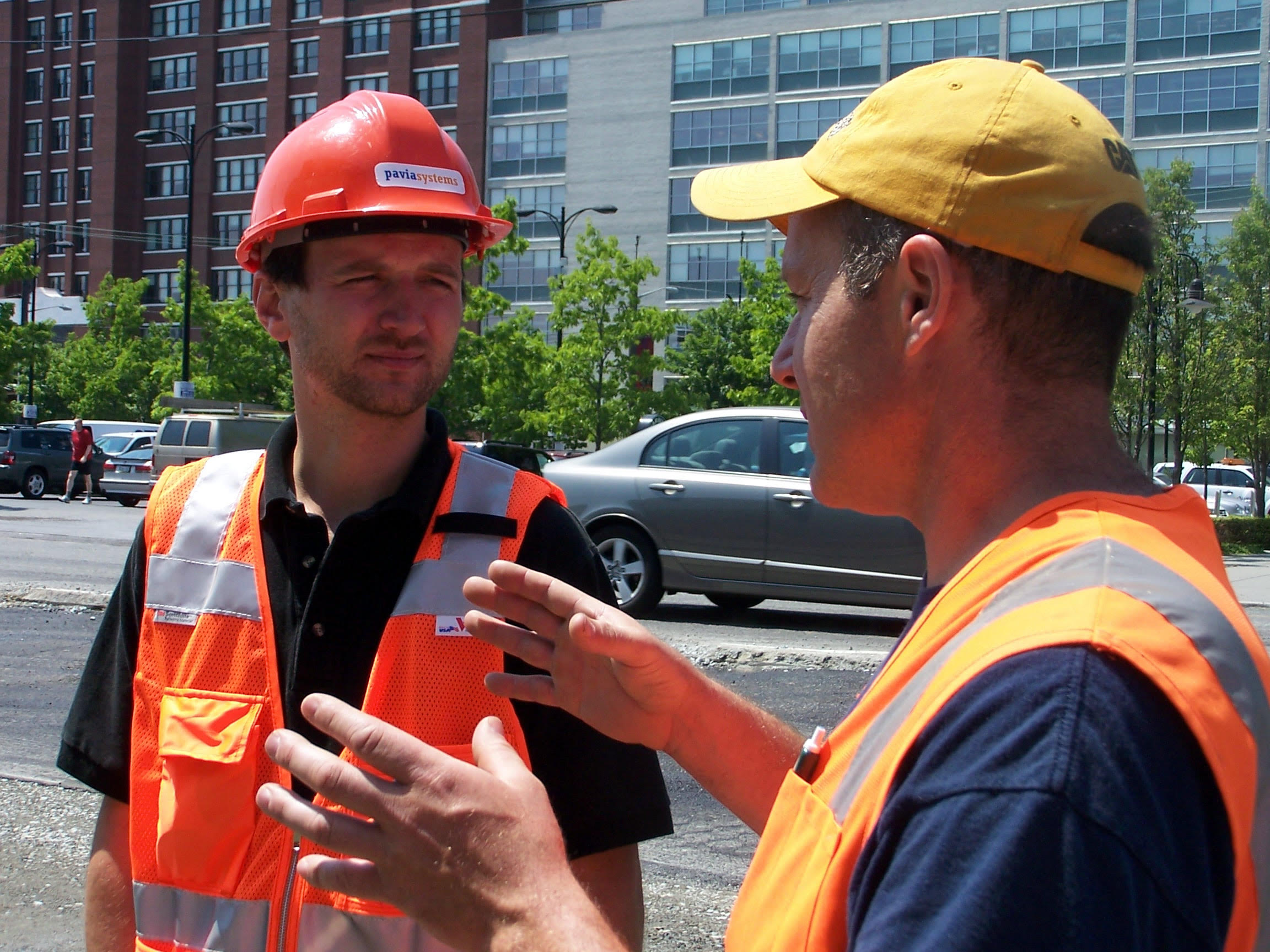
Three years later, White and fellow engineering student Si Katara started Pavia Systems with University of Washington professors Joe Mahoney and Steven Muench. The company spun out of UW in 2005 and was incubated by CoMotion Labs. This was not the garage mythology of consumer tech. It came with professors, transportation research and the unflashy conviction that infrastructure deserved better software.
The founders did a useful thing before asking inspectors to adopt a useful thing: they went to see them. HeadLight’s company history describes months spent with infrastructure and transportation leaders in Washington, Texas, Minnesota and California. They listened, built, adjusted and built again. The repeated verb is the point. Construction has little patience for a tool designed by someone who has never watched the work.
That fieldwork also reversed the usual hierarchy of a software pitch. The inspector was not treated as the final stop in a chain of executive decisions. The inspector’s day was the raw material. Where did a note begin? When did it get typed again? Which detail vanished between the shoulder of a highway and the filing cabinet? These are small questions with expensive answers. Asking them in sequence turned the jobsite into a design studio, albeit one with stricter footwear rules.
02 / The useful pivot
Finding the product inside the paperwork
Pavia first sold online training materials to transportation clients. It later shifted toward tools used during the job itself. That pivot tightened the distance between the company and its customer’s daily irritation. Inspectors were recording observations, calculations and inventory by hand, then returning to a desk to turn the day into formal documentation. A highly trained person could spend the evening behaving like a human adapter cable.
The mobile product changed the sequence. An inspector could enter an observation and take a photograph on site. The information could move into the project record without being reconstructed from scattered notes. In 2016, Seattle magazine reported pilot results in which documents that had taken an hour could be generated in seconds. The publication also reported the software in use on 42 Washington jobsites, including the State Route 520 floating bridge and an Interstate 5 expansion.
The stealable idea
Look for the second shift: the hour after the real work when a skilled operator translates notes, pictures and memory into somebody else’s system. Preserve context at the moment of capture, and the report becomes an output instead of a separate performance.
In 2015, Pavia Systems became HeadLight. The new name suited a product concerned with seeing, but the deeper continuity mattered more than the rebrand. White stayed with transportation infrastructure, a market where procurement is careful, terminology is dense and a missing record can become expensive long after the crew has moved on. Vertical software rewards such patience. Every year spent near the work adds vocabulary that a general-purpose tool does not have.
It also adds an appreciation for the unglamorous dependencies. A field observation may influence a report. The report may support a payment. The payment may depend on materials verification. Months later, the same record may help explain a change or answer a claim. A product that appears to capture notes is really entering a chain of accountability. White’s engineering background is relevant here less as biography than as posture: trace the load, understand the connection and avoid pretending that one component lives alone.
“Helping our customers increase the value they can deliver for taxpayers by using technology is what drives our business.”George White, on HeadLight’s work with Rhode Island DOT
That line reveals the audience behind the user. The inspector operates the software, but the eventual beneficiary is a traveler or taxpayer who may never hear the company’s name. In public construction, efficiency is not merely a nicer dashboard. It can mean broader inspection coverage, faster decisions and a clearer defense of what was built, when and why.
03 / Evidence has coordinates
The photograph that knows where it belongs
A construction photograph becomes useful evidence only when it keeps its context. Otherwise it is a mystery with excellent resolution. HeadLight’s approach joins visual observations to time and location, then makes them available to the people coordinating a project. The humble image becomes a project object: searchable, shareable and harder to misplace in the historical record.
That mattered in Louisiana’s 2020 hurricane response. Transportation crews used visual observations and GPS data to document debris and road damage from their vehicles. The same basic workflow that helps verify ordinary construction could support priority setting amid an extraordinary cleanup. White’s public comment focused on the agency and the people responding, not on software theatre. He described Louisiana’s response as swift and efficient and said HeadLight intended to keep supporting its partners in resilience.
The application is dramatic, but the product logic remains almost domestic: put each thing back where it belongs. A photo with its location. A note with its project. A decision with its evidence. Software earns trust in serious industries by being boring in precisely the right ways.
- 2002 / ResearchWhite co-authors award-winning work on online tools for hot-mix asphalt monitoring.
- 2005 / FormationPavia Systems spins out of the University of Washington.
- 2015 / FocusThe company takes the HeadLight name and centers visual field inspection.
- 2020 / ScaleHeadLight announces a $25 million investment from Viking Global Investors.
- 2021 / RecognitionThe company appears on the Inc. 5000 at No. 1,467.
04 / The long road
Patience as product strategy
By June 2020, HeadLight had attracted a $25 million investment from Viking Global Investors. White discussed the round shortly afterward on the podcast What Fuels You, along with choosing partners, defining operating principles and the importance of vulnerable leadership. Vulnerability may sound far from asphalt, yet it fits the founder’s method. Listening in the field requires admitting that the operator understands the problem better than the person arriving with software.
The company’s path contains a quiet lesson about durability. It began with training, moved into field tools, changed its name and kept the industry. White did not treat infrastructure as a fashionable vertical to enter and exit. He learned its forms, agencies, liabilities and rhythms. By 2021, HeadLight was No. 1,467 on the Inc. 5000. Rankings pass. Fluency remains.
The contrast with consumer software is instructive. A social app can ask people to invent a habit. Construction technology usually has to meet a habit already carrying legal, financial and operational weight. The old process may be clumsy, but it exists for reasons. Replacing it requires more than novelty. The new tool must preserve what the paper protected, improve what the paper obscured and work in weather that has never read a product roadmap. Patient founders learn to distinguish tradition from friction before removing either.
His official biography also points to research involving drones for bridge inspection and work helping executives at public organizations and large companies apply technology to infrastructure projects. The connective tissue is visual knowledge: how to collect more of it, how to keep it attached to reality and how to make it useful for a decision.
White’s aspiration, as HeadLight tells it, was to help improve the world around him and make infrastructure construction easier, simpler and safer. The wording is earnest. The practice is concrete. It asks what happens to one observation after an inspector makes it, then follows that observation all the way to a report, a payment, a resolved question or a future maintenance decision.
A road is visible. Its information system mostly is not. Yet every bridge leaves behind a second landscape of photographs, tests, forms and approvals. George White has spent two decades making that landscape easier to navigate. The notebook still has its charms. It simply no longer gets the last word.