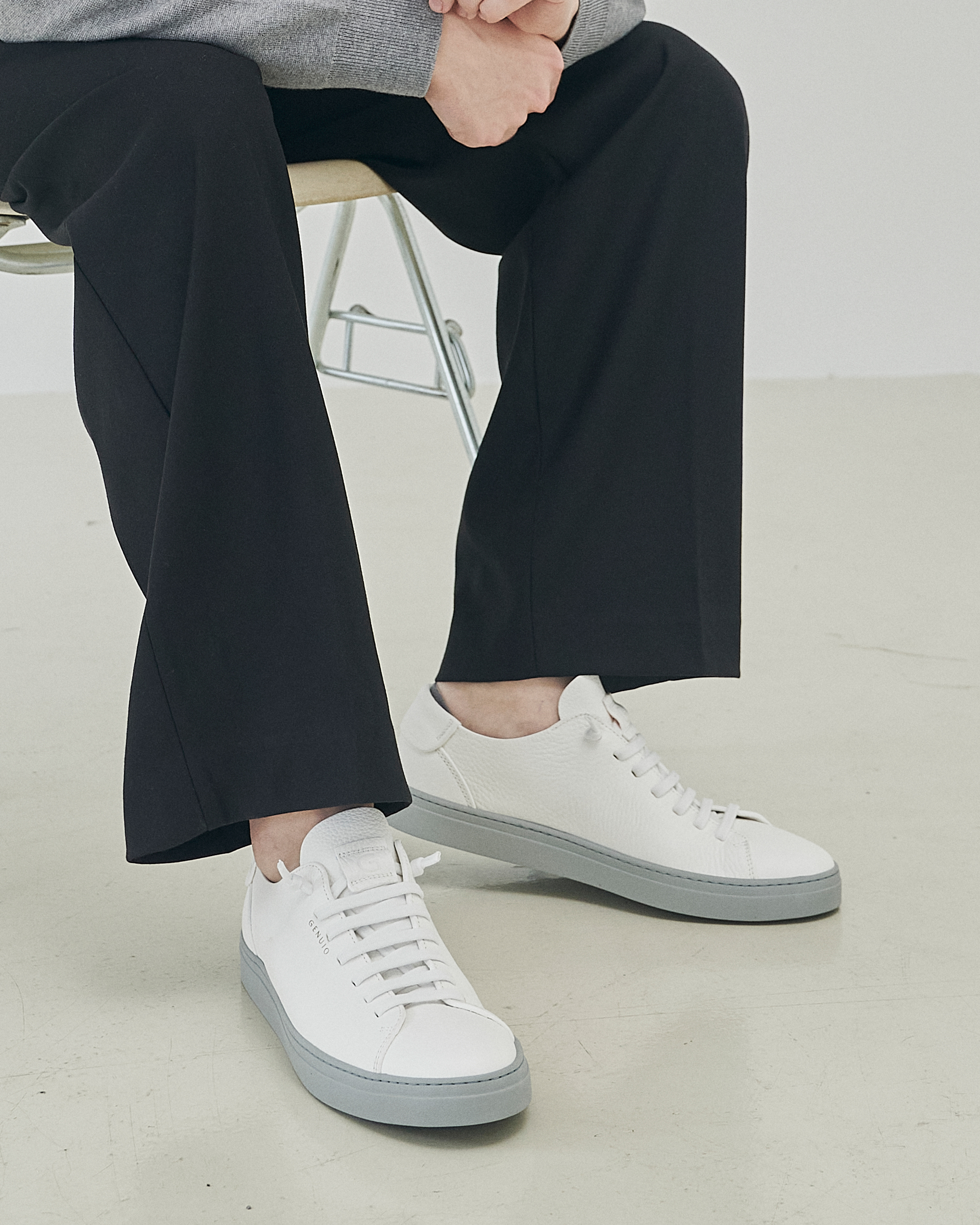
The useful thing about a white sneaker is that it has nowhere to hide. There is no complicated pattern to distract from a crooked seam, no loud color to excuse a clumsy shape. It is leather, proportion, construction and fit. For Genuio, a small Seoul footwear company founded in 2017, that blank canvas became both product and argument: Korean shoppers could buy shoes made in Italian factories without financing the usual tower of distributors, stores and luxury-brand overhead.
The proposition sounds almost suspiciously tidy. Founder Yulduck Sung had worked in Italy, learned the language and watched how luxury products moved from factory to sales floor. Back in Korea, he compared the shoes he had worn abroad with what was available locally. His conclusion was half consumer complaint, half founder thesis: perhaps the only reliable way to get the shoes he wanted was to make a brand himself.
Genuio now sells Italian-made sneakers, Oxfords, loafers and leather accessories through its own store. The catalogue runs from the understated Perfetto and Leggero to the sportier Cesto and Vince. Recent listed prices put many sneakers between KRW 275,000 and KRW 352,000 - well above mass-market footwear, but below the four-figure territory of many luxury labels. Its customer is not looking for the cheapest shoe. The target is someone who knows what an expensive European shoe feels like and has started asking how much of the bill belongs to the object.
01 / What failed first
The factories did not need another tiny brand
Sung's Italian contacts opened doors, but they did not open production lines. A new Korean label wanted small initial quantities. Established factories wanted dependable volume. The first proposal was refused, then the next. For roughly six months, Sung travelled and asked a practical follow-up whenever a factory owner declined: was there anyone nearby who might at least take a meeting?
That question mattered because Italian footwear manufacturing works as a local network, not a search result. Genuio points to Marche - including Montegranaro and Sant'Elpidio a Mare - and Tuscany as the clusters behind its shoes. Factories, artisans, tanneries, sole makers and technicians sit inside relationships accumulated over decades. Sung's break came when one factory had expanded and needed more work than an existing Prada-group order supplied. Spare capacity met a small founder who had not stopped asking.
“The initial quantity was so small that no factory wanted to produce it.”Yulduck Sung, translated from a 2023 Wadiz interview
The first failure was not design. It was minimum viable credibility. Genuio could speak Italian, understand trade and recognize construction, but it still needed a production partner willing to tolerate startup quantities. That detail is easy to edit out of a glossy D2C story. It is also the part another founder should underline.
02 / The price experiment
What it cost, and what the crowd paid
Genuio's business model is direct-to-consumer in the literal sense: source production, import the finished product and sell through a Korean-language ecommerce operation. The company says it cuts conventional distribution layers, holds its own margin down and discloses manufacturing cost on product detail pages. It also offers free domestic delivery, exchanges and returns through its customer-service channel. Those promises are part of the price, too. A returned shoe takes a reverse trip even when the middleman does not.
The clearest market test came through Wadiz. The first shoe campaign generated about KRW 240 million. A second generated about KRW 1.84 billion. Together, that is roughly KRW 2.08 billion in commitments - a striking number for a then-young brand built around a white sneaker. Crowdfunding reduced the guesswork around an initial production run and put the product story in front of shoppers prepared to wait.
The cost story changed. In 2019, press coverage described Genuio's leather sneakers in the KRW 180,000 range. In 2023, Sung said global inflation had nearly doubled some prices and production costs, forcing repeated increases. The current Perfetto list price is KRW 275,000. Removing retail layers gave Genuio room; it did not repeal freight, leather, labor or inflation.
03 / The mind change
Italian-made was the starting point, not the verdict
At launch, Genuio followed European standards. Then Korean supporters wore the shoes. They commented on fit, leather and shape. The company changed the thickness of the leather and adjusted the last - the three-dimensional form around which a shoe is built - to match what its local customers found comfortable. Production stayed in Italy; product judgment travelled back to Seoul.
This is where Genuio separates itself from an importer. An importer finds an existing European object and sells it in Korea. Genuio's more interesting claim is that it connects Italian manufacturing competence to a Korean feedback loop. Perfetto, the line Sung calls a concentration of the company's know-how, became its continuing store bestseller after the Wadiz campaigns.
The company also turns construction knowledge into marketing. Its blog explains steel shanks, Strobel stitching, Bologna-style ideas, outsole compounds and shoe repair with the cheerfulness of a person dismantling a toaster at the kitchen table. This is useful commerce. An unfamiliar label cannot rely on a century-old crest, so it teaches customers what they are looking at. The expertise becomes evidence.
Giro, for example, was designed as a lighter, athletic-looking sneaker using suede and fabric rather than the calfskin-heavy formula of much of the range. Its Wearlight EVA outsole was chosen for flexibility and cushioning. Leggero uses an unlined upper, elastic laces and Strobel-style construction to make slipping the shoe on easier. The catalogue is not one white sneaker copied seventy times, though the website's many colorways can occasionally feel like a very disciplined paint box.
04 / The actual company
A supply-chain business wearing nice shoes
Genuio describes itself as a fashion company combining Italian luxury production with technology and data-informed supply-chain decisions. The visible operation is less futuristic: merchandising, demand signals, factory coordination, ecommerce, customer service and content. That is not a criticism. Software does not need to be the product for data to matter. In footwear, knowing which size, color and construction to reorder can be the difference between cash and a handsome stack of boxes.
The public team directories are small, around two or three people in some records, while recruiting materials describe a compact specialist group across fashion, programming, analytics and web design. Those materials emphasize autonomy, process-building, attention to detail and an unusual willingness to let employees shape the culture. The company has reported pre-Series A backing from Capstone Partners and Cognitive Investment. A supplied company record lists USD 670,000 raised in 2020.
Genuio sits between luxury imports and mass footwear: a premium Korean D2C label using Italian production, local fit development and lower retail overhead as its wedge.
Its alternatives are broad. A buyer can choose a famous Italian house and pay for brand assurance, visit a Korean premium shoemaker for local service, buy department-store imports, or order from global D2C labels such as Koio, Oliver Cabell or Beckett Simonon. Genuio's advantage is narrower: Korean-language service, a fit refined with Korean customers and founder-level access to Italian production. The disadvantage is the mirror image. A small company has less room for inventory mistakes, supply shocks and marketing that fails to convert.
05 / What to steal
Copy the sequence, not the cream sneaker
There are five reusable moves here. Start in a category where you possess awkward, specific knowledge: language, factory access, technical literacy and trade operations. Choose one product whose value can be explained in a sentence. Use preorders or crowdfunding to expose demand before making a heroic inventory bet. Treat early buyers as a product panel, not an applause track. Finally, publish the expertise that helps a customer understand why the object costs what it does.
The model will not work merely because a founder can find a factory on a marketplace. Removing intermediaries works only if the company can replace their functions: quality control, financing, consolidation, import compliance, merchandising, retail education, returns and repair. It also struggles when minimum order quantities are high, fit is unpredictable, freight consumes the price advantage, or the incumbent's logo is the very thing customers want.
Nor is crowdfunding free money. A campaign concentrates operational risk into a public promise. Late deliveries, inconsistent sizing or a production defect arrive in batches, accompanied by a comment section. Genuio's formula benefited from a founder who understood the factories and from a product simple enough for strangers to assess quickly. In a category without that expertise or visual clarity, the same launch mechanic could produce noise instead of signal.
The moat was not “Made in Italy.” It was the round trip from an Italian workbench to a Korean foot and back again.
Genuio's most amusing contradiction is also its strongest idea. It sells authenticity by admitting that the original European standard was not automatically right. The Italian factory supplied craft; the Korean customer supplied correction. Between them sat a tiny company willing to translate both directions.
That leaves a less glamorous, more durable story than “luxury for less.” Genuio first earned the right to make the shoe, then earned the feedback to make it fit, then discovered that global costs could still move the price. The logo tax was only one line on the bill. The work never left.