The first Genelec speaker was bad. Not hopeless, not embarrassing, but, in the company's own tidy phrase, "far from perfect." That matters. Corporate histories usually buff the prototype until it gleams. Genelec's story begins with two engineering students needing their customer to explain what an active monitoring loudspeaker even ought to do.
In 1976, Juhani Borenius, an acoustician at Finland's public broadcaster YLE, asked Ilpo Martikainen and Topi Partanen to make one for a new radio house. They returned with a sample in two weeks. Its promise bought them time, not victory. Two years of engineering, measurement and testing followed. In 1978, Genelec Oy was formed in Iisalmi, the S30 monitor was ready, and YLE's eventual order for 340 units gave the four-person company about a year of work.
The assignment was severe in useful ways. The monitor had to behave consistently, survive professional use, be serviceable and adjust to the room around it. YLE tested cold and humidity. One account has its head of audio maintenance deliberately pushing a speaker off a table. Procurement theater, perhaps, but also a durable product brief. Genelec still organizes the business around reliability, adaptation and long support.
A company built around the lie in the room
Genelec makes active loudspeakers. "Active" is not decoration. The amplifier lives inside the cabinet, so the company can design the drivers, crossover, protection and amplification as a system. Its catalog runs from compact 8010A nearfield monitors to large main-monitor systems, subwoofers, the coaxial models called The Ones, installed speakers and the G and F ranges for home listening.
Its customers are people for whom a flattering speaker can be expensive: recording, mixing and mastering engineers; broadcasters; film, television and game-audio teams; schools and research labs. The installed-sound side reaches museums, restaurants, offices, stores and theaters. Home buyers get the same basic proposition in a friendlier context - hear the recording, not a loudspeaker's editorial opinion.
The central problem is translation. A mix that sounds balanced in one room can turn boomy, thin or oddly placed in another. Walls, desks and listening distance interfere. A small studio makes this worse. Genelec first offered physical response controls, but company research found that nearly half of users never touched them. Some blamed the monitor for what the room and setup were doing.
The room is not the packaging around a monitoring system. It is an unruly component inside it.
That observation changed the product. Genelec began a digital-monitor project and in 2006 introduced Genelec Loudspeaker Manager, or GLM. A measurement microphone captures what happens at the listening position. GLM then sets levels, delays and equalization across compatible Smart Active Monitors and subwoofers. Its GRADE reports can show what the system and room are doing together. Correction cannot repeal physics, but it can give a working engineer a more neutral starting point.

The expensive decision was focus
Genelec did not begin as a pure product company. Sound-reinforcement contracting supplied roughly half its early business. The team installed systems in Finnish theaters, a Moscow hospital, the Moscow Circus and YLE broadcast vans. Contracting was not collapsing when management left it in 1989. The company simply wanted to be known as a manufacturer.
That is the moment founders should underline. The cost was not a disclosed consulting fee or a heroic seed round. It was the voluntary surrender of a healthy revenue stream and the comfort of diversification. Genelec narrowed its identity so engineering, manufacturing, distribution and brand could compound around one job. Focus worked because a real global market for accurate monitors existed and the company already had demanding reference customers. Copy the logic carelessly in a tiny market and all you have done is fire half your business.
The bet also made room for recognizable industrial design. Rounded aluminum enclosures reduce edge diffraction while making the product visually legible from across a studio. The Ones arrange drivers coaxially to behave more like a point source, improving imaging and controlled dispersion. Competitors including Neumann, Adam Audio, Dynaudio, Focal, JBL, PMC and ATC attack the same broad market with their own combinations of transducers, amplification and correction. Genelec's distinction is less a single patent than the completeness of the loop.
From one box to an ecosystem
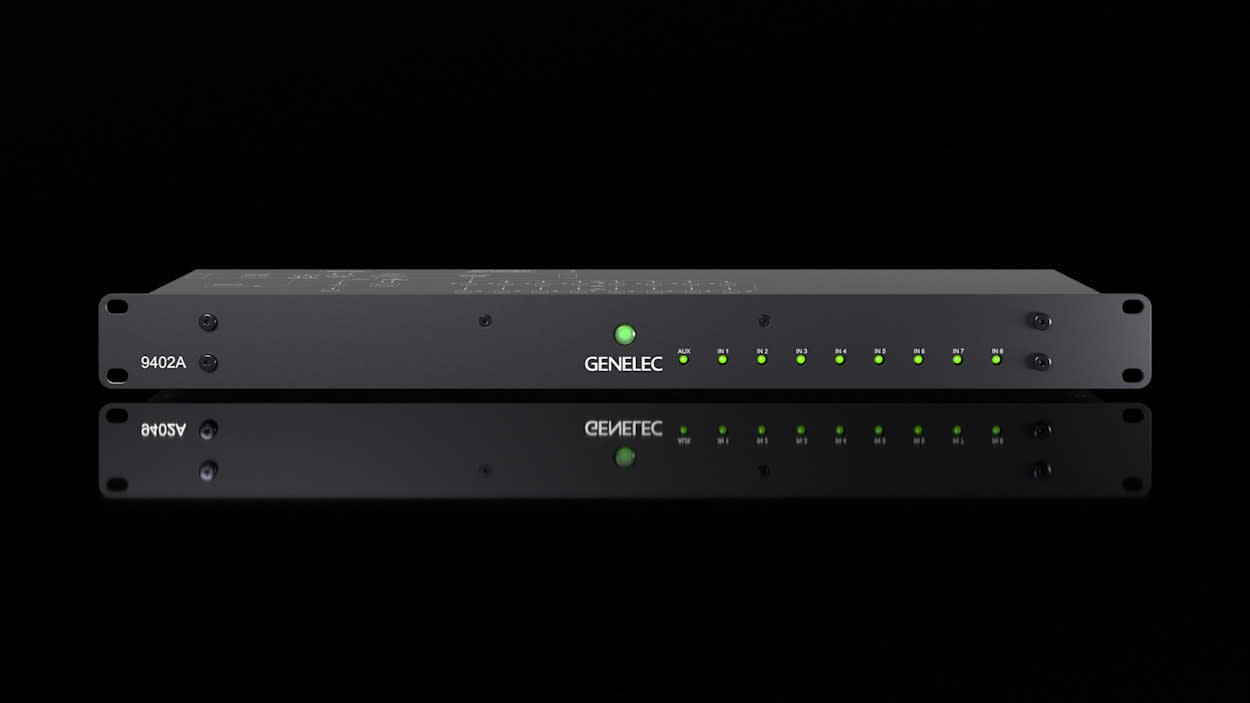
The company now sells continuity across places and formats. UNIO joins calibrated in-room monitoring with headphone workflows, including the 9320A controller and Aural ID's personalized binaural model. Smart IP moves power, audio and management over Ethernet for installed systems. The 2026 9402A adds Dante and AES67 connectivity, bridging networked audio into SAM systems from stereo through 9.1.6 immersive layouts.
This is a hardware business with a software flywheel. Genelec earns primarily by selling monitors, subwoofers, controllers and installation products through dealers, distributors and integrators. GLM, measurement, reporting, account services and accessories make the hardware more useful together. A calibrated room can expand from stereo to immersive without replacing its operating logic. That is helpful to the customer and sticky for the vendor.
The buyers remain different. A songwriter in a spare bedroom wants a mix that travels. A post house wants repeatable decisions among multiple rooms. An integrator wants one cable to carry power, signal and control. A museum wants dozens of discreet speakers to run reliably. A home listener wants studio logic without a studio's furniture. The shared product is confidence that the sound will survive the next room.
Revenue / € millions / 2021-2025
Durability as an operating system
Genelec's sustainability argument is refreshingly physical. It designs for long use, retains spare-part support and says it can service even some of its oldest models. Aluminum can be recycled; rounded cabinets use it efficiently; intelligent standby reduces idle power. Factory roof solar supplied roughly 10 to 15 percent of energy needs in 2023. The company has kept manufacturing in Iisalmi, far from Finland's larger commercial centers.
This philosophy fits the customer's economics. Studios build muscle memory around a monitoring reference. Replacing it casually imposes setup time, recalibration and doubt. A product that lasts for decades is more compelling here than in a fashion category. It would work less well where technology cycles make old hardware incompatible, repairs cost more than replacement or buyers actively seek novelty.
Culture is not treated as office wallpaper. Genelec names belief, enthusiasm, honesty, respect and justice as its values. It supports arts initiatives and describes cultural responsibility as part of sustainability. There is obvious brand benefit in an audio company standing near musicians and exhibitions, including a 2026 immersive collaboration with Björk at Iceland's National Gallery. There is also fit: artists are not an audience borrowed for marketing; they are the people the tools are for.
What to copy
Let a difficult customer sharpen the brief. Integrate the pieces that determine the outcome. Remove setup work users repeatedly skip. Support the installed base long enough for trust to accumulate.
When it breaks
Do not sacrifice diversification before a focused market is proven. Calibration cannot fix poor placement, untreated extremes or insufficient output. Ecosystems repel buyers when compatibility and service do not outlive the hardware.
What the reader can steal
First, look for the variable your category politely leaves to the customer. For Genelec, it was the room and the ignored switches. Measuring and correcting that variable created a software layer around hardware. Second, turn the first customer's painful requirements into principles, not bespoke debris. YLE's demand for consistency, repairability and adaptation still explains products launched nearly five decades later.
Third, focus around a job rather than a form factor. Genelec's job is truthful, repeatable monitoring. That allows the form to move from analog box to calibrated network, headphones and immersive audio without making the company incoherent. Finally, choose the cost you can actually bear. Walking away from contracting worked after Genelec had products, customers and exports. It was conviction with evidence.
The company's recent moves are plumbing more than spectacle: Dante compatibility, updated Smart IP control, Aural ID 2.1, a new 8380A midfield monitor. That is exactly the point. Genelec does not need to reinvent hearing each season. It needs to keep the reference stable while studios, networks and listening habits change around it.
There is a useful restraint in that posture. A monitoring company sells judgment at one remove: its product helps somebody else decide how a record, film or game should sound. The loudspeaker cannot make the creative decision, and calibration cannot make a mediocre room excellent. The system can reduce uncertainty so the decision travels. Genelec works best when the user values neutrality, takes placement and acoustics seriously, and expects to keep the equipment. It makes less sense for a casual buyer who wants dramatic coloration, disposable convenience or the lowest upfront price. Truthful sound is a practical promise only when the listener actually wants the truth.