In the beginning, there was a bass problem. Walter Becker of Steely Dan was working on Pretzel Logic in 1973 and wanted a monitoring system that could make the bottom octave legible. Ken Kreisel built a balanced dual-driver subwoofer for the sessions. A request from an exacting musician became a product thesis: if a loudspeaker can expose decisions in a control room, perhaps it can preserve those decisions in a home.
That thesis became Miller & Kreisel Sound, founded in California in 1974 by Kreisel, audio retailer D. Jonas Miller and acoustics scientist Dr. Lester Field. It also explains the company's odd position today. M&K is neither a mass-market consumer-electronics label nor merely a studio-monitor supplier. It sells speakers, powered subwoofers and architectural models to mixers, post-production rooms, custom installers and home-cinema owners who want the domestic system to behave like the last link in a production chain.
The boxes are usually black. The pitch is not.
The product was translation
M&K's early achievement was architectural. The 1976 David & Goliath system separated small main speakers from a dedicated bass cabinet. The 1977 Volkswoofer put the amplifier inside that bass cabinet. Today this looks obvious because soundbars arrive with wireless subs and “2.1” is a dropdown in electronics stores. In the mid-1970s, it was a useful break with the refrigerator-sized loudspeaker.
Separating bass gives a designer options. Low frequencies interact strongly with a room, so the best place for a subwoofer is not always the best place for the stereo image. Compact satellites can sit where voices and instruments lock to the screen; the bass box can move where the room behaves. M&K later added Phase-Focused crossovers, sealed cabinets, push-pull subwoofer drivers and Tripole surrounds. Different mechanisms, same job: make timing, tone and level remain coherent across seats and channels.
One reference, three rooms
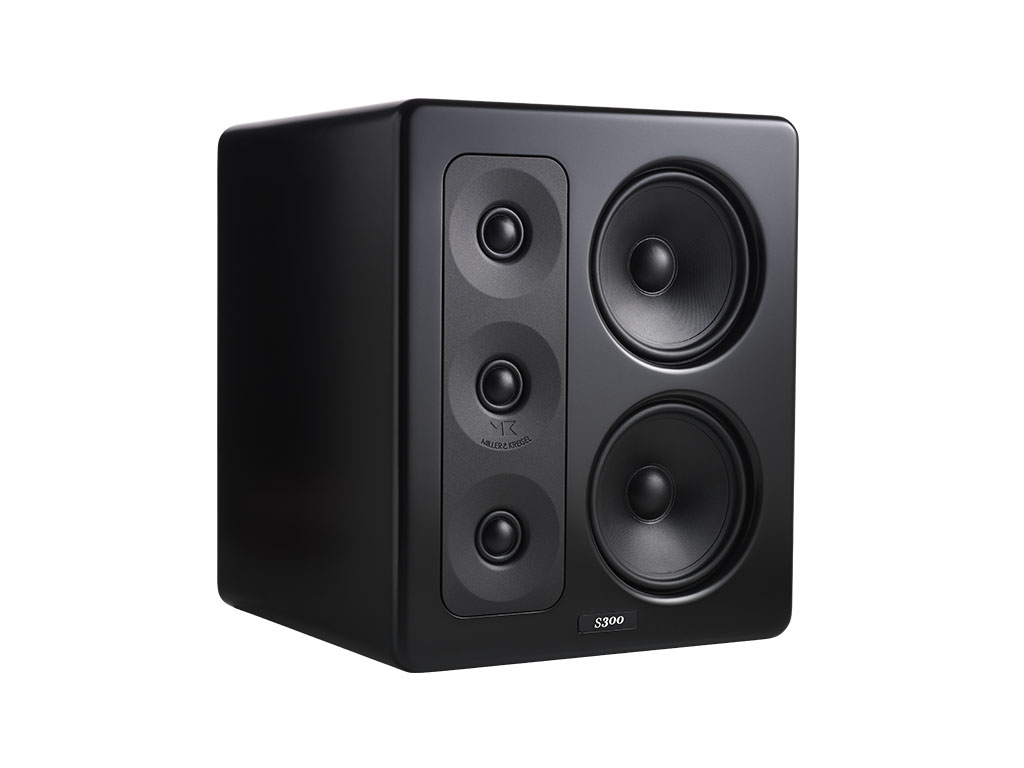
The S150 turned that logic into a recognizable object. Introduced in 1995, the squat five-driver monitor uses two bass/midrange drivers and a vertical trio of tweeters. It became common enough in film and music rooms that M&K now calls it its “Porsche 911” - a form revised without being disowned. Identical left, center and right speakers help a sound keep the same character while it crosses a screen. Surround variants trade a pinpoint source for a wider field.
“I've mixed at least 10,000 songs on my M&K speakers.”Chris Lord-Alge, mix engineer
What failed first
The company did. In 2007, the original American M&K filed for bankruptcy and stopped building speakers. Product affection did not make the balance sheet immortal. The first thing to fail was not the satellite/subwoofer idea or the professional reputation; it was the corporate vehicle carrying them.
A Danish venture that included M&K's former European distributor and former international management bought the intellectual property and assets from bankruptcy. The revived business initially used “MK Sound,” without the ampersand. In 2013, around the brand's 40th anniversary, it restored M&K Sound and Miller & Kreisel. Public accounts do not reveal a cinematic moment when everyone changed their mind. They show a more practical calculation: recognizable designs, professional users and international channels still had value after the old company had none.
This distinction matters. A comeback story is tempting copy, but bankruptcy did not become a secret growth hack. The new owners inherited an unusual asset - decades of trust attached to a repeatable listening reference - and still had to rebuild products, dealers and distribution. A logo alone would have been a very expensive souvenir.
How expensive is “hear what they heard”?
Reference points, not current quotes: IW500 launch MSRP (2024); S150/X10 review package (2022); seven-piece S150 review system (2018). Amplification, subwoofers, installation and room treatment can add materially more.
Who pays - and why
M&K's customer is buying confidence at two ends of the market. A professional wants a monitor that exposes a bad edit, translates to other rooms and survives long sessions. A home buyer wants dialogue to stay anchored, effects to move without tonal jumps and bass to arrive with impact but stop on time. A custom installer wants matched product families, predictable dispersion and models that can disappear into walls and ceilings.
The 2024 IW500 makes the economics vivid. It launched at a U.S. MSRP of $4,999 per speaker and carries THX's Dominus certification for large home cinemas. It can sit vertically or horizontally behind a screen or in a baffle wall. The new IC65 and IC80 in-ceiling models, announced in February 2026, push the same brand into less visible installations. In premium residential audio, the room increasingly wins the argument: performance must fit the architecture, not ask the architecture to leave.
M&K reaches those rooms through distributors, authorized dealers and integrators. Habitech handles a route into the United Kingdom; mediacraft was appointed for Germany and Austria in 2025. In April 2026, Audio Collective Group became the exclusive U.S. distributor, replacing the 2024 Watershed arrangement. That quick change is a reminder that a small Danish manufacturer depends on local inventory, training and service as much as crossover math.
A moat made of other people's ears
M&K's differentiation is professional adoption made useful to consumers. Its materials cite work with Dolby, early Home THX participation and use at facilities associated with Sony Pictures, Twentieth Century Fox, Skywalker Sound and Warner Bros. The company also points to films whose sound work was monitored on M&K systems. The claim needs careful phrasing: speakers do not win Oscars; people do. But equipment embedded in repeat professional workflows is stronger evidence than a celebrity placing one cabinet in a listening room.
Competitors attack from both sides. Genelec, Neumann, PMC, ATC and JBL Professional are credible monitoring alternatives. JBL Synthesis, Perlisten, KEF, Wisdom Audio, Procella, DALI and Bowers & Wilkins compete for premium theaters and designed interiors. Some add room correction, active electronics, luxurious finishes or broader dealer footprints. An integrator can also assemble a mixed-brand system with excellent results.
M&K's answer is continuity: one tonal vocabulary across front speakers, surrounds, subs and architectural models. The buyer is not choosing the most impressive individual box. The buyer is choosing fewer translation errors across an entire room.
01 / Start with a painful job
The origin was not “make an audio brand.” It was “let a producer hear bass well enough to decide.” Specific pain creates testable products.
02 / Sell the same truth twice
Professional use generates proof; consumer use expands the market. The bridge works because both buyers value translation.
03 / Build a family, not a trophy
Matched centers, surrounds, in-walls and subs give installers a system they can specify repeatedly.
04 / Preserve the recognizable core
The S150 earns attention because revisions remain legible. Continuity turns old installations into current sales collateral.
When the playbook breaks
Accuracy is not a universal taste. A revealing speaker can expose a thin recording; a listener who wants warmth may call that clinical. Sealed speakers and demanding 4-ohm loads can need capable amplification. Subwoofers excite room modes regardless of their pedigree. Poor placement, untreated reflections and casual calibration can erase the advantage that premium drivers were purchased to deliver.
Do not copy this blindly
The professional-to-consumer loop fails when professionals use a product for reasons consumers do not share, when the consumer version is only a licensed costume, or when installation determines more of the outcome than the product. It also struggles at mass-market prices: certification, dealer margins, heavy cabinets and local service make the model expensive.
Nor does studio credibility eliminate business risk. The 2007 failure is the loudest evidence on the page. A loved product can still carry too much cost, too little distribution or the wrong capital structure. M&K's current company remains small - LinkedIn places it in the two-to-ten employee band - and relies on partners to put large, heavy products in front of buyers. That is focus, but it is also dependency.
The quiet second act
M&K Sound today is a Danish-owned hardware company with Californian memories and a global dealer problem to solve one territory at a time. It sells the S150 and larger S300, more accessible 750 and M Series speakers, X+ and V+ subwoofers, professional active monitors, and a widening architectural range. There is no public venture-funding saga and no useful public valuation. This is a product-and-distribution business, not a software multiple wearing a woofer.
That also explains where it fits in the market. M&K sits above ordinary home-theater bundles and below the rarefied world of systems treated as collectible furniture, though a fully installed room can easily reach that world's budget. It earns hardware revenue when a studio, dealer or integrator specifies cabinets; no public subscription layer softens the gaps between projects. The small team therefore has to make a limited catalogue travel far. Regional partners hold stock, teach installers, arrange demonstrations and handle the unglamorous questions that arrive after a heavy box has been put behind a finished wall.
Its best idea remains almost comically plain: the audience should hear what the creators approved. The company has spent half a century turning that sentence into driver arrays, crossovers, sealed cabinets, certifications and dealer relationships. It failed once. The sentence survived.